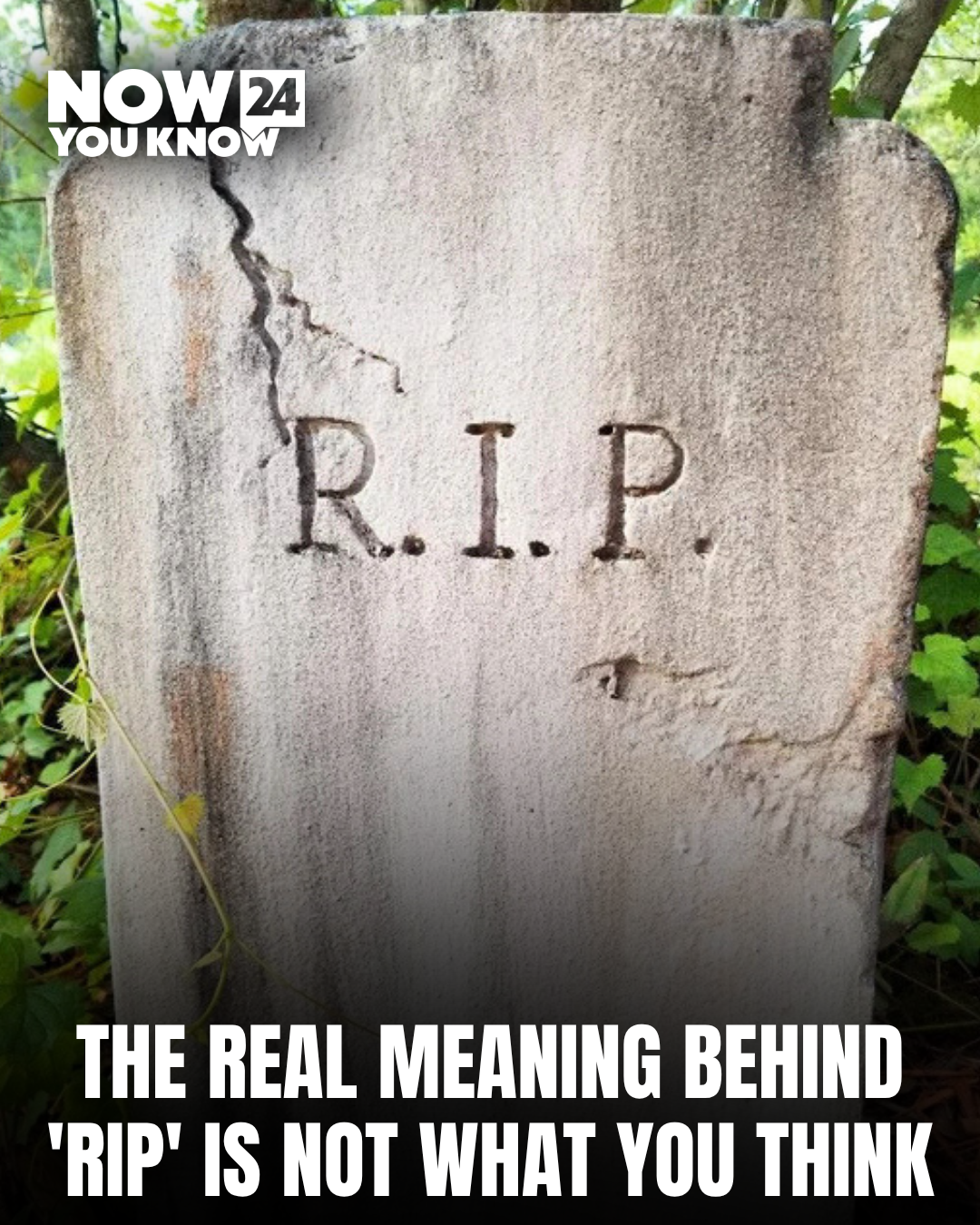

Walk through any cemetery in the English-speaking world, and you will see the same three letters carved into almost every headstone: R.I.P.

For centuries, we’ve accepted these letters as a quiet, final shorthand. We use them in sympathy cards, we see them in historical dramas, and today, they’ve even become a standard part of our digital vocabulary. When a celebrity passes or a beloved fictional character meets their end, social media feeds are instantly flooded with those three simple characters.
Most of us have gone our entire lives assuming we know exactly what they stand for. It’s an open-and-shut case, right? “Rest In Peace.”
But as a recent wave of viral realization has proven, that common English phrase is actually a back-formation. The truth is, the letters R.I.P. weren’t originally English at all—and their real meaning is rooted in a language that hasn’t been widely spoken for over a thousand years.
The “Common Sense” Trap
The reason most people are shocked to learn the truth is that “Rest In Peace” fits perfectly. It’s a rare linguistic coincidence where the English translation matches the initials of the original phrase.
However, if R.I.P. simply stood for the English words “Rest In Peace,” it wouldn’t make sense that the same abbreviation appears on ancient graves in Italy, France, Spain, and Poland—countries where the local languages don’t use those specific English words.
The Video Game Connection
Interestingly, a large portion of the population already knew the secret—not from a history book, but from a video game. Fans of the Assassin’s Creed franchise, particularly those who followed the journey of Ezio Auditore through Renaissance Italy, noticed that the protagonist would often whisper a specific phrase over his fallen enemies.

While many players assumed it was just a localized flair for the game, it was actually the first clue to a mystery that dates back to the 8th century.
A Prayer, Not Just a Wish
Before R.I.P. became a standard social media comment, it was a “solemn invocation.” It wasn’t just a polite way to say goodbye; it was a functional part of early Christian burial rites.
In the medieval era, Latin was the “universal language” of the Church. Whether you were in a small village in Ireland or a cathedral in Rome, the liturgy remained the same. Because of this, the abbreviation became standardized across the globe, surviving the transition of languages as the centuries passed.
What It Actually Stands For
So, if it isn’t “Rest In Peace,” what is it?
The letters R.I.P. actually stand for the Latin phrase: “Requiescat In Pace.”
While the English “Rest In Peace” is a literal translation, the Latin Requiescat carries a slightly different grammatical weight. In Latin, it is a verb in the “subjunctive” mood, meaning it functions as a prayer or a petition.
Literally translated, it means “May [he/she] rest in peace.” It began appearing on Christian tombstones around the 8th century as a request for the soul of the deceased to find eternal tranquility before the eventual resurrection. By the 1700s, the phrase became so ubiquitous that the English-speaking world simply adopted the initials and attached their own words to them.
Next time you see those three letters, you’ll know you aren’t just looking at an English abbreviation—you’re looking at a linguistic fossil that has survived from the ancient world to the modern screen.