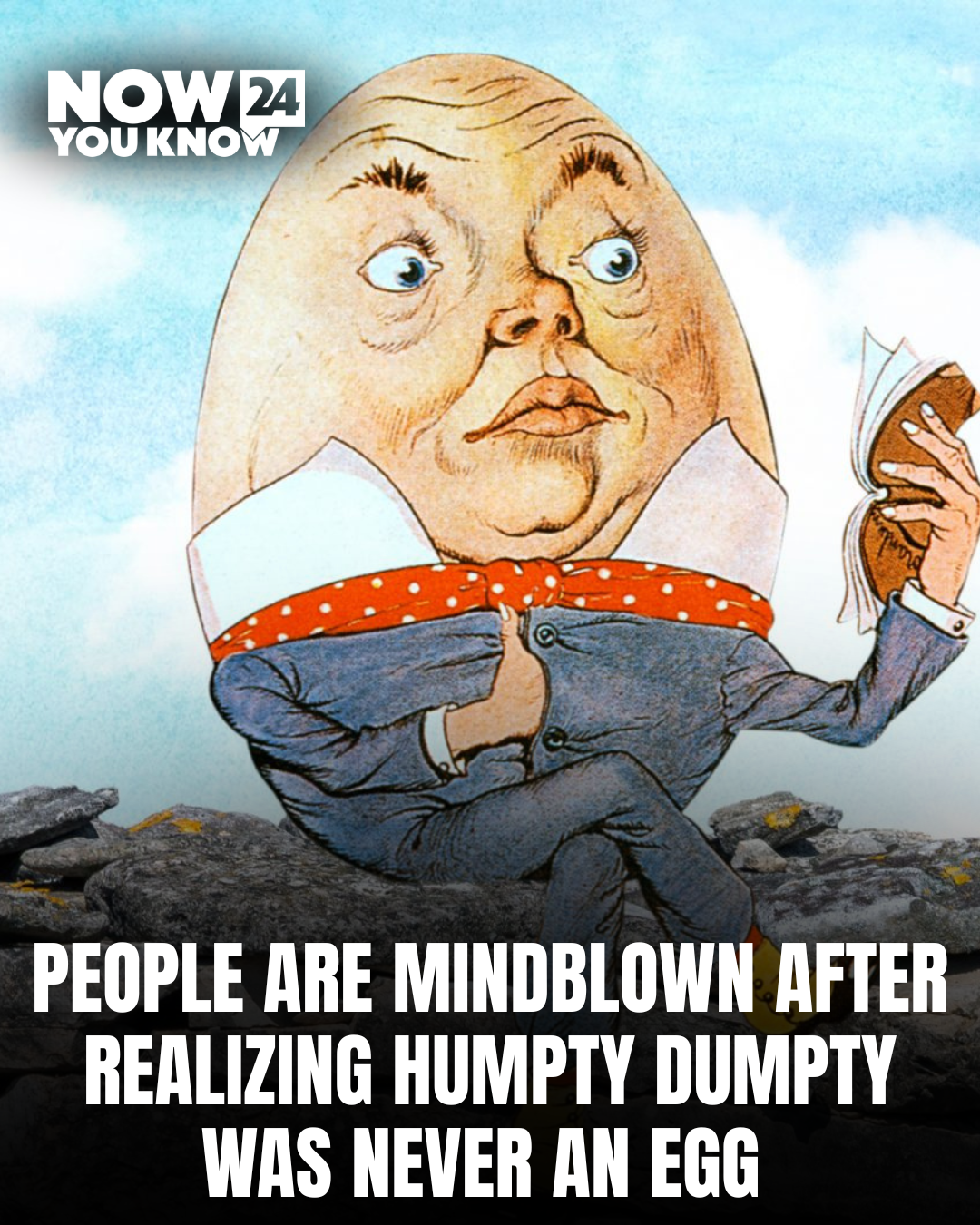

A long-standing childhood assumption about one of the most famous nursery rhyme characters is being challenged online, as people discover that Humpty Dumpty was never actually described as an egg in the original rhyme.
The revelation has sparked widespread reactions across social media, with many users saying they feel “shocked,” “confused,” and even “haunted” by the discovery.
The Original Nursery Rhyme
The well-known verse reads:
Humpty Dumpty sat on a wall
Humpty Dumpty had a great fall
All the king’s horses and all the king’s men
Couldn’t put Humpty together again
Nowhere in the original text is Humpty Dumpty described as an egg, despite how the character is almost universally depicted today in children’s books and media.
So How Did the Egg Image Begin?
Historical accounts suggest that the egg interpretation became popular much later, largely influenced by illustrator interpretations in children’s literature.
One major turning point is often linked to Through the Looking-Glass by Lewis Carroll, where Humpty Dumpty appears in a human-like form but helped cement the character’s visual identity in popular culture.
Over time, illustrators increasingly portrayed Humpty as an egg, likely because the imagery fit the idea of something fragile that “cannot be put back together.”
Theories About the Real Meaning
Some historians argue that the rhyme may have deeper historical roots rather than being a simple children’s story.
One theory connects Humpty Dumpty to the English Civil War era, suggesting it may have referred to a large cannon used during a siege, which once fell and could not be repaired.
Another interpretation links the rhyme loosely to medieval warfare imagery or even symbolic political propaganda, though none of these theories are definitively proven.
Why the Misconception Stuck
Experts say the egg image became dominant largely due to repetition in illustrated children’s books and modern adaptations in cartoons and nursery media.
Once the visual interpretation took hold, it quickly overshadowed the original text, shaping how generations of children and adults now remember the character.
Why People Are Reacting Now
The renewed attention comes from viral social media posts where users express surprise at realizing the rhyme never mentions an egg at all.
For many, it highlights how childhood interpretations can become accepted “facts” simply through repetition over time.
A Classic Example of Evolving Folklore
Humpty Dumpty remains a strong example of how folklore and nursery rhymes evolve across centuries, shaped by cultural reinterpretation, illustration, and storytelling trends.
While the original meaning may never be fully confirmed, the modern egg version has now become the dominant global image.