




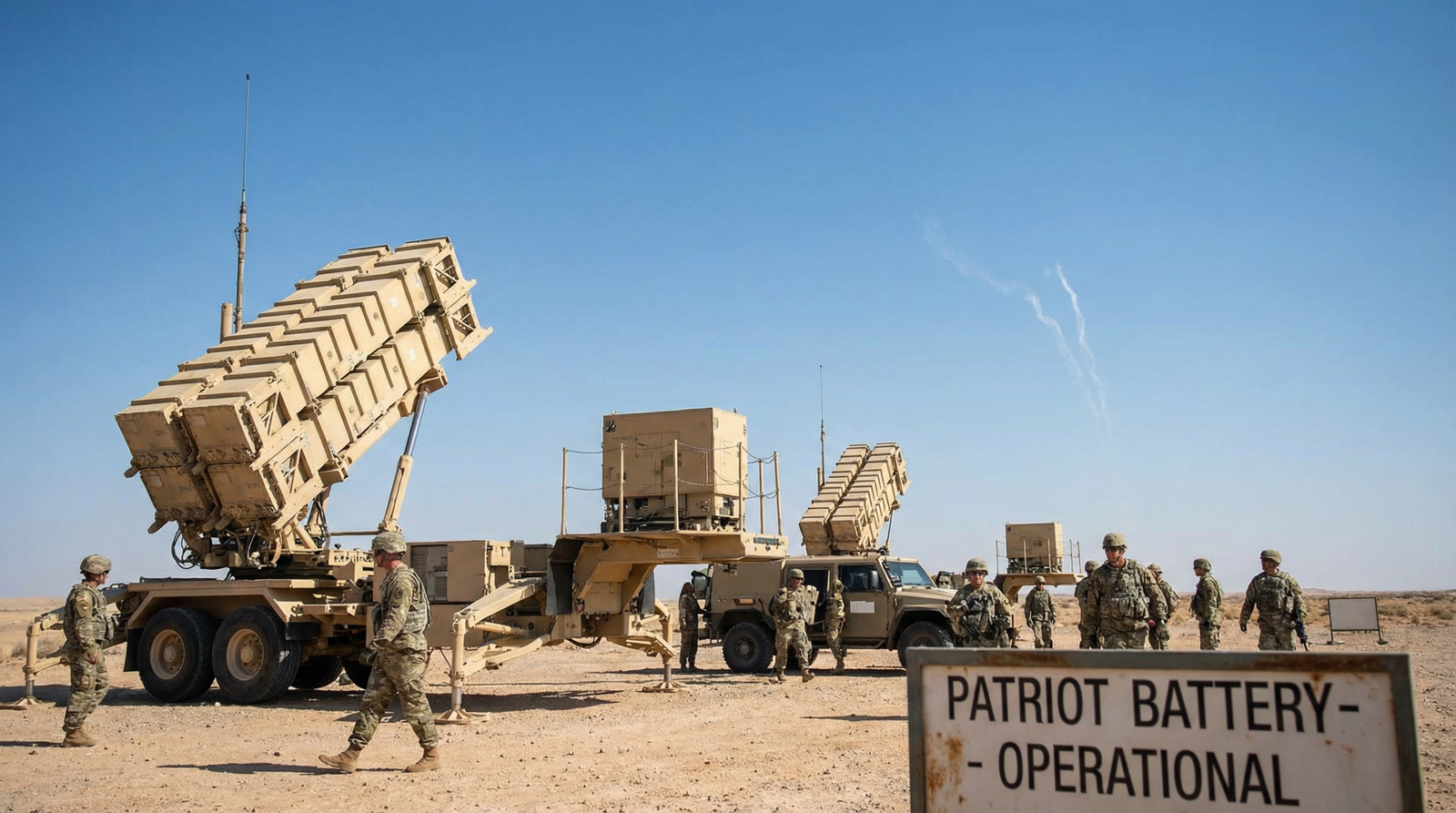

In the ongoing conflict involving Iran, the United States and its allies are increasingly relying on Patriot missile systems to intercept missile and drone attacks launched by Iranian forces. This surge in use has placed significant pressure on Patriot missile stockpiles, which were already strained due to high demand in previous conflicts and ongoing support to other nations such as Ukraine.
Since the start of recent military operations—Israel’s Operation Roaring Lion and the United States’ Operation Epic Fury—strikes have expanded across Iran and retaliatory missile attacks have targeted countries supporting U.S. forces. These hostile actions have required a robust response from U.S. and allied air defense units, deploying Patriot Advanced Capability-3 (PAC-3) missiles, Terminal High Altitude Area Defense (THAAD) batteries, and ship-launched Standard Missile interceptors to defend against incoming threats.
Middle Eastern U.S. allies, including Qatar, Bahrain, Kuwait, and the United Arab Emirates, operate variants of the Patriot missile system and have been actively engaged in defending against Iranian missile and drone attacks. Recent reports from Kuwait indicated it had faced 97 ballistic missile strikes and 283 drone incursions, underscoring the high volume of Iranian weaponry used and the substantial demand for air defense missiles.
The conflict’s duration and intensity could heavily depend on the availability of munitions on both sides. Experts, including Seth Jones of the Center for Strategic and International Studies, have noted that neither the United States nor Israel possesses enough offensive or defensive munitions for a prolonged war spanning weeks or months. The demand for interceptors is particularly acute because multiple interceptors are typically required to neutralize a single threat.
Lockheed Martin, the manufacturer of the PAC-3 missile, has acknowledged the challenge in rapidly increasing production to meet demand, which can take years to scale up effectively. Despite this, the company has plans to substantially raise output from 600 to 2,000 interceptors annually over the next seven years. The U.S. Army has committed over $1 billion to purchasing Patriot missiles, with a goal of acquiring 13,773 missiles in total. One PAC-3 interceptor costs approximately $3.7 million.
Ukraine remains a major user of the Patriot system, defending itself against persistent Russian missile barrages. Ukrainian President Volodymyr Zelenskyy has indicated that prolonged conflict in the Middle East could impact the supply of Patriots to Ukraine. The competing needs underscore the global strain on these critical air defense systems.
Pentagon officials have maintained that the U.S. military currently possesses sufficient munitions to meet operational requirements, but there is a clear recognition of the need to bolster production and stockpiles to prepare for extended conflicts. Navy Adm. Samuel Paparo, head of US Indo-Pacific Command, acknowledged that ongoing conflicts in Ukraine and the Middle East have reduced available Patriot stockpiles within his command area.
Strategists also warn of the broader geopolitical implications of depleting missile defenses. A retired Australian general, Mick Ryan, pointed out that adversaries such as China could benefit from the U.S. expending significant munitions in the Middle East, potentially leaving the U.S. less prepared for high-end conflicts elsewhere.
With the clash showing signs of escalation, the demand for Patriot missiles and other air defense interceptors is expected to continue rising, challenging defense manufacturers and military logistics to keep pace with rapidly evolving battlefield requirements.