
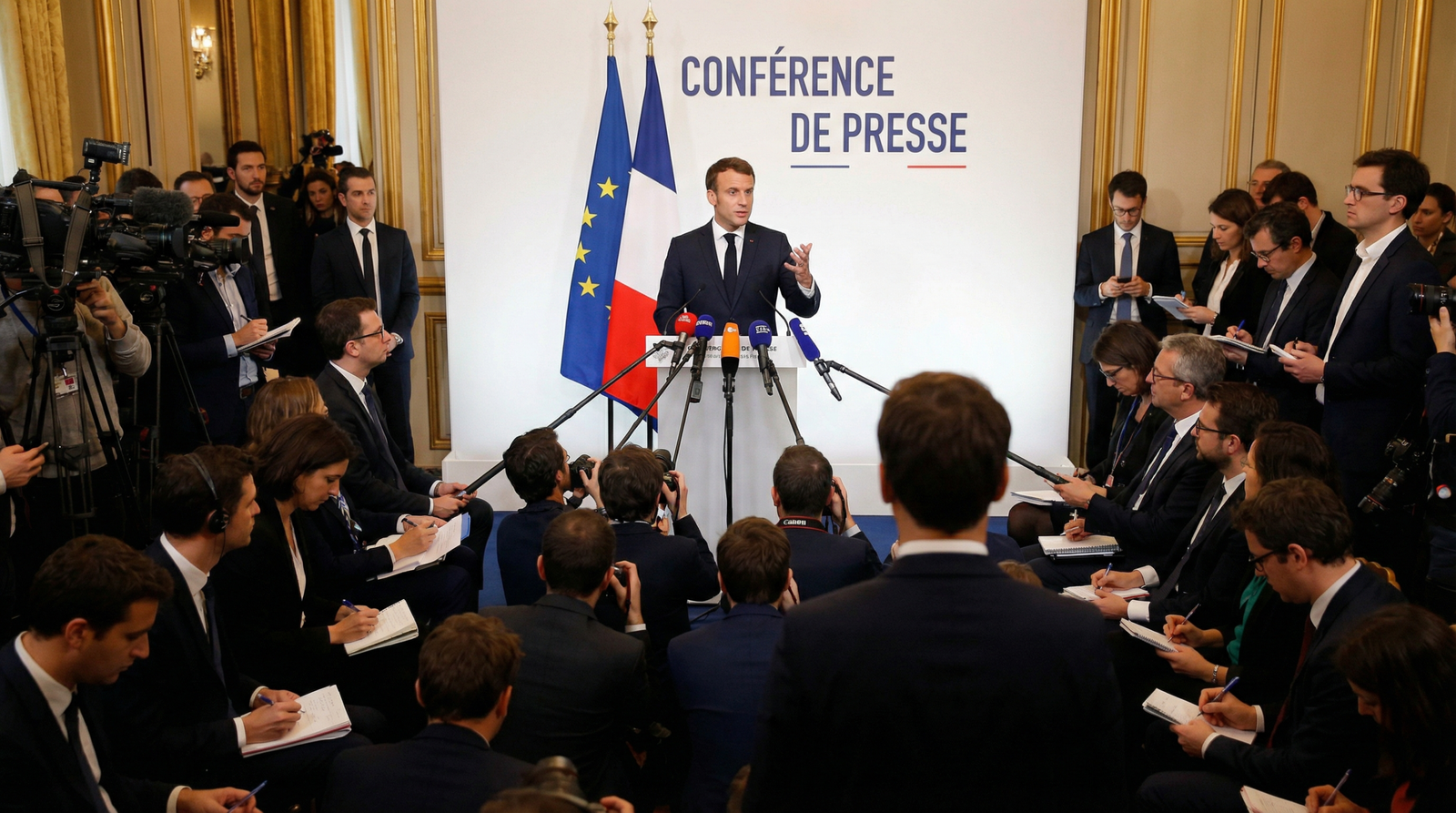

French President Emmanuel Macron has called on Europe to embrace its role as a global power in response to increasing geopolitical challenges. Speaking to a consortium of European newspapers ahead of an upcoming EU summit in Brussels, Macron emphasized that the continent faces a “wake-up call” amid growing threats from China, Russia, and the United States.
Macron questioned whether Europe is prepared to become a major force, highlighting the need for progress in economic and financial sectors, defense and security, as well as democratic institutions. He noted previous reluctance within the EU to consider itself a power, stating, “In another era we might have said it is the moment to ‘assume our majority.’”
Among his proposals, Macron reiterated his support for EU-wide mutualized loans to fund industrial investments. He advocated for the introduction of shared debt instruments, such as eurobonds, to raise the hundreds of billions of euros needed annually. “The time has come to launch a shared debt capacity to fund our future expense—eurobonds for the future,” he said, emphasizing the requirement for large-scale European programs to finance leading projects.
Acknowledging internal divisions, Macron recognized skepticism from some member states such as Germany, which question whether France is attempting to pass on financial responsibilities due to its own economic reforms lagging behind those of other nations. He admitted, “France has never had a balanced model, unlike certain economies of the north built more on a sense of responsibility.” He referenced reforms undertaken in other southern European countries, including Portugal, Spain, Italy, and Greece, as examples that are now bearing fruit.
Macron highlighted international financial markets’ growing interest in mutualized European debt as an alternative to reliance on the American dollar, noting concerns about the stability of the US currency. “The world markets are increasingly afraid of the American greenback. They want alternatives… For investors everywhere a democratic state of law is a huge attraction,” he said, contrasting Europe’s model with the authoritarian nature of China and what he described as the United States’ drift away from rule-based governance.
He estimated the EU requires about €1.2 trillion annually for vital sectors such as security, defense, clean energy, and artificial intelligence. To protect these industries, Macron called for coherent policies that avoid imposing restrictive rules on European producers that do not apply to foreign competitors. “The Chinese do it, the Americans too. Europe today is the most open market in the world,” he said, stressing that the approach is not about protectionism but strategic coherence.
Macron pointed to multiple global challenges, including accelerating climate change, the unreliability of the US security guarantee, the cessation of affordable Russian energy supplies, and China’s increasingly intense rivalry. He asserted, “Today, we Europeans are on our own. But we have each other. We are 450 million people. It’s huge. For me, becoming a power is the fulfillment of the European adventure.”
He recalled the continent’s original goals to prevent war and build a shared market but noted that the EU has traditionally avoided the concept of power. On recent tensions with the United States concerning Greenland, Macron warned against complacency. After a crisis involving US President Donald Trump’s threats over the Danish territory, Macron cautioned that the situation should not be underestimated. “At the end of a crisis, there is a cowardly tendency to sit back and say ‘phew’. There are threats and intimidation, and then suddenly Washington gives way. And people think it’s over. Don’t believe it for a single second,” he said.
Macron’s remarks come as the EU faces significant decisions at the Brussels summit, where discussions on defense, economic cooperation, and responses to global geopolitical challenges are expected to be central topics.