


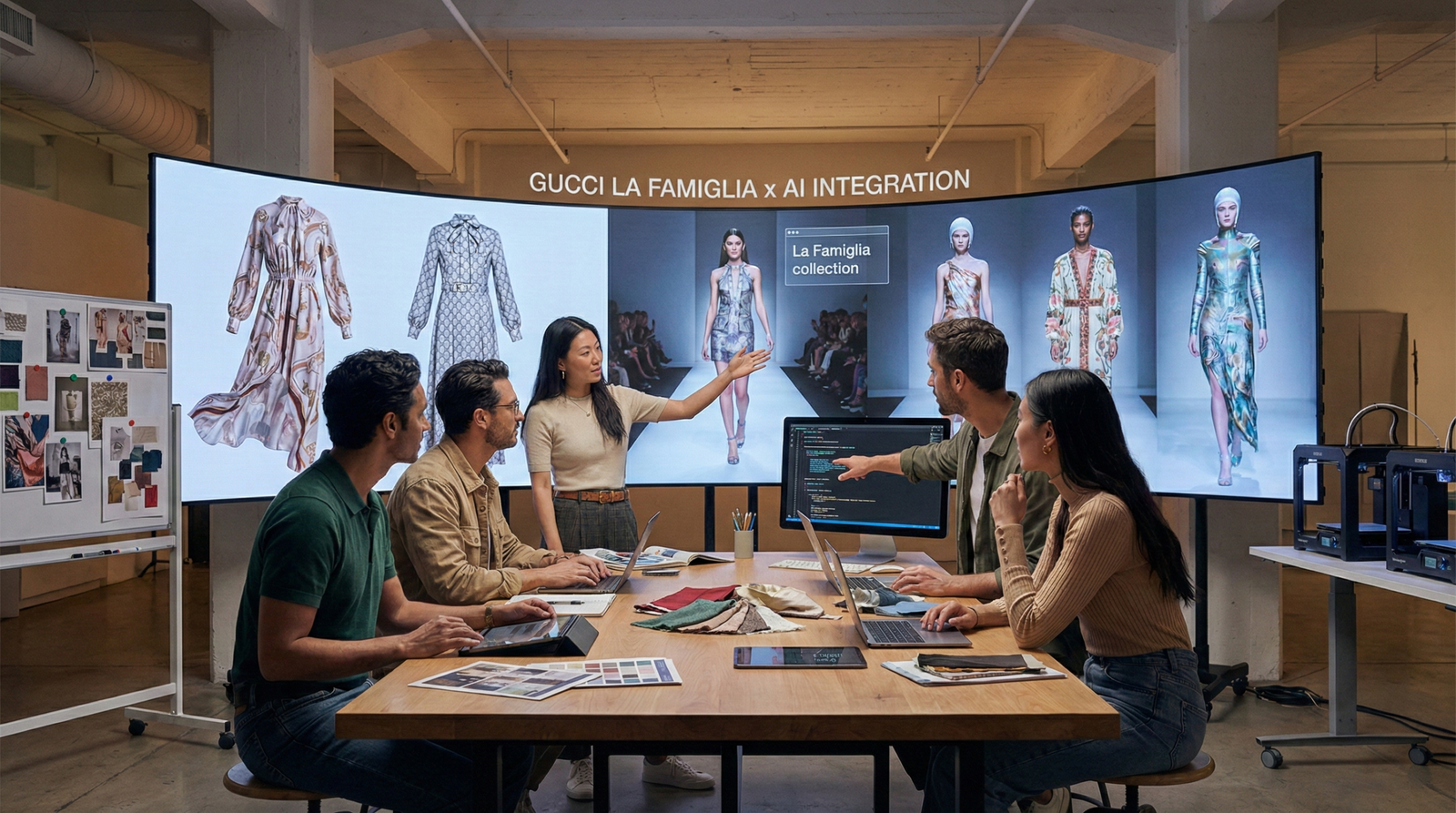

The fashion industry is rapidly adopting artificial intelligence technologies across various sectors, from creative design to operational efficiencies. Recently, Gucci launched AI-powered Snapchat lenses featuring avatars from Demna Gvasalia’s La Famiglia collection, marking the first luxury brand to introduce sponsored AI lenses on the platform. This generative AI feature allows users to virtually experience looks from Demna’s debut collection, presenting six distinct figures and styles, and serves as an innovative interaction between technology and consumer experience.
In parallel, the Council of Fashion Designers of America (CFDA) announced a two-year partnership with OpenAI to aid American designers and brands in integrating AI tools into their creative and business workflows. The program is designed to meet designers’ specific needs by pairing CFDA members with AI developers, fostering the creation of practical, industry-focused AI applications. CFDA CEO Steven Kolb highlighted the potential of AI to enhance diverse aspects of fashion, including design, customer engagement, manufacturing, sustainability, accessibility, and marketing.
Meanwhile, PVH Corp., parent company of Calvin Klein and Tommy Hilfiger, revealed a collaboration with OpenAI to develop custom AI models aimed at improving product design, demand forecasting, inventory management, and consumer interaction. The partnership emphasizes a “test-and-learn” approach to embed AI in operations, aiming to strengthen engagement with customers and streamline marketing, supply chains, and retail functions.
Technology giants Meta and Microsoft have also ramped up their AI investments significantly, with Meta planning nearly $135 billion in capital expenditure for 2026 and Microsoft increasing data center spending by 66% in the fourth quarter of 2025. These unprecedented spending levels underscore their commitment to advancing AI capabilities, although investor reactions have been mixed regarding the sustainability of these investments.
In the health technology space, Amazon has launched an AI health assistant available exclusively to members of its One Medical service. This assistant offers round-the-clock personalized health guidance, including symptom analysis, medical history review, appointment scheduling, and mental health support backed by clinical professionals. This launch follows OpenAI’s introduction of ChatGPT Health, a feature encouraging users to share medical and wellness data to receive tailored advice, though both services caution that they are not replacements for professional medical care.
On the wearable technology front, Apple is reportedly developing an AI-enabled wearable pin, featuring multiple cameras and audio components, adding to ongoing rumors about the company’s expansion into AI-powered devices beyond smart glasses.
Advertising within AI platforms is another focus area for innovation. OpenAI plans to begin testing personalized ads in ChatGPT conversations, clearly marked and tailored to users’ interactions. Google has introduced a similar pilot with personalized shopping ads in its AI Mode, allowing retailers to target consumers with exclusive offers and integrate direct purchasing via platforms co-developed with Shopify.
In regulatory news, the US Food and Drug Administration (FDA) has eased oversight on certain digital health products, excluding wearable wellness devices that do not diagnose or treat medical conditions from strict medical device classification. This move aligns with national strategies to promote AI innovation domestically.
Lastly, the luxury wellness brand Equinox launched a campaign titled “Question Everything But Yourself” that emphasizes authenticity by contrasting AI-generated images with real photography, sparking conversations on the cultural implications of AI in visual media.
Collectively, these developments indicate a significant integration of AI across business, creative, and consumer aspects of the fashion and wellness industries, reflecting both opportunities and challenges as the sector adapts to emerging technologies.