




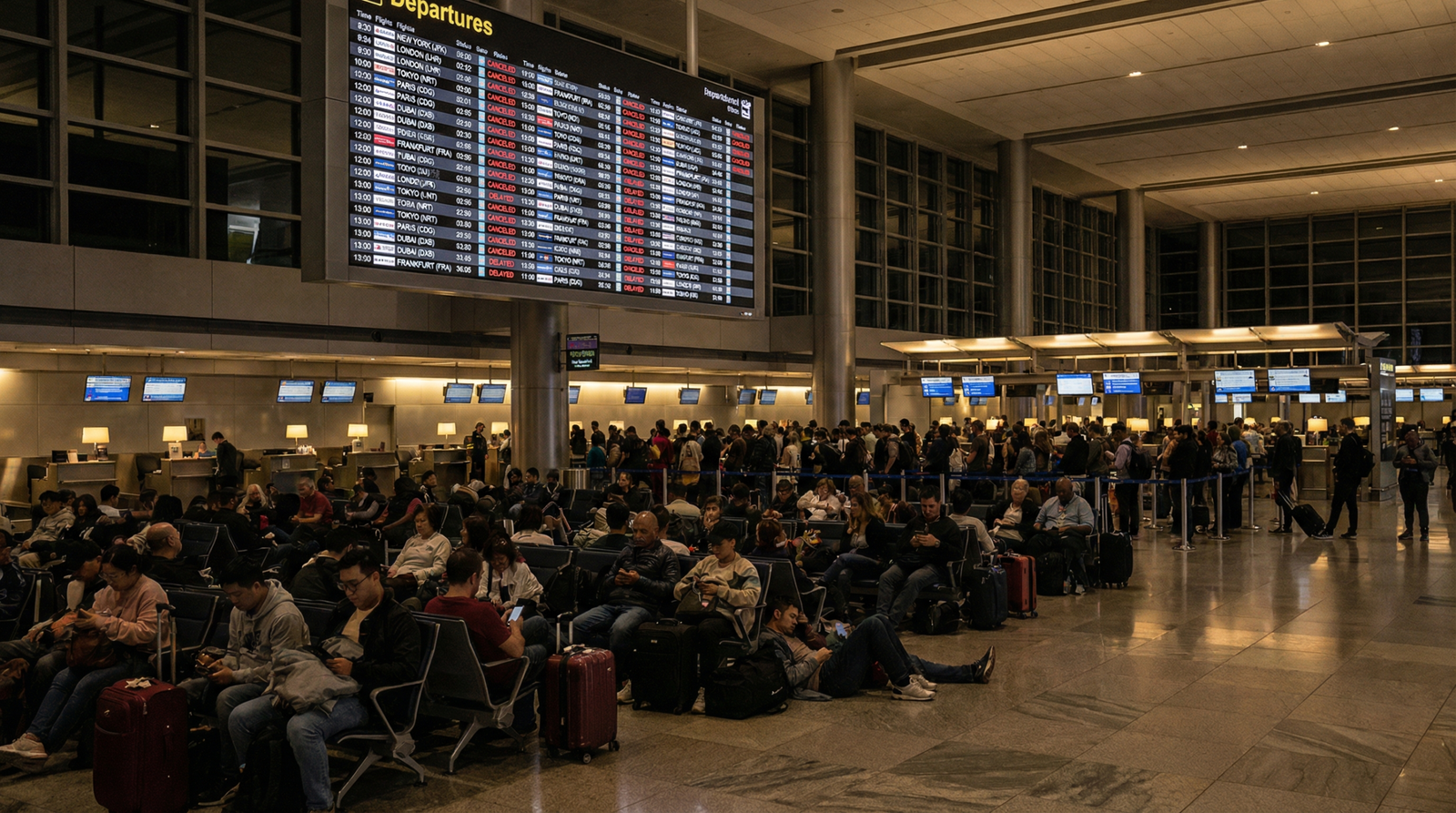

Major airline stocks around the world experienced significant declines on Monday as military strikes involving the United States and Israel on Iran triggered widespread travel disruptions. The conflict led to the closure of airspace in several Middle Eastern countries, affecting thousands of flights and causing extensive delays and cancellations.
In European markets, shares of leading airline groups fell sharply. International Airlines Group (IAG), which operates British Airways, Iberia, and Aer Lingus, saw its stock price drop by more than 5% by early afternoon local time. Similarly, Air France-KLM shares fell nearly 9%, while Lufthansa shares declined around 6%.
Meanwhile, airlines in the Asia-Pacific region also faced losses at the start of the trading week. Australia’s Qantas, Hong Kong’s Cathay Pacific, Singapore Airlines, and Japan Airlines each saw their shares decrease by approximately 5%. The trend extended to the United States, where American Airlines, Delta Air Lines, and United Airlines were all down more than 5% in premarket trading despite less direct exposure to the Middle Eastern airspace disruptions.
The Middle Eastern carriers Emirates, Etihad, and Qatar Airways are government-owned and not publicly traded, but their operations were significantly affected by the airspace closures. Iran, Iraq, Kuwait, Bahrain, Qatar, Israel, and the United Arab Emirates closed their airspace airspace following the weekend’s military actions.
This widespread closure disrupted flight routes through key hub airports in the region, leading to tens of thousands of delayed and canceled flights. Many passengers were left stranded worldwide due to the suspension of flights operating through these hubs. Although a limited number of flights resumed on Monday, industry experts anticipate that the disruptions to international air travel may last for several days or longer.
The stock market reaction reflects investor concerns about the long-term impact of ongoing conflict in the Middle East on the global airline industry. Higher operational costs, rerouted flights, and uncertainty surrounding regional security contribute to the current volatility in airline equities.
The situation remains fluid, with airlines and regulatory authorities monitoring developments closely as the conflict and its consequences unfold.