




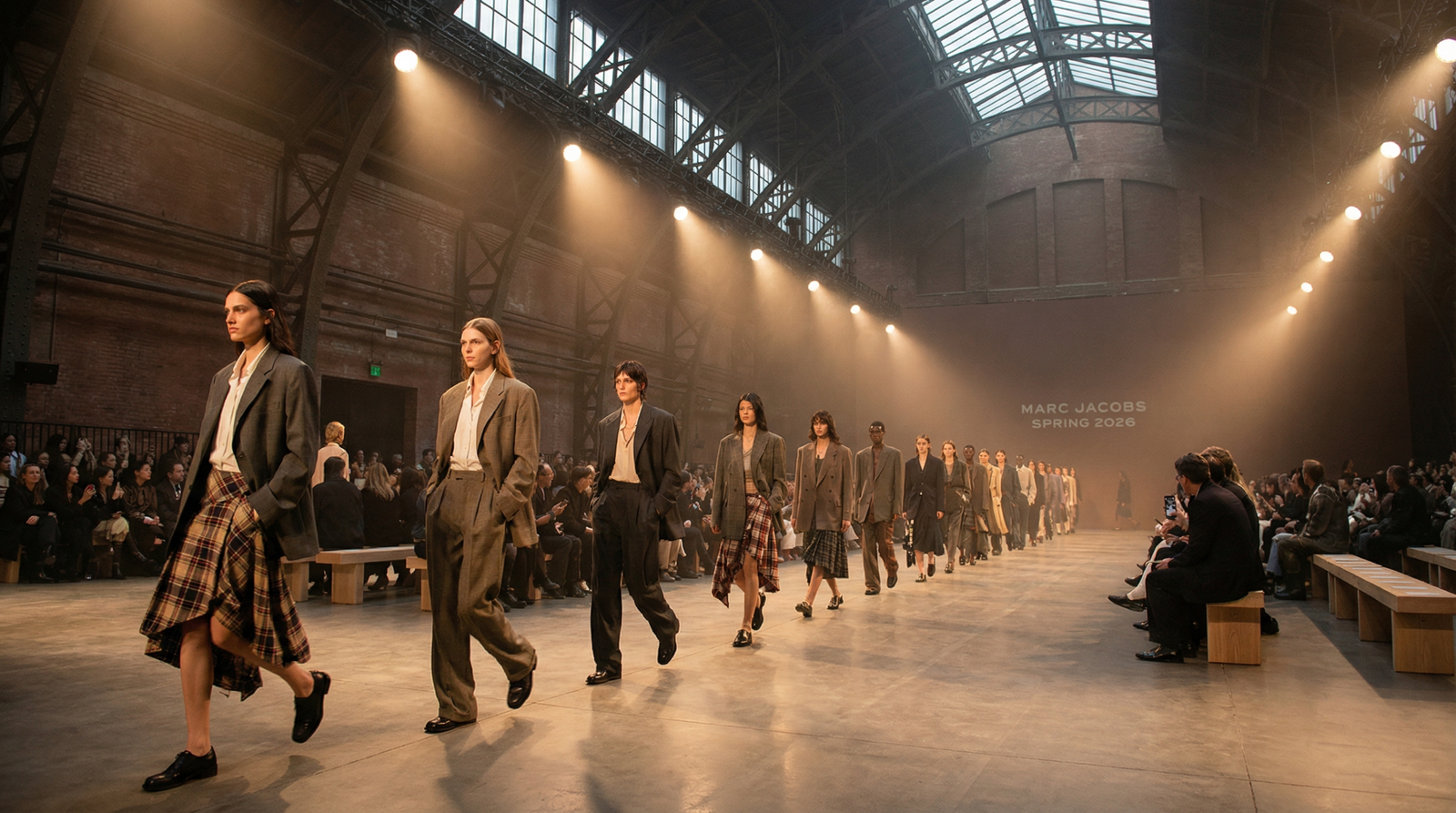

Marc Jacobs presented his Spring 2026 Ready-to-Wear collection at the Park Avenue Armory, marking his return to the venue after two years. The show reflected a deeply personal exploration of memory and creativity, as Jacobs conveyed through his notes the impact of past experiences on present and future endeavors. Central to the staging were scaled-down versions of artist Robert Therrien’s oversized folding table and chairs, originally featured in Jacobs’s Spring 2024 show, with a small commissioned painting by Anna Weyant placed upon the table. The painting, depicting a daisy with pinned, stripped petals, was intentionally minimal from the audience’s perspective, symbolizing the private nature of memories in contrast to public nostalgia.
The soundtrack featured Bjork’s 1997 track “Joga,” connecting to a pivotal year when Jacobs became the first creative director of Louis Vuitton and defined an era of American sportswear distinguished by simple, clean lines including v-necks, button-downs, and shift dresses. This season’s collection revisited and reimagined those styles with subtle modifications: waistbands were looser, coats were worn backwards with buttons along the spine, and decorative frogging sparkled with effects reminiscent of artificial intelligence. These adjustments introduced a novel twist on familiar silhouettes, differing notably from Jacobs’s recent post-pandemic runway shows, which emphasized dramatic, exaggerated shapes reminiscent of designers like Vivienne Westwood and Rei Kawakubo.
Unlike the theatrical nature of previous collections, the latest show featured designs that were praised for their wearability. Designer Anna Sui applauded the collection as “clothes we can wear.” Among the audience were prominent figures from the fashion industry, including Michael Burke, chairman and CEO of LVMH Americas, and Sidney Toledano, a senior advisor to Bernard Arnault. Their presence coincided with news of LVMH’s renewed investment in the Marc Jacobs brand following an unsuccessful sale to Authentic Brands Group.
The collection’s timing is notable, as it reconnects with a generation familiar with Jacobs’s earlier work but less engaged with his recent high-concept runway presentations. By returning to more accessible, nostalgic fashion statements, Jacobs bridges his influential past with current market interests. This strategic approach may reinvigorate consumer enthusiasm and reinforce the brand’s position in the contemporary fashion landscape.
Overall, Marc Jacobs’s Spring 2026 collection blends reverence for the past with forward-looking design, offering both homage and innovation within the framework of ready-to-wear fashion.