



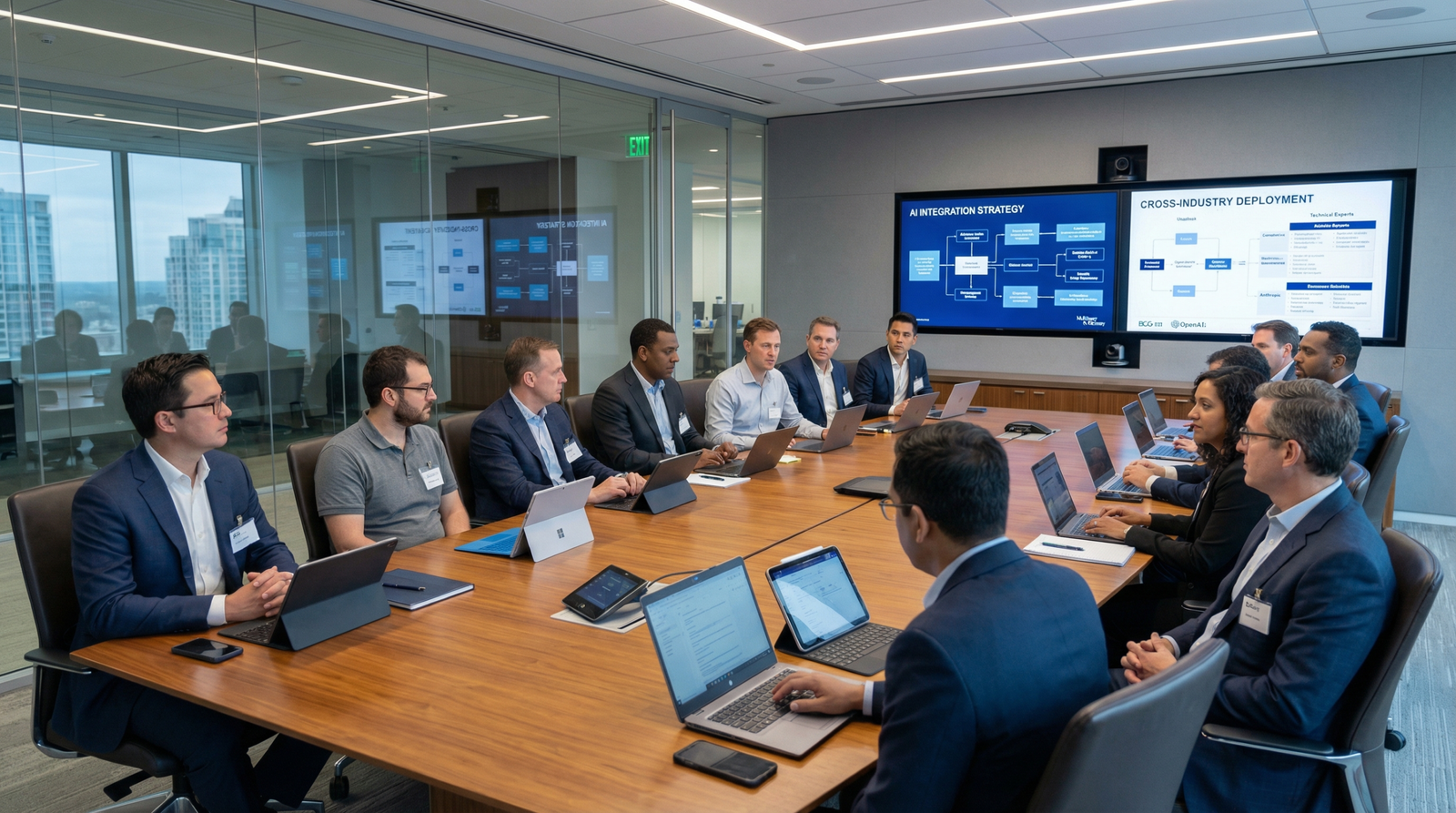

Leading artificial intelligence startups OpenAI and Anthropic have recently announced strategic multi-year partnerships with major consulting firms to support the adoption and integration of AI technologies within enterprise environments. OpenAI’s new agreements include collaborations with Boston Consulting Group (BCG), McKinsey & Company, Accenture, and Capgemini. These partnerships are designed to assist businesses in incorporating AI tools into their existing operations, rethinking workflows, and deploying AI collaborators at scale alongside OpenAI engineers.
Ben Ellencweig, a senior partner at McKinsey, noted that working closely with OpenAI enhances the firm’s capability to help companies reimagine their business processes to maximize AI-driven value. OpenAI’s blog highlighted that these partnerships will enable the deployment of AI-powered coworkers across client enterprises, signaling a significant push towards embedding AI into day-to-day operations.
Similarly, Anthropic has established collaborations with Accenture and Deloitte aimed at accelerating enterprise adoption of its AI platform. In December, Anthropic and Accenture announced efforts to help enterprises transition from AI pilot projects to full-scale deployment. Earlier in the year, Anthropic partnered with Deloitte to integrate its AI assistant, Claude, into Deloitte’s global network, coupled with a certification program preparing 15,000 Deloitte employees to create AI-based solutions tailored for regulated sectors such as financial services, healthcare, and life sciences.
Anthropic’s enterprise focus aligns with its broader strategic goals, as the company recently introduced a suite of AI tools designed to integrate Claude into common workplace software like Microsoft Excel and PowerPoint. Both OpenAI and Anthropic face competition from established technology companies such as Microsoft and Google, which already provide widely used corporate productivity tools.
These partnerships also illustrate a mutual adaptation process: while AI startups leverage consulting firms to expand their market reach and validation, consulting firms are evolving their business models to maintain competitiveness in an AI-driven landscape. Since the emergence of OpenAI’s ChatGPT in 2022, consulting firms have accelerated their adoption of AI technologies.
At McKinsey, for instance, senior partners report that approximately 40% of the firm’s current work involves analytics or AI initiatives, with a growing shift toward generative AI. BCG has indicated that nearly 90% of its workforce actively uses AI tools, producing more customized GPT-based applications than any other OpenAI client, with a significant increase in employee engagement over the past year, according to Alicia Pittman, head of BCG’s global people team.
Despite widespread use, consultants acknowledge that AI tools are still maturing and not yet fully embedded across all workflows. Mina Alaghband, a former McKinsey partner, remarked that while many have adopted AI assistants like Copilot, GPT, or Claude, these tools do not always meet enterprise-grade standards or include sufficient regulatory safeguards in all applications.
As AI continues to reshape consulting and enterprise operations, these partnerships between AI developers and consulting firms represent critical steps toward the broader integration of AI technologies in business strategies.