




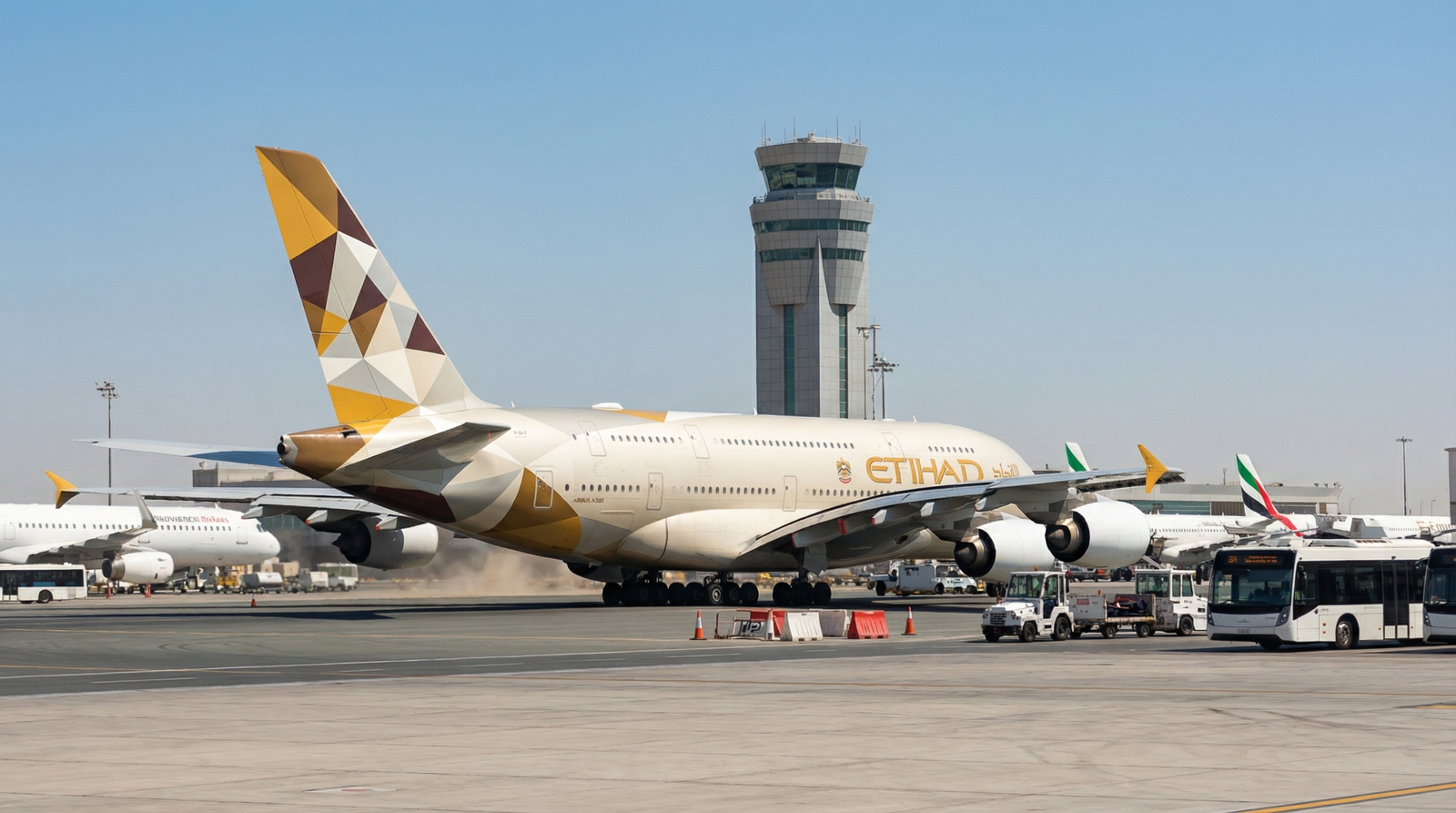

Flights departing from Abu Dhabi have partially resumed following recent drone strikes attributed to Iran, although significant confusion persists regarding flight operations. On Monday, 12 Etihad Airways flights took off from Abu Dhabi around 5 p.m. local time, even though the airline officially announced a suspension of all flights. Among these flights was a highly tracked Etihad Airbus A380 departing for London at 2:39 p.m., followed by wide-body aircraft bound for cities including Paris, Amsterdam, Moscow, Mumbai, New Delhi, Cairo, Karachi, Islamabad, Riyadh, Jeddah, and Dammam.
Despite this activity, Etihad Airways had earlier stated via social media that flights to and from Abu Dhabi were suspended until 2 p.m. on Tuesday. Furthermore, a warning on the Abu Dhabi airport website advised passengers scheduled to travel on Monday to check directly with their airlines due to a temporary closure of UAE airspace. This closure has affected flights from other regional airports such as Dubai, Qatar, Bahrain, and Kuwait, which remained grounded as of Monday morning.
The disruption followed a deadly incident on Sunday when an Iranian drone targeting Abu Dhabi International Airport was intercepted, resulting in the death of a Nepali national and injuries to seven others from falling debris. Authorities have confirmed the incident, though Etihad Airways and Abu Dhabi International Airport have not issued immediate comments.
In addition to Etihad flights, a Lufthansa Airbus A380, which had been in Abu Dhabi for maintenance, departed for Munich on Monday. The aircraft typically accommodates over 500 passengers, but only two pilots were aboard due to ongoing restrictions. Lufthansa indicated that flying passengers was considered unfeasible because assembling the necessary flight attendants was hindered by the current air traffic restrictions in the UAE. Issues surrounding passenger access to the airport and uncertainties about check-in and security procedures further complicated efforts to resume normal flight services.
As the situation develops, passengers are advised to monitor updates directly from airlines prior to travel. The temporary airspace closure and regional tensions have led to an unpredictable travel environment across the Middle East, impacting connectivity and passenger scheduling.