



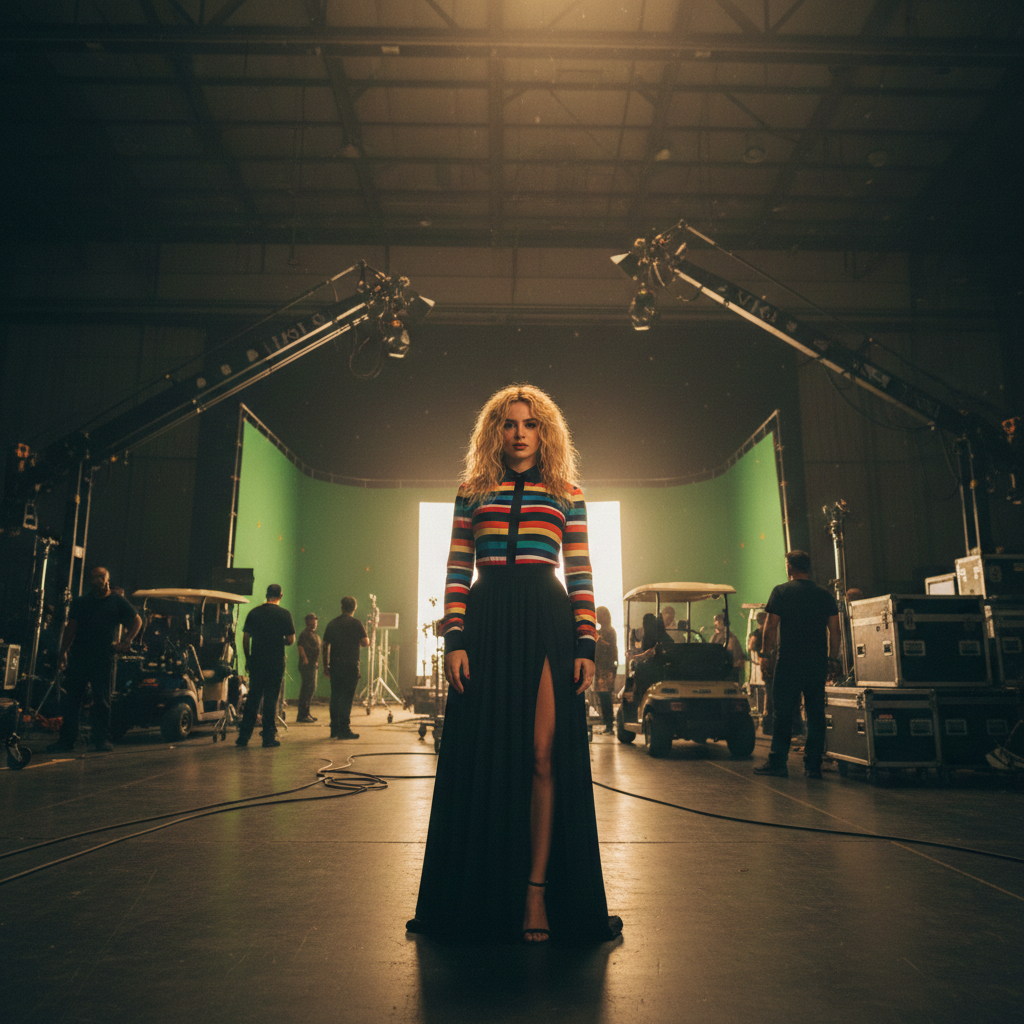

In December, Spanish singer Rosalía welcomed the press to a Hollywood soundstage, over a month after the release of her fourth album, Lux. Initially vague about her activities, it soon became clear that Rosalía was filming scenes for the highly anticipated third season of HBO’s Euphoria, set to return in April after a four-year break. Though details of her role remain scarce, a trailer reveals Rosalía portraying a character who works as a stripper and wears a bedazzled neck brace.
Rosalía, 33, presented a composed and reflective demeanor during the interview, wearing a distinct ensemble including a long black skirt by Ganni, stiletto pumps from Yves Saint Laurent, and a colorful striped shirt from a Barcelona-based culture podcast. Her ethereal halo of bleached blond hair contrasted with her dark locks, marking the visual identity of her Lux era.
Known for her powerful vocal presence, Rosalía also showed an intellectual depth, drawing on diverse religious texts and philosophical works such as the Bible, Quran, Vedas, and writings by Simone Weil, Caroline Walker Bynum, and Clarice Lispector. She spoke freely and fluidly, switching between English and Spanish, and emphasized the freedom found in the writing of author Chris Kraus.
Lux distinguishes itself through its complex musical and lyrical structure. Unlike most contemporary albums, Rosalía began by writing lyrics over the course of a year, often in solitude, before composing the music. The album’s themes are inspired by female saints and mystics from various cultures and eras. This influenced the use of 14 languages, ranging from German to Ukrainian, French, Italian, and Spanish, to evoke the personas of figures like Saint Hildegard of Bingen, Saint Olga of Kyiv, Teresa of Ávila, Joan of Arc, and Clare of Assisi.
The album features collaborations with notable artists including Patti Smith, Carminho, Björk, Yahritza y Su Esencia, and Yves Tumor. The London Symphony Orchestra provides sweeping orchestral elements, while arrangements by Pulitzer Prize-winning composer Caroline Shaw contribute to the album’s cinematic feel. The Escolania de Montserrat boys’ choir adds liturgical background vocals, blending classical sounds with electronic music.
Lux’s 18 tracks are organized like an opera, divided into four movements and progressing through various musical and emotional phases. The opening piece, “Sexo, Violencia y Llantas,” serves as an overture, while tracks like “Berghain” fuse orchestral grandeur with the energy of techno music. The song includes vocals in German and features Björk chanting alongside Rosalía, with themes of rage and love interwoven in the lyrics.
Flamenco influences persist throughout the album. Songs such as “Mundo Nuevo” reinterpret traditional flamenco styles, while “De Madrugá” incorporates typical flamenco scales, vocal techniques, and rhythms. Rosalía also integrates elements from Romani culture, as heard in the track “La Yugular,” which uses Caló language.
Lux achieved remarkable reception upon release. It garnered over 42 million Spotify streams within the first 24 hours, setting a record for a Spanish-speaking female artist. The album also topped Spotify’s global charts for a week, briefly surpassing major releases such as Taylor Swift’s The Life of a Showgirl. Additionally, Rosalía became the first artist to secure the number one spot simultaneously across five Billboard album charts, including Latin, Latin Pop, Classical, and Classical Crossover categories.
Visually, the Lux era is marked by symbolic imagery reflecting feminine spirituality. The album’s cover features Rosalía wearing a white headpiece resembling a nun’s habit and a white garment evocative of a straitjacket, symbolizing constraint and devotion. She describes this as a representation of the album’s spiritual foundation and thematic focus.
As Lux continues to captivate audiences, Rosalía’s expanding artistic ventures, including her role on Euphoria, highlight her evolving presence in both music and popular culture.