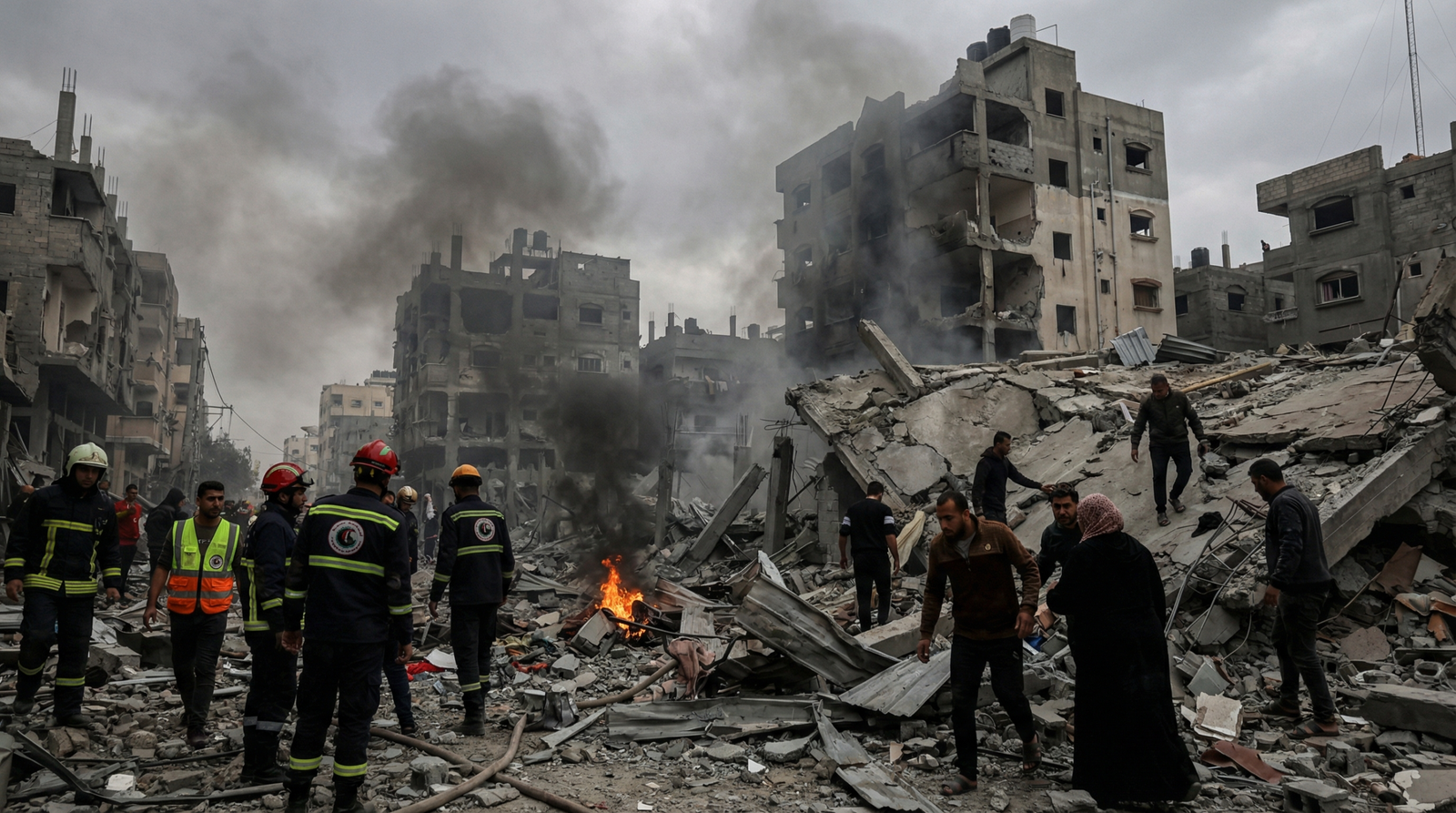

On August 10, 2024, Yasmin Mahani searched through the ruins of the al-Tabin school in Gaza City for her missing son, Saad. Despite days spent looking through hospitals and morgues, she found no trace of him, only fragments of flesh and blood at the site where he was last seen. Mahani’s experience is shared by thousands of Palestinians reported missing amid the ongoing conflict in Gaza, where over 72,000 people have died since October 2023.
A detailed investigation conducted by Al Jazeera Arabic highlights that Gaza Civil Defence teams have documented 2,842 Palestinians who have effectively “evaporated,” leaving behind no identifiable remains. This phenomenon is attributed primarily to the use of thermal and thermobaric munitions by Israeli forces. These weapons, often called vacuum or aerosol bombs, generate intense heat levels exceeding 3,500 degrees Celsius (6,332 degrees Fahrenheit), capable of obliterating human bodies entirely.
Russian military expert Vasily Fatigarov explained that thermobaric weapons work by dispersing a fuel cloud that ignites to produce a massive fireball and vacuum effect. The addition of aluminum, magnesium, and titanium powders elevates the explosion temperatures to between 2,500 and 3,000 degrees Celsius. These conditions can transform human tissue and fluids into ash in seconds. Dr. Munir al-Bursh, Director General of the Palestinian Ministry of Health in Gaza, described the biological impact of such extreme heat, noting that the human body, largely composed of water, is incinerated instantly under these conditions.
The investigation identified specific U.S.-manufactured munitions used in Gaza linked to these disappearances: the MK-84 “Hammer,” a 900-kilogram unguided bomb utilizing tritonal explosive, producing temperatures up to 3,500 degrees Celsius; the BLU-109 bunker buster, which was employed in an attack on a declared “safe zone” in al-Mawasi and incinerated 22 people within enclosed spaces; and the GBU-39 precision glide bomb, which maintains building structures relatively intact while destroying interior contents and was used in the al-Tabin school attack.
Civil Defence spokesperson Mahmoud Basal confirmed that in many cases, only parts such as scalps or traces of blood remain at sites where entire families had disappeared. These findings have drawn attention to the legal and ethical implications of using such weapons. Human rights lawyer Diana Buttu, speaking at the Al Jazeera Forum in Doha, emphasized that the continuous supply of these munitions by Western countries amounts to complicity in acts that may constitute war crimes due to their indiscriminate nature.
Despite rulings by the International Court of Justice and arrest warrants issued by the International Criminal Court against Israeli officials, violence and killings in Gaza have continued. Professor Tariq Shandab of international law highlighted the failure of international justice mechanisms, pointing to the ongoing blockade and siege that exacerbate humanitarian suffering. He noted the role of international political dynamics, such as the U.S. veto at the UN Security Council, in allowing continued impunity.
For individuals like Rafiq Badran, who lost four children in the conflict, these legal and political discussions offer little solace. He has been able to recover only small body parts of his children, with the rest of their remains having vanished due to the effects of these high-temperature munitions. Badran’s experience encapsulates the broader tragedy suffered by thousands amid the war in Gaza.