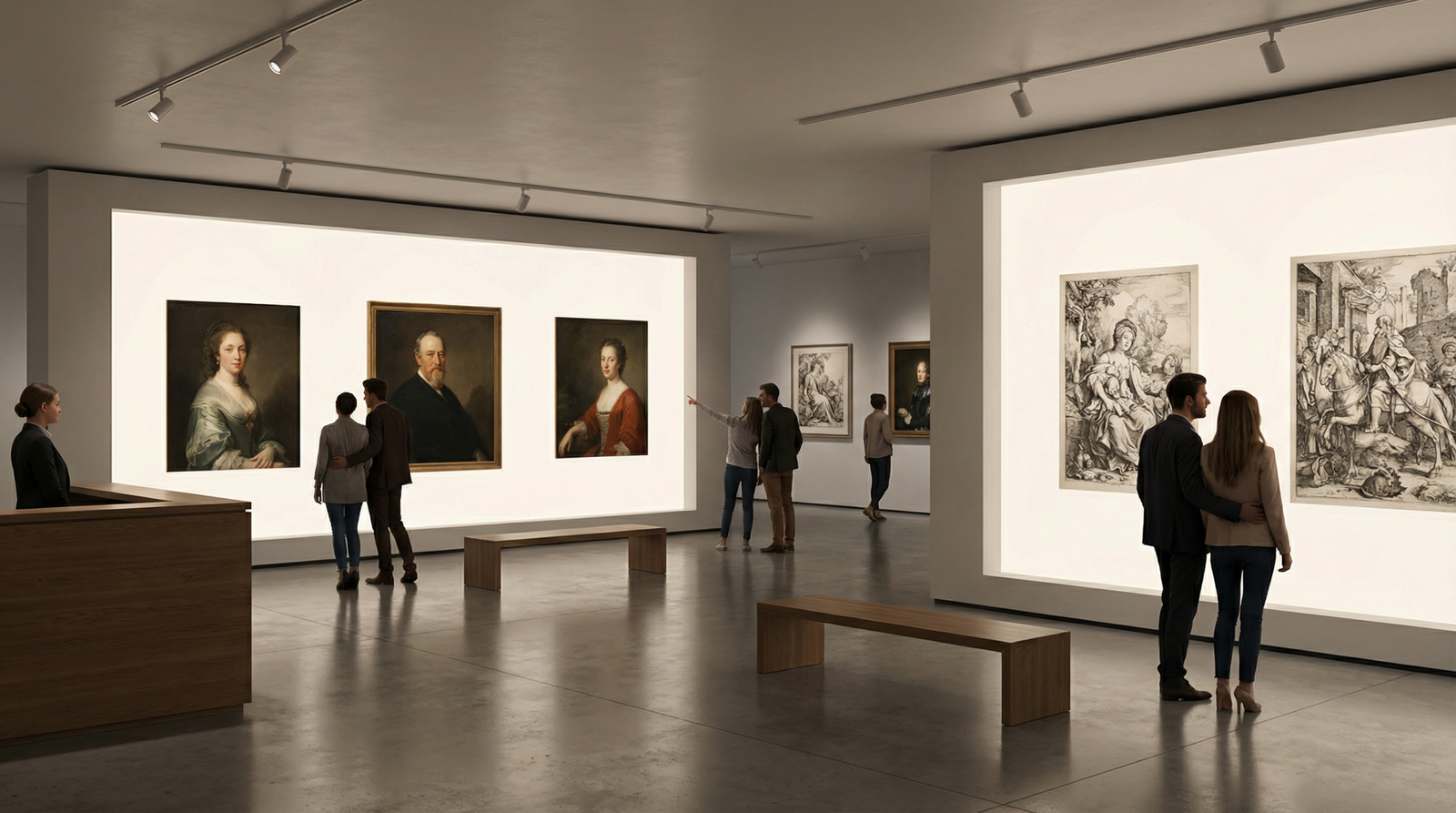

An exhibition at London’s National Portrait Gallery showcases a broad selection of Lucian Freud’s drawings, etchings, early works, and paintings, providing an extensive overview of the artist’s varied output. While Freud is widely celebrated for his powerful oil paintings, this display also includes his lesser-seen sketches and etchings, some of which have received mixed reactions.
Freud’s reputation as a master painter remains undisputed, especially through iconic works such as his 1990s portrait of Sue Tilley, a “Benefits Supervisor.” This painting stands out in the exhibition, exhibiting Freud’s detailed attention to physical texture and flesh tones that critics and audiences have long admired. However, much of the exhibition’s focus on Freud’s drawings and printwork presents a more complicated impression.
The gallery features numerous etchings, a medium Freud explored predominantly in his later years but which, according to some observers, lacks the vitality and complexity of his paintings. Several etchings, including detailed portraits and nude studies, are described as less successful. For instance, the 1985 etching “Man Posing” depicts a nude male figure in a pose also captured in a nearby painting, with critics noting a disparity between the two—where the painting impresses with color and intensity, the etching appears awkward.
Freud’s early drawings, which include childhood crayonings and portraits from the 1940s and ’50s, also reveal a range of qualities. While these works show his early development and fascination with human faces, some responses characterize them as overly sentimental or lacking the intensity found in his later painting. These pieces demonstrate Freud’s initial focus on drawing as a precise observational tool before fully committing to painting.
The exhibition traces Freud’s artistic evolution, noting a distinct turning point in the 1960s when he shifted away from drawing to concentrate exclusively on painting from life. His 1963 self-portrait is cited as a pivotal work, signaling his emergent style marked by intense scrutiny of the human form through direct observation.
The curatorial decision to emphasize Freud’s drawings and etchings has met with some criticism, with suggestions that this approach highlights the artist’s less accomplished efforts rather than his celebrated strengths. Some argue that the exhibition risks redefining Freud’s legacy by focusing on what is considered less impactful work, potentially affecting public perception and market value.
Nonetheless, the exhibition offers an in-depth view of Freud’s full artistic range, from his early experiments through to his mature paintings, allowing visitors to gain insight into his processes and development as an artist. “Lucian Freud: Drawing Into Painting” runs from 12 February to 4 May at the National Portrait Gallery in London.