




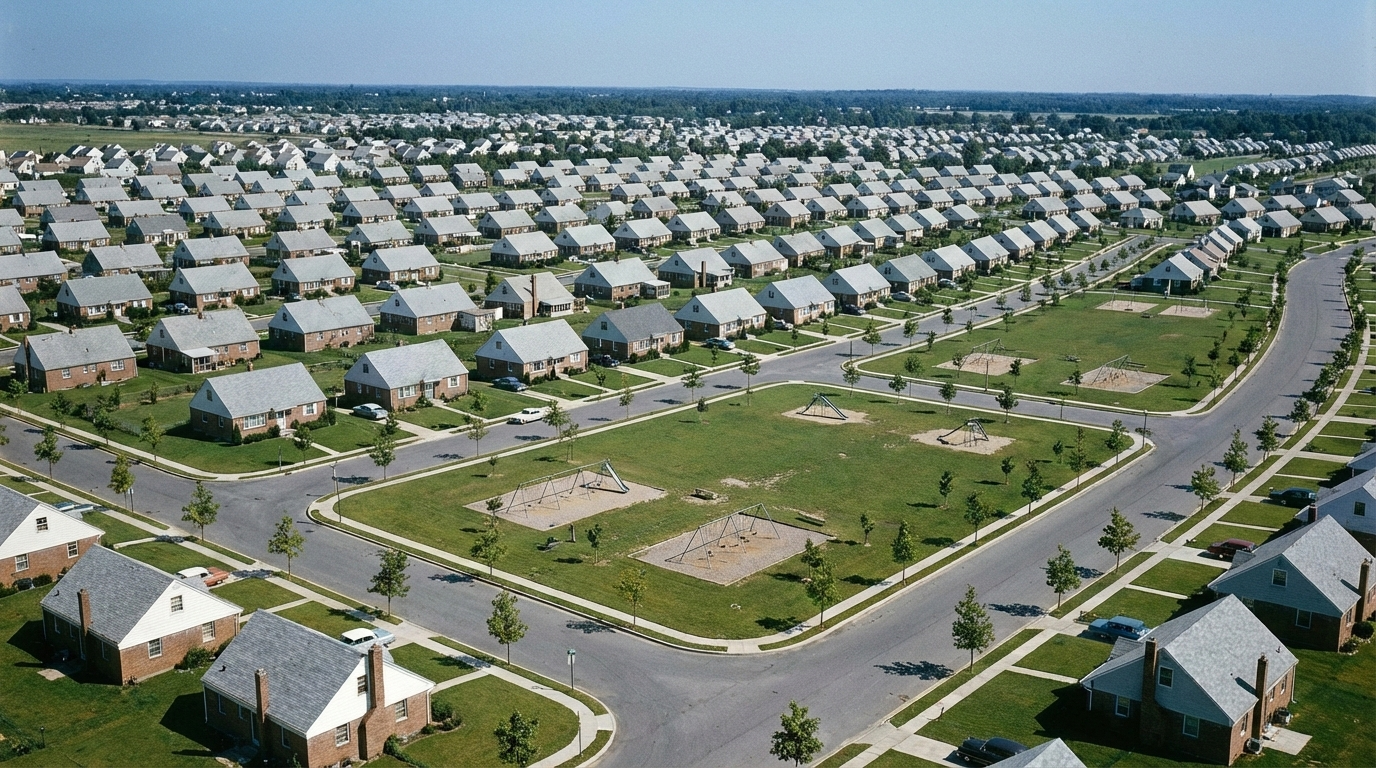

Levittown, located on Long Island, New York, is widely regarded as the first modern American suburb, ushering in the mass suburbanization of the post-World War II era. Established in 1947 by Levitt and Sons, this community featured uniform Cape Cod-style homes that cost about $7,000 each, drawing growing families eager to leave urban centers.
The postwar period saw a massive demographic shift, with families moving out of cities into newly built suburban communities. This migration was largely fueled by the Baby Boom, a surge in births beginning in 1946, as well as government incentives such as the GI Bill, which provided returning veterans with home loans and educational opportunities. These factors, combined with advancements in highway construction and mass production building techniques, accelerated suburban growth.
Before the 1950s, the majority of Americans lived in cities for factory jobs or in rural areas for agriculture. However, by the 1950 census, 40% of the population lived in suburbs, a proportion that increased rapidly in the following decade. Levittown’s construction utilized an innovative assembly-line approach, enabling the rapid building of houses—one was constructed every 16 minutes during the peak period, resulting in over 17,000 homes built by 1951.
Each Levittown home sat on a 6,000-square-foot lot and initially featured four rooms along with built-in amenities such as televisions and radios. The uniform design led to some residents accidentally entering the wrong homes, highlighting the community’s homogeneity. Extensive greenery lined the streets, with a tree planted every 28 feet, and community facilities included swimming pools and several shopping centers known as village greens.
Levittown’s affordability was a major appeal; the mortgage payments were around $29 a month, substantially cheaper than urban apartment rents at the time. By the mid-1950s, Levittown’s population had grown to approximately 82,000 residents, making it one of the largest private housing developments in U.S. history.
Despite its growth and prosperity, Levittown was marked by racial exclusion. African Americans and other minorities were largely barred from purchasing homes due to discriminatory policies and practices. The benefits of the GI Bill were not equally accessible to all veterans, and Levittown remained predominantly white for many years. One significant challenge to this policy arose in 1952 when William Cotter, a Black man, sublet a home but was refused renewal of the lease by Levittown’s management, sparking local controversy.
The rise of Levittown coincided with the expansion of highways, which facilitated commuting; by 1950, about 80% of working men in Levittown commuted to jobs in Manhattan. The suburban lifestyle became synonymous with the era’s ideal of the nuclear family and homeownership, although it also brought shifts in gender roles. Women, some of whom had entered the workforce during the war, were often expected to return to homemaking and child-rearing, a dynamic critiqued in literature such as Betty Friedan’s 1963 book “The Feminine Mystique.”
Community activism emerged as residents, including women advocating for safety improvements like stop signs, engaged in local affairs. Politically and culturally, Levittown stood as a symbol of American prosperity and stability during the Cold War, embodying hopes for economic security and suburban life.
Levittown’s development set a precedent for thousands of suburban communities built across the United States in the 1950s, reshaping American living patterns and becoming a defining icon of the mid-20th century.