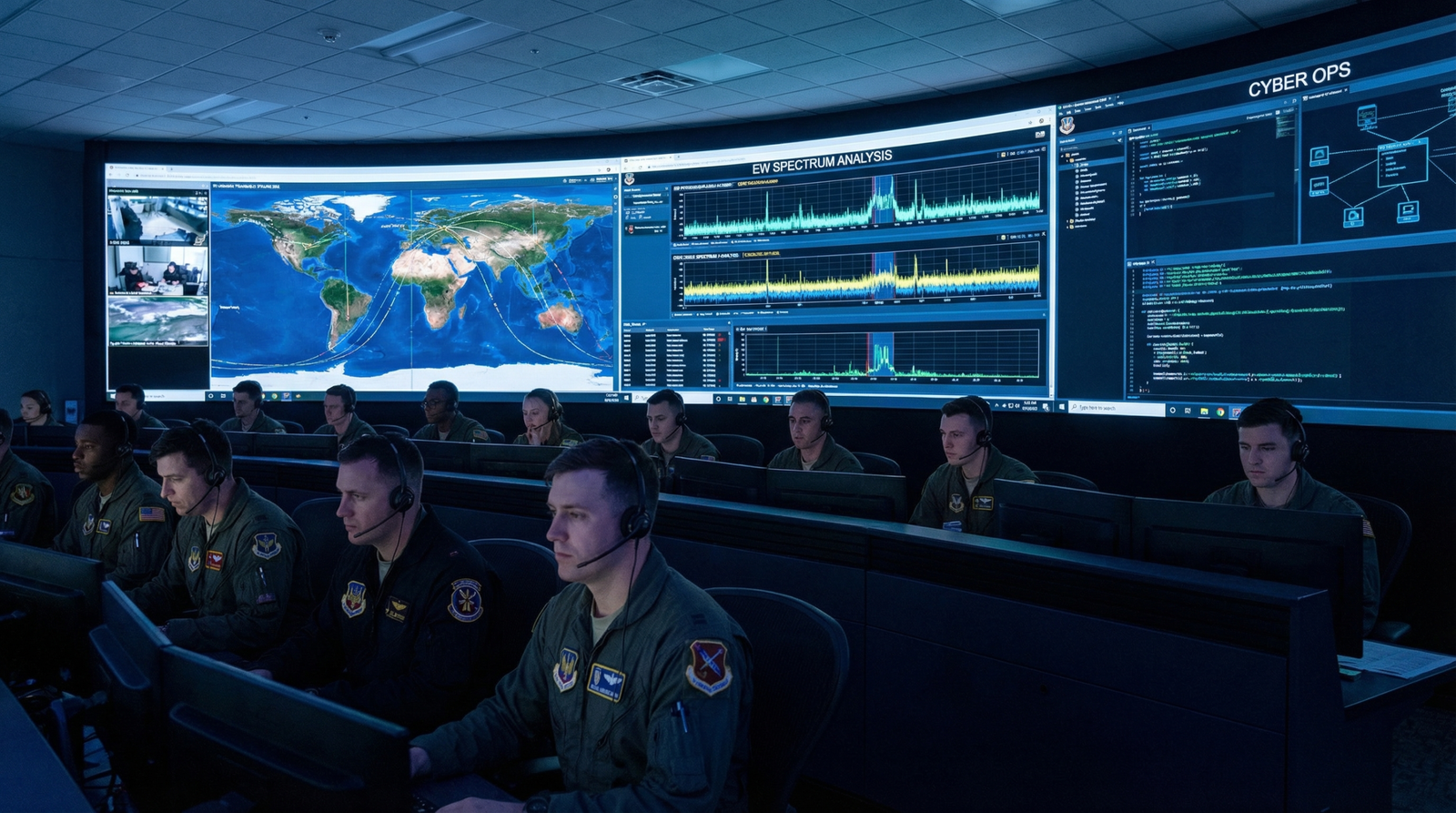

Recent U.S. military operations against Iran have underscored the vital role of non-kinetic warfare methods, such as cyber, space, and electromagnetic spectrum operations, in contemporary conflicts. Officials and experts emphasize that controlling these less visible but crucial battlespaces is essential for achieving success in modern combat scenarios.
In the early stages of Operation Epic Fury, U.S. forces employed layered non-kinetic measures including electronic warfare to disrupt Iranian capabilities. These actions aimed to degrade, confuse, and blind Iranian combat assets ahead of more traditional kinetic strikes. General Dan Caine, Chairman of the Joint Chiefs of Staff, noted that space and cyber units were the first to act, setting conditions for subsequent operations.
Similar tactics were utilized in Operation Absolute Resolve in Venezuela and Operation Midnight Hammer, which targeted Iran’s nuclear infrastructure. In each case, cyber, space, and electromagnetic spectrum operations played a key role in disrupting enemy communications, defense systems, and surveillance capabilities without direct physical attacks.
Non-kinetic warfare involves jamming signals, hacking networks, and interfering with satellite operations. These methods prevent or degrade an adversary’s ability to gather information, coordinate responses, or operate systems reliant on signals and navigation. U.S. military strategy highlights the importance of maintaining superiority in the electromagnetic spectrum, considered foundational to overall operational success.
The electromagnetic spectrum covers a wide range of light and radio energy, essential to communication and sensor systems. Houston Cantwell, a retired U.S. Air Force brigadier general, emphasized that spectrum dominance has evolved from being important in the 20th century to absolutely critical in the 21st century.
The concept of electronic warfare and spectrum control traces back to World War II, where radar, jamming, and signals intelligence first emerged as key tools. Despite technological advancements, the strategic principles remain: detect, disrupt, deceive, and protect one’s own use of the spectrum. According to U.S. defense documents, securing freedom of action in the electromagnetic domain is a prerequisite for success across all military domains.
U.S. and Israeli forces have reportedly targeted Iranian air defenses, potentially using jamming and cyber capabilities to disable radars and disrupt communications between command centers, radar installations, airbases, and fighter aircraft. Such efforts aim to blind and confuse adversaries to facilitate kinetic strikes and reduce the risk to attacking forces.
Maintaining control over the electromagnetic spectrum is also critical for the effectiveness of precision-guided weapons that depend on laser or satellite guidance. If spectrum access is denied or degraded, the accuracy and reliability of these weapons may be significantly compromised.
Lessons from the ongoing conflict in Ukraine have reinforced the significance of electronic warfare. Russian forces have used jamming techniques to reduce the accuracy of Ukrainian precision weapons, highlighting the impact of spectrum control. U.S. forces have studied these developments carefully to adapt their own approaches to future conflicts with peer adversaries.
Cyber warfare, closely linked to these operations, plays a significant role in disrupting enemy infrastructure and supporting intelligence efforts. Although specific details of U.S. cyber operations remain classified, experts like Louise Marie Hurel from the Royal United Services Institute point out that cyber capabilities function more effectively as enablers within broader military campaigns rather than as standalone decisive tools.
Ultimately, the integration of cyber, space, and electronic warfare enables forces to weaken enemy defenses and protect their own operations. Military specialists agree that while spectrum dominance alone does not guarantee victory, failing to control the electromagnetic environment can severely undermine any military campaign.
These developments demonstrate the increasing complexity of modern warfare, where unseen battles in cyberspace and the electromagnetic spectrum are as critical as traditional kinetic confrontations in determining success on the battlefield.