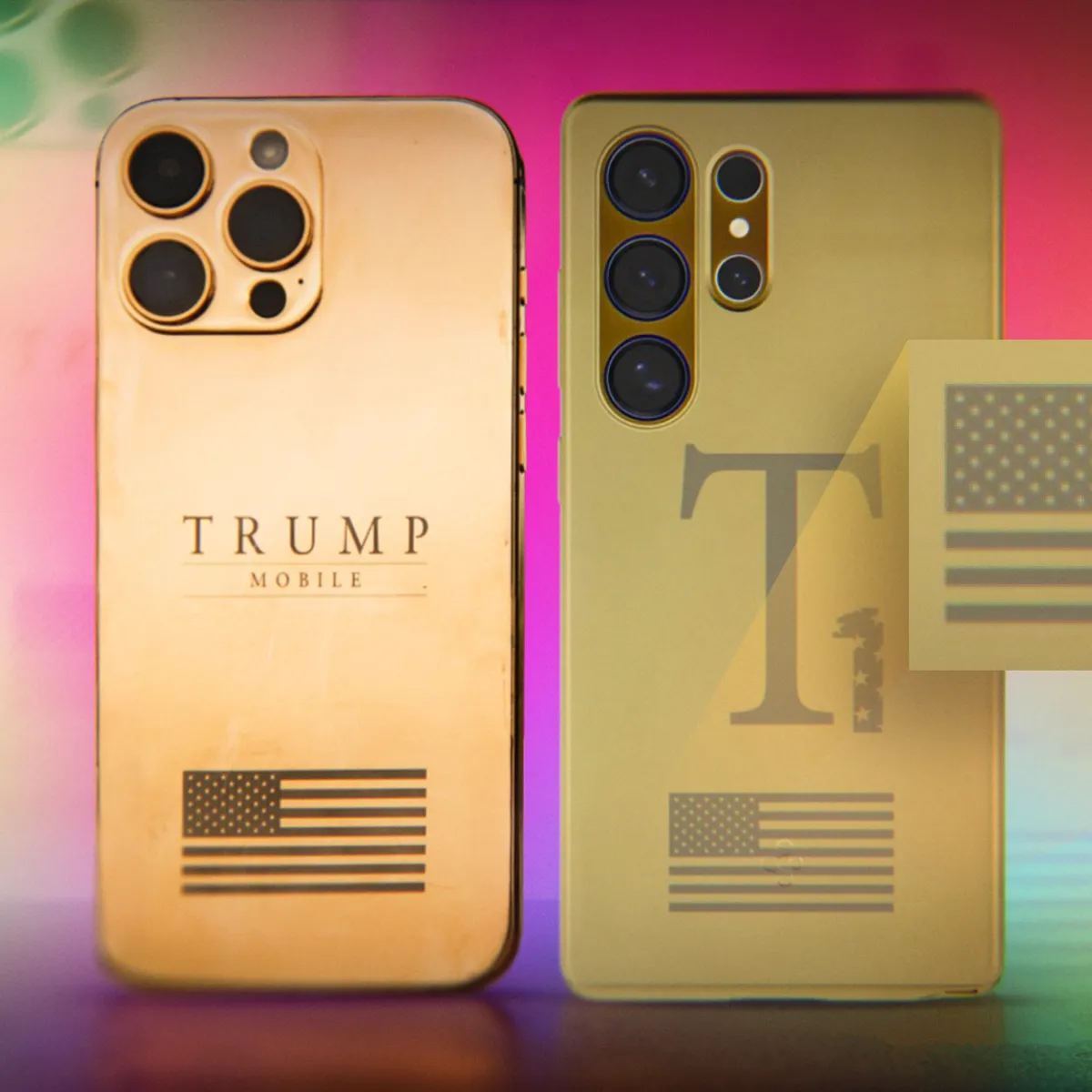

Trump Mobile just showed off a redesigned version of their T1 phone. The new mockup looks sleeker than the previous renders. But here’s what actually matters: they still won’t commit to a release date, and they still haven’t disclosed who’s manufacturing the hardware or what Android fork they’re running.
I’ve shipped phones at scale. When a consumer electronics company won’t tell you the chipset, the manufacturer, or the release quarter, that’s not strategy — that’s a supply chain in chaos.
What Changed in the Redesign
The updated T1 mockup shows a cleaner industrial design with what appears to be a glass back and a centered camera module. The bezels are thinner than the previous renders. The Trump branding is more subtle.
These are aesthetic choices any product designer can make in Figma. What hasn’t changed is the complete absence of technical specifications. No mention of the processor, RAM, storage tiers, or camera sensors. No FCC filings that would indicate imminent production.
For context, when Nothing launched their Phone (1), they announced the Snapdragon 778G+ processor nine months before launch. When Fairphone ships a device, they publish detailed teardowns showing every component supplier. Trump Mobile is now over two years into marketing this device with zero hardware transparency.
The Release Date Dance
The original Trump phone announcement came in late 2024 with promises of a 2025 launch. We’re now in April 2026, and the language on their enrollment page remains deliberately vague: “coming soon” and “be the first to know.”
In consumer electronics, this pattern has a name: vaporware with rolling preorders. You collect emails, you iterate on renders, but you never commit to a date that would force you to either ship or admit failure. The Verge documented dozens of crowdfunded hardware projects that followed this exact playbook between 2015 and 2020.
Here’s what a real product timeline looks like: concept (6 months), engineering validation (6 months), design validation (4 months), production validation (3 months), then manufacturing ramp. We’re 18+ months past when Trump Mobile should have been in engineering validation if they were targeting 2025.
What The Press Got Wrong
Most coverage treats this as a straightforward product update story. New design, still waiting on a date — end of article. That fundamentally misunderstands what’s happening here.
The redesign isn’t progress. It’s a signal that Trump Mobile is stuck in the brand layer and hasn’t solved the hard problems: finding a manufacturing partner willing to take the political risk, securing component supply at reasonable margins, and building a software team capable of maintaining a secure Android fork.
Every political figure who has tried to launch a phone has hit the same wall. These aren’t software products where you can iterate in the cloud. Phones require supply chain relationships, regulatory approvals across dozens of countries, and sustained engineering investment. Trump Mobile is selling a brand promise while hoping someone else figures out the product.
The real question isn’t “when will it ship?” The question is “who’s actually building this, and why haven’t they put their name on it?” In consumer electronics, anonymity equals risk. When Samsung ships a phone, they stake their reputation on every component. When an unknown manufacturer builds white-label hardware for a political brand, they’re pricing in the probability that orders never materialize.
The Privacy Paradox Nobody Mentions
Trump Mobile markets the T1 as a privacy-focused alternative to mainstream Android phones. But privacy in mobile requires two things: a hardened operating system and a track record of security updates.
GrapheneOS, the gold standard for privacy-focused Android, publishes their entire source code, maintains monthly security patches, and runs on Google Pixel hardware because those are the only phones with a secure element architecture they trust. CalyxOS, another privacy-focused alternative, does the same.
Trump Mobile hasn’t published a single line of code. They haven’t committed to a security update schedule. They haven’t disclosed whether they’re forking AOSP directly or using a pre-packaged solution like /e/OS. For a privacy product, this is disqualifying.
The technical reality is harsh: building a secure mobile OS requires a team of 20+ full-time engineers and multi-million dollar annual investment. GrapheneOS, which is donation-funded and has been in development since 2014, barely maintains feature parity with stock Android. The idea that Trump Mobile is building something comparable in stealth mode strains credibility.
Who Actually Wins and Loses
Winners: Email marketing platforms and whatever design agency is iterating these mockups. Trump Mobile has built a substantial mailing list they can monetize indefinitely without shipping hardware. The political brand benefits from the narrative of “fighting big tech” without the accountability of delivering a product.
Losers: Anyone who believes this phone will meaningfully challenge the iOS-Android duopoly. The lesson from the last decade of alternative phone projects is clear: even Amazon failed to compete with Fire Phone despite infinite capital and retail distribution. Essential Phone, backed by Android’s co-founder, shut down after one device. The Trump phone won’t succeed where they failed.
The real losers are privacy-focused phone buyers who could have been directed to actual solutions like GrapheneOS on Pixel or the Fairphone. Trump Mobile’s marketing pulls oxygen away from products that work.
The Manufacturing Mystery
No credible phone manufacturer has publicly associated with Trump Mobile. The obvious partners — Foxconn, BYD, Wingtech — have said nothing. The smaller ODMs that typically build white-label phones for niche brands haven’t surfaced either.
This matters because phone manufacturing at scale requires minimum order quantities of 50,000+ units. At an estimated $500+ retail price, that’s $25 million in component purchases before you sell a single device. Someone has to underwrite that risk, and two years into this project, nobody has stepped forward.
The most likely scenario: Trump Mobile is negotiating with third-tier manufacturers who will only commit to small batch runs of 5,000-10,000 units. That explains the delays and the refusal to announce a firm date. They’re trying to de-risk by waiting for preorder volume that would justify larger production runs. But consumer electronics doesn’t work backwards from preorders to manufacturing — the capital requirements are too front-loaded.
What Comes Next
The pattern from here is predictable. Trump Mobile will continue to collect emails and iterate on renders. They might eventually ship a small batch of devices to the most committed preorder customers — likely rebranded hardware from an existing Android manufacturer with custom wallpaper and preloaded apps.
That’s not a conspiracy theory. It’s what happened with the Freedom Phone in 2021, which turned out to be a $119 Chinese phone marked up to $499 with minimal software modifications. Ars Technica documented the entire supply chain breakdown.
The tell is in what they’re not saying. Real hardware companies talk about their manufacturing partners because trust is built on transparency. Trump Mobile’s silence on who’s building the T1 and when they’ll start production reveals everything you need to know about the gap between marketing and reality.
The Bigger Lesson About Political Brands in Hardware
Political brands excel at low-capital products: media, subscriptions, merchandise. They fail at hardware because hardware requires multi-year technical commitments that outlast political cycles. You can’t pivot a phone’s industrial design when the news cycle shifts. You can’t cancel production runs because polls dropped.
This is why Trump-branded products have succeeded in real estate, golf courses, and steaks but failed in airlines, vodka, and now phones. Real estate is about brand association and location. Phones are about supply chain execution and software maintenance. One rewards charisma, the other rewards technical depth.
The T1 redesign is Trump Mobile trying to keep the dream alive without confronting the economics. Every mockup refresh buys another six months of “it’s coming soon.” Every vague update resets the clock on when supporters will demand accountability.
Why This Matters Beyond One Phone
The Trump phone saga is a case study in the difference between brand equity and technical execution. Silicon Valley learned this lesson in the 2010s when celebrity-backed hardware startups burned through hundreds of millions trying to compete with Apple and Samsung.
The technical bar for shipping a competitive smartphone in 2026 is brutal: sub-$500 pricing requires you to move 500,000+ units to hit component costs. Premium pricing requires you to out-execute companies that have been refining hardware for decades. There is no middle ground where political brand value bridges the gap.
Trump Mobile’s real competition isn’t Apple or Samsung. It’s every other niche phone maker fighting for the same small audience: the Light Phone, the Punkt phone, the Mudita Pure. Those companies succeed by staying small, using existing hardware platforms, and setting realistic expectations. Trump Mobile is trying to play the big phone game with small phone resources, and the redesign doesn’t change that math.
The Trump phone will either ship as quietly rebranded Chinese hardware at massive markup, or it won’t ship at all — and in consumer electronics, the longer you wait to commit to manufacturing, the more you’ve already chosen the second option.