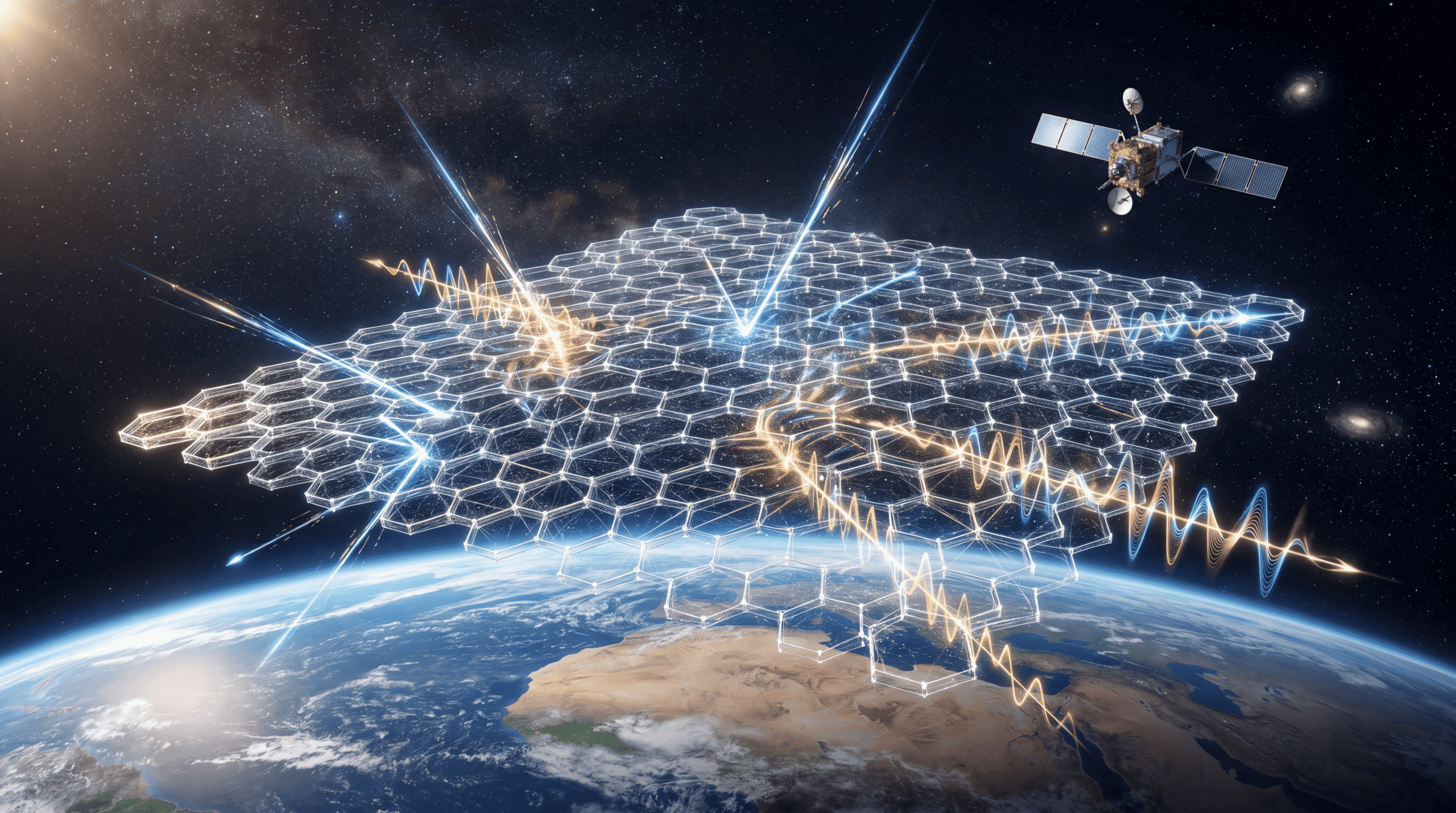

A team at Northwestern just solved two problems at once with a material thinner than a human hair, and the space industry is about to feel it. They built a shield that blocks both electromagnetic interference and ionizing radiation using a single 2D layer. The press is running Mars colony headlines, but the actual impact hits closer to home: every satellite company is now looking at their weight budgets differently.
Why Current Radiation Shielding is a $10,000 Per Kilogram Problem
Launch costs have dropped to roughly $2,000-$3,000 per kilogram with SpaceX’s reusable rockets, but that’s still a brutal tax on traditional radiation shielding. Lead sheets, aluminum composites, polyethylene layers — they all add mass. A typical communications satellite carries 50-100 kg of shielding alone. That’s $100,000-$300,000 in launch costs before the satellite does anything useful.
The Northwestern material, published in Advanced Materials, weighs almost nothing because it’s a 2D structure. The researchers combined graphene with hexagonal boron nitride and molybdenum disulfide in a layered lattice. The result blocks 99.9% of electromagnetic interference across radio frequencies AND stops ionizing radiation that would normally require centimeters of traditional materials. This isn’t incremental — it’s a different physics approach to the same problem.
What makes this actually deployable: they can manufacture it using chemical vapor deposition, the same process that makes graphene at scale today. We’re not talking about lab curiosities that require a particle accelerator to produce. This can be built in existing semiconductor fabs with modifications.
How They Actually Built It (And Why It Took This Long)
The breakthrough came from understanding how different 2D materials interact when stacked. Graphene conducts electricity exceptionally well, which makes it great for dissipating electromagnetic fields. Hexagonal boron nitride is an insulator with a wide bandgap, which means it can absorb high-energy particles without breaking down. Molybdenum disulfide adds another layer of electron interaction that captures particles the other two miss.
The trick was getting them to stick together without introducing defects. 2D materials are notoriously difficult to layer because any contamination between sheets ruins the quantum mechanical properties that make them work. The Northwestern team developed a transfer process using a polymer scaffold that keeps the layers atomically clean. According to their paper in Advanced Materials, they achieved less than 0.1% defect density across a 10cm wafer.
This wasn’t possible five years ago. The fabrication technology didn’t exist. Chemical vapor deposition has improved to the point where you can grow these materials with controlled thickness down to a single atomic layer. The polymer transfer technique came from research on flexible electronics — a completely different field that happens to solve this problem.
What The Press Got Wrong About This Shield
Every article mentions Mars missions and deep space exploration. That’s the sexy application, but it’s not where this technology matters first. Mars missions are 10-15 years away from needing production shielding. Satellite constellations need it now.
Starlink operates 5,000+ satellites. OneWeb is building toward 650. Amazon’s Project Kuiper is targeting 3,236. Each satellite faces radiation degradation in low Earth orbit that limits lifespan to 5-7 years. If you can extend that to 10 years with minimal weight penalty, the economics flip completely. You launch fewer replacement satellites, which means lower ongoing costs.
The electromagnetic interference blocking is actually the more immediate win. Satellites are packed with electronics operating at different frequencies. Traditional EMI shielding uses copper tape, metal enclosures, and careful circuit board layout. All of that adds weight and complexity. A single conformal coating that does the same job changes how you design the entire satellite bus.
According to SpaceNews coverage of satellite design trends, the industry is moving toward software-defined satellites where you reconfigure the payload electronically instead of launching new hardware. That requires MORE electronics packed closer together, which makes EMI a bigger problem. This material solves that before it becomes a bottleneck.
The Manufacturing Reality Nobody Wants To Discuss
Chemical vapor deposition at scale is still expensive. A 300mm wafer of this heterostructure probably costs $5,000-$10,000 to produce today. That’s 10-20x more expensive than the aluminum it replaces per square meter. The economics only work if the weight savings are dramatic enough to justify it.
For satellites, they are. For terrestrial electronics, not yet. That’s the dividing line. Applications where launch costs or extreme environments justify premium materials will adopt first. Consumer electronics will wait until manufacturing costs drop another order of magnitude.
The good news: 2D material production costs have dropped 100x in the last decade. Graphene was $1000 per gram in 2008. It’s $10 per gram today for high-quality material. The same learning curve applies here. When production volume hits the point where aerospace suppliers build dedicated fabs, costs will collapse.
Who Actually Wins and Loses
Winners:
Satellite manufacturers who move fast. Companies like Rocket Lab, which builds small satellites for commercial customers, can offer longer mission life at lower mass. That’s a direct competitive advantage. They can pitch 10-year satellites at the cost of 7-year satellites using conventional shielding.
2D materials suppliers. Applied Graphene Materials, Grafoid, and a handful of others already produce graphene and boron nitride. They now have a premium application that justifies building the heterostructure production lines. This is a $50-100M annual market within 5 years.
Electronics companies with harsh environment requirements. Military systems, nuclear plant sensors, space-based compute — anywhere radiation or EMI is currently solved by overbuilding and redundancy.
Losers:
Traditional shielding material suppliers. The aluminum and lead foil business isn’t huge, but it’s steady. That revenue stream starts declining as new satellite designs adopt 2D alternatives.
Satellite operators who just launched constellations with 5-7 year lifespan assumptions. They’re locked into a replacement cycle that competitors might avoid. Iridium NEXT satellites, launched 2017-2019, are already depreciating assets. If the next generation lasts 50% longer, that’s a competitive problem.
Companies that waited to see if 2D materials would actually work. There was legitimate skepticism that these lab results would transfer to production. That window just closed. Now you’re behind instead of cautious.
What This Actually Means For Space Access
Lighter satellites mean more satellites per launch. A Falcon 9 can lift 22,800 kg to low Earth orbit. If each satellite drops 10 kg of shielding, you fit one or two more per launch. At $67M per launch, that’s $3-6M saved per mission. Multiply by hundreds of launches per year, and it changes project economics.
Longer satellite lifespans reduce space debris. This is less obvious but more important long-term. Every satellite becomes debris eventually. If satellites last 10 years instead of 5, you launch half as many over a 20-year period. That’s half the collision risk in already-crowded orbits.
The technology also enables closer packing of electronics in spacecraft, which means more capability per kilogram. Software-defined radios, edge computing, AI inference — all of those require dense electronics that generate heat and electromagnetic noise. Current designs space components apart to manage interference. This material lets you pack them tighter.
The Timeline That Actually Matters
Lab demonstration to production qualification takes 3-5 years in aerospace. The Northwestern team has proven the concept. Now it needs environmental testing: thermal cycling from -150°C to +150°C, vacuum exposure, atomic oxygen erosion, radiation dosing equivalent to 10 years in orbit. All of that happens in test facilities before any satellite manufacturer trusts it.
First commercial deployments likely happen in 2027-2028 on experimental satellites. Full production adoption across new satellite designs hits 2029-2030. By 2032, this is the default shielding approach for any new constellation.
The companies positioning now — building relationships with the Northwestern team, running their own qualification tests, designing satellite buses around the weight savings — will have 18-24 months of advantage. In the satellite business, that’s the difference between winning and losing a $500M contract.
What Nobody Is Asking Yet
Can you repair this material in orbit? 2D structures are atomic-scale. If a micrometeorite punches through, you can’t patch it like you would aluminum. That’s fine for disposable satellites, but what about the International Space Station? The ISS has been continuously occupied since 2000, and it’s not getting replaced anytime soon. Do you retrofit sections? Or is this technology only for new builds?
The other question: what happens when you scale to square meters instead of wafers? The Northwestern demonstration is 10cm diameter. A satellite might need 2-3 square meters. Do the defect rates stay low? Does the manufacturing cost scale linearly or exponentially? Nobody knows because nobody has tried yet.
These are the questions that determine whether this stays a niche technology or becomes infrastructure.
The Real Prediction
By 2030, satellite manufacturers will bid two versions of every design: legacy shielding and 2D heterostructure. Customers will pay a 15-20% premium for the 2D version because the total cost of ownership is lower. By 2035, the legacy version disappears entirely — not because it doesn’t work, but because nobody wants to launch extra weight when they don’t have to.
The more interesting shift: ground-based electronics start adopting this for data centers near power infrastructure, medical devices, and anywhere EMI creates reliability problems. Once aerospace proves the technology and drives costs down, it bleeds into applications nobody is talking about yet. The shield that enables Mars colonies gets used first to make your WiFi router slightly more reliable.
The satellite industry just got handed a weight budget they didn’t know they had, and the first companies to redesign around it will build the constellations that matter for the next decade.