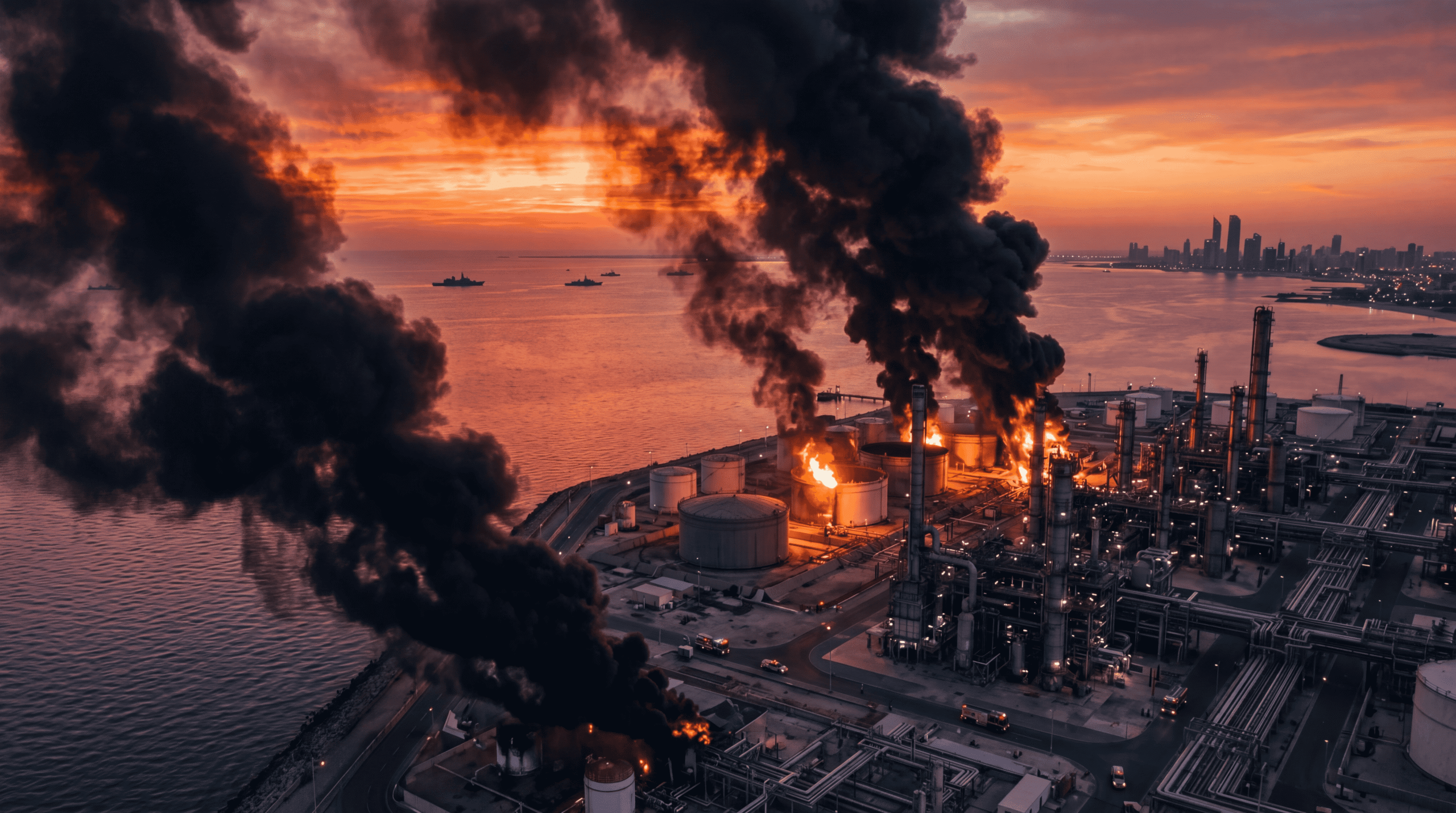

The strike on Abu Dhabi wasn’t just an attack—it was a message written in fire across the Gulf’s economic heartland. On day 66 of what historians will likely call the Second Hormuz Crisis, Iran crossed a threshold that regional powers spent three decades trying to avoid. By targeting United Arab Emirates energy infrastructure with precision-guided missiles, Tehran has formally ended the fiction that Gulf Arab states could remain neutral bystanders in a US-Iran confrontation.
This is no longer a containable border skirmish. What began as tit-for-tat naval harassment in the Strait of Hormuz has metastasized into the most dangerous confrontation in the Middle East since the 2003 Iraq invasion—with economic consequences that will be measured in trillions, not billions.
Why Iran Just Redrew the Map of Middle East Conflict
Iran’s calculus is brutal and clear: if Washington wants to strangle Iranian oil exports, Tehran will demonstrate it can choke the entire Gulf’s energy lifeline. The UAE processes nearly 3 million barrels per day through facilities that were struck yesterday. According to initial damage assessments from Brookings energy security analysts, even temporary disruption to these facilities removes roughly 3.5% of global oil processing capacity from the market.
But the real target wasn’t oil—it was psychology. The UAE, along with Saudi Arabia, has spent the past decade positioning itself as a stable alternative to Iran for regional influence. They’ve invested hundreds of billions in infrastructure explicitly designed to route energy flows around the Strait of Hormuz chokepoint. The Council on Foreign Relations’ analysis of regional energy security has long emphasized these bypass pipelines as insurance against exactly this scenario.
Iran just called that insurance policy worthless. If Tehran can strike Abu Dhabi with impunity, no Gulf infrastructure is safe—regardless of how far it sits from Iranian borders.
Trump’s Ultimatum: The Ghost of 1988 Returns
President Trump’s warning—delivered via Truth Social at 2:47 AM Washington time—carries historical weight that most coverage has missed. “Any attack on US commercial vessels will be met with immediate and overwhelming force,” he wrote, adding that “Iran’s leaders will be held personally responsible.”
This isn’t bluster. It’s a direct echo of Operation Praying Mantis in April 1988, when the Reagan administration destroyed roughly half of Iran’s operational naval fleet in a single day after the USS Samuel B. Roberts struck an Iranian mine. That operation remains the largest US naval engagement since World War II. Senior Iranian Revolutionary Guard commanders remember it vividly—it’s taught as a case study in asymmetric warfare limitations at their military academies.
But 2026 is not 1988. Iran’s military capabilities have evolved exponentially. According to Reuters’ documentation of Iranian missile capabilities, Tehran now possesses precision-strike weapons with 2,000-kilometer ranges and guidance systems accurate to within 10 meters. The Islamic Revolutionary Guard Corps has transformed from a guerrilla force into a technologically sophisticated military with demonstrated capability to strike targets across the entire Middle East.
More critically, Iran has spent two decades building redundant command-and-control systems precisely to survive a decapitation strike. Trump’s threat of holding “leaders personally responsible” sounds decisive, but Iran’s military structure is designed to function even if Supreme Leader Khamenei and the entire Guardian Council were eliminated. This institutional resilience is the bitter fruit of lessons learned from Qassem Soleimani’s assassination in 2020.
What This Means For You: Beyond $5 Gasoline
If you’re reading this in Berlin, Mumbai, or São Paulo, you might think this is someone else’s problem. You would be catastrophically wrong.
The Strait of Hormuz channels 21% of global petroleum supply. Even with US shale production and renewable energy growth, the world economy remains existentially dependent on this 21-mile-wide chokepoint. When Iran seized a British-flagged tanker in 2019, insurance premiums for Gulf shipping increased 300% within 72 hours. That was a single vessel detained for two months.
We are now facing the prospect of sustained military conflict that could close the Strait entirely for weeks or months. The Financial Times’ energy markets analysis suggests that a full closure would remove 18-20 million barrels per day from global markets—roughly 20% of worldwide consumption. The Strategic Petroleum Reserve, even at full capacity, covers about 35 days of US consumption alone. It does nothing for Japan, South Korea, or China, which depend on Gulf oil for 70-80% of their energy imports.
The ripple effects extend far beyond energy. European manufacturing—still recovering from the 2022 energy crisis—cannot absorb another supply shock. India’s inflation rate, currently at 4.8%, would likely breach 10% within months. China’s economic stimulus plans, already fragile, would collapse under the weight of energy costs doubling or tripling.
And for Americans? Even with domestic production, gasoline prices don’t exist in a vacuum. When global oil prices spike, US prices follow—typically with a 2-3 week lag. The last time oil hit $150 per barrel (2008), the US entered its deepest recession since the 1930s. We are currently at $112 and climbing.
The Escalation Ladder: Three Scenarios from Here
Scenario One: Managed De-escalation (Probability: 25%)
Backchannel negotiations—likely through Oman, which has maintained relations with both Washington and Tehran—produce a face-saving formula. Iran agrees to cease attacks on Gulf Arab infrastructure in exchange for limited sanctions relief and an explicit US commitment not to pursue regime change. The UAE accepts symbolic compensation and increased US security guarantees. Oil markets stabilize around $95-105 per barrel.
This requires both sides to value stability over victory. History suggests that’s the exception, not the rule, in Middle Eastern conflicts.
Scenario Two: Limited War (Probability: 50%)
The current trajectory continues: escalatory strikes and counterstrikes that remain below the threshold of full-scale war but above the threshold of mere posturing. US forces conduct systematic degradation of Iranian naval and missile capabilities. Iran responds with attacks on Gulf infrastructure, cyber operations against US financial systems, and activation of proxy forces in Iraq, Syria, and Yemen. The Strait closes intermittently—3-5 days at a time—sending oil prices oscillating between $120-180 per barrel.
This is the 2026 version of World War I’s trench warfare: devastating, economically ruinous, and with no clear path to resolution. It could persist for 18-24 months before either exhaustion or accident forces a resolution.
Scenario Three: Regional Conflagration (Probability: 25%)
An accident or miscalculation triggers full-scale war. The most likely trigger: an Iranian anti-ship missile striking a US destroyer with significant casualties, or a US strike inadvertently killing Chinese or Indian nationals on a commercial vessel. Once American or allied casualties reach triple digits, domestic political pressure makes de-escalation nearly impossible.
Regional war draws in Israel (which has its own Iran score to settle), risks Hezbollah opening a northern front, and could pull in Russia (which has defense agreements with Iran) and China (which cannot afford to lose access to Gulf energy). This is the scenario that keeps national security advisors awake at night—not because it’s likely, but because it’s not impossible.
What Happens Next: The 72-Hour Window
The next three days are critical. Iran’s strike on the UAE was calibrated to inflict economic pain without causing mass casualties—only four workers were killed, all third-country nationals. This suggests Tehran still wants to leave room for negotiation.
But Trump’s public ultimatum has created a domestic political trap for himself. If Iran tests his red line by harassing US commercial shipping, he must respond or appear weak in an election year. If he responds with disproportionate force, he owns the economic consequences of $150 oil during an already fragile economic recovery.
Watch three indicators in the coming week:
First, does the UAE request activation of Article 5-equivalent provisions in its defense agreements with Washington? If yes, the US is formally committed to treating attacks on Emirati territory as attacks on American interests.
Second, do insurance underwriters suspend coverage for Gulf shipping entirely? If major Lloyd’s syndicates declare the region uninsurable, the economic impact arrives before a single additional shot is fired.
Third, does China send naval vessels into the Gulf under the pretext of protecting its energy security? Beijing has historically stayed out of Middle Eastern military affairs, but it cannot afford to be a bystander if its energy lifeline is severed.
The Historical Parallel Everyone Missed
The closest historical analogue isn’t 1988 or even the Tanker War of the 1980s. It’s the 1973 oil crisis—but in reverse.
In 1973, Arab oil producers weaponized supply to punish the West for supporting Israel. The embargo lasted six months, quadrupled oil prices, and triggered a decade of stagflation in advanced economies. But critically, the Arab states were choosing not to sell oil—they had agency and control.
In 2026, Iran is demonstrating that it can prevent everyone from selling oil through the Gulf, regardless of their preferences. This is a different—and more dangerous—form of energy warfare. It converts the Gulf’s greatest economic asset into a shared vulnerability that no amount of military spending can fully protect.
Saudi Arabia and the UAE built their modern states on the promise that they could guarantee stable energy flows to global markets. Iran is systematically disproving that guarantee, not to conquer territory, but to establish that no regional order can function without accommodating Iranian interests.
The Verdict: Deterrence Has Failed
Here’s the uncomfortable truth that most analysis won’t state clearly: the existing security architecture of the Persian Gulf has collapsed. Decades of US military presence, tens of billions in arms sales to Gulf monarchies, and elaborate missile defense systems have not prevented Iran from striking at will into the heart of the region’s economic infrastructure.
The UAE attack proves that Iran has solved the targeting problem, the delivery problem, and the political will problem. The only question remaining is whether they’ve solved the consequences problem—whether they can absorb US retaliation and continue functioning as a state.
Trump’s threat suggests Washington believes the answer is no. But if four decades of sanctions, assassination campaigns, and military pressure haven’t broken Iran’s government, it’s unclear what remaining leverage could prove decisive without triggering the regional war everyone claims to want to avoid.
The crisis that began 66 days ago isn’t approaching its climax—it’s entering a new phase where the only certainty is that the old rules no longer apply, and the new rules haven’t been written yet.