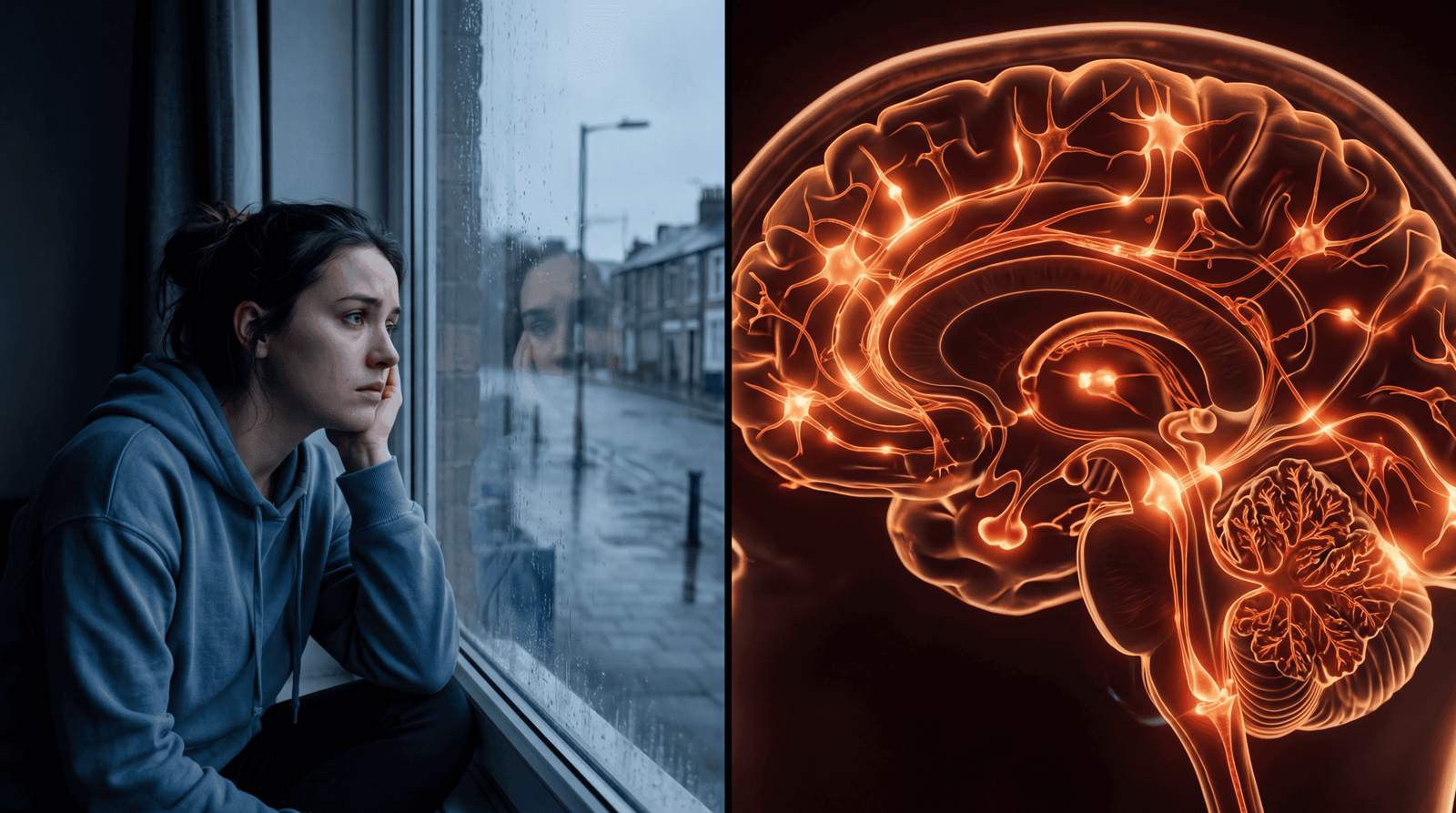

Here’s what nobody wanted to admit in March 2020: we weren’t just facing a virus. We were about to undergo the largest uncontrolled psychological experiment in human history. And five years later, the results are in—and they’re not what you think.
I’ve spent fifteen years studying how people make decisions under uncertainty. Nothing in my training prepared me for what I witnessed during the pandemic. Not the scale of the mental health crisis—that was predictable. What shocked me was how specific psychological mechanisms, ones we barely understood before 2020, suddenly became the dominant forces shaping millions of lives simultaneously.
The Psychological Siege: What Isolation Actually Does to Your Brain
When the World Health Organization reported a 25% global increase in anxiety and depression during the pandemic’s first year, most people read it as a statistic. I read it as evidence of mass neurological reorganization.
Here’s what was actually happening in your brain during lockdown: prolonged social isolation doesn’t just make you feel lonely. It triggers what neuroscientists call “threat vigilance hypersensitivity”—your amygdala essentially gets stuck in overdrive, scanning for dangers that aren’t there. This isn’t weakness. This is your brain doing exactly what evolution designed it to do when separated from the tribe.
The mechanism is called social baseline theory, and it explains why Zoom happy hours felt so exhausting. Your brain evolved to regulate emotion through physical proximity to other humans. Take that away, and you’re essentially asking your nervous system to run on backup generators 24/7. Research published in Psychiatry Research found that even people without prior mental health issues showed measurable changes in cortisol patterns and emotional regulation capacity after just eight weeks of isolation.
The Cognitive Bias That Made Everything Worse
But isolation wasn’t the only psychological mechanism at play. The pandemic activated something called uncertainty intolerance—and it hit some people like a freight train.
Uncertainty intolerance is exactly what it sounds like: your brain’s inability to function normally when it can’t predict what’s coming next. Under normal circumstances, about 15-20% of the population has high uncertainty intolerance. During the pandemic? That number appeared to skyrocket across entire populations.
I watched this play out in my own practice. Patients who’d never experienced anxiety suddenly couldn’t sleep because they were catastrophizing about scenarios six months out. Why? Because the pandemic removed all the little certainties that normally keep uncertainty intolerance in check—knowing when you’d see friends again, whether your job was secure, even what the next week would look like.
A study in the Journal of Anxiety Disorders found that individuals with high uncertainty intolerance were 3.2 times more likely to develop clinical anxiety during the pandemic, regardless of their actual COVID exposure risk. Your brain wasn’t responding to the virus—it was responding to the absence of predictable patterns.
Why Teen Girls Suffered Most: The Invisible Mechanism
When mental health emergency visits among teen girls increased 22.1% compared to pre-pandemic baselines, most explanations focused on social media or academic pressure. They missed the real mechanism: identity foreclosure under duress.
Adolescence is when your brain is actively constructing your adult identity through social experimentation. You try on different versions of yourself in different contexts—at school, with friends, in activities. The pandemic didn’t just disrupt this process. It froze it mid-construction.
For teenage girls in particular, whose identity development research shows is more relationally dependent than boys’, this created a perfect storm. Depressive symptoms rose from 47% to 57% in adolescent females between 2019 and 2021, while boys’ rates barely budged (27% to 29%).
This wasn’t about girls being “more emotional.” It was about a specific developmental process being disrupted at the exact wrong time. Your identity doesn’t just wait patiently for the world to reopen. It either develops in unhealthy isolation or it stalls—and stalled identity development looks clinically identical to depression.
The Survivors Nobody Talked About
Here’s something that got buried in the news cycle: COVID-19 survivors showed dramatically higher rates of depression (45% vs. 33%), anxiety (47% vs. 31%), and sleep disturbances (34% vs. 20%) compared to people who never had COVID.
This isn’t just about trauma from being sick. There’s emerging evidence of a mechanism called post-viral neuroinflammation—essentially, the virus triggers an inflammatory response in your brain that persists long after the physical illness resolves. Research in Nature Neuroscience found measurable changes in microglial activation (your brain’s immune cells) in COVID survivors up to a year after infection.
Translation: for millions of people, the mental health impact wasn’t psychological at all. It was neurological. Your brain was physically different after COVID, and nobody told you that depression and anxiety might be symptoms of biology, not just “having a hard time.”
The Groups We Failed Completely
The pandemic revealed something ugly about how our brains handle collective crisis: we default to in-group bias amplification. When threats increase, we unconsciously narrow our circle of concern to people who look and live like us.
This showed up in the data in devastating ways. Suicide rates among Black residents in Maryland doubled during the pandemic, while rates among white residents nearly halved. Healthcare workers faced exponentially higher rates of suicidal ideation than the general population. People with pre-existing mental health conditions saw their mortality risk from COVID skyrocket—not just from the virus, but from systemic abandonment.
This wasn’t an accident. This was predictable psychology: when resources feel scarce, we instinctively protect “us” and deprioritize “them.” The pandemic didn’t create these biases. It just removed the social constraints that normally keep them partially in check.
The Research Says: Some Changes May Be Permanent
Five years out, longitudinal studies are revealing something crucial: not everyone bounced back. Research published in American Psychologist tracking the same individuals from 2020 through 2024 found that approximately 30% of people who developed anxiety or depression during the pandemic still met clinical criteria years later—even after returning to “normal” life.
Why? Because of something called neuroplasticity consolidation. When your brain operates in a heightened threat state for months or years, those neural patterns don’t just disappear when the threat ends. They get reinforced, consolidated, encoded as your new baseline.
Think of it like this: if you spent two years training your brain to scan for threats, to catastrophize, to isolate—congratulations, you got very good at those things. And your brain doesn’t automatically unlearn skills just because you don’t need them anymore.
A massive study in The Lancet Psychiatry analyzing mental health data from 204 countries found that the pandemic’s psychological impact showed distinct “persistence patterns” varying by age, gender, and pre-existing conditions—suggesting we’re not dealing with one mental health crisis, but dozens of overlapping ones with different trajectories.
The Unexpected Silver Lining Nobody Saw Coming
Here’s the part that surprised me most: the pandemic did produce one genuinely positive psychological shift. It shattered the stigma barrier around mental health in ways decades of awareness campaigns never managed.
When telemedicine encounters surged 766% in the first months of the pandemic, something more important than convenience happened: people who would never have walked into a therapist’s office suddenly found themselves in virtual sessions. The barrier to entry collapsed.
This activated what psychologists call normalization through universal experience. When everyone is struggling, struggling stops feeling like personal failure. The shame mechanism that keeps most people from seeking help? It requires feeling uniquely broken. The pandemic made mental health struggles feel universal—and that universality might be its most lasting gift.
Research on adolescent technology use during isolation found that virtual connections, while not equivalent to in-person interaction, did provide measurable protective effects against depression—but only when used intentionally for connection, not passive consumption.
What Your Brain Actually Learned
The pandemic taught your brain some things worth keeping and some things desperately worth unlearning. The trick is knowing which is which.
Worth keeping: increased awareness of your mental health needs, reduced shame around asking for help, appreciation for the psychological necessity of social connection, recognition that uncertainty is survivable.
Worth unlearning: hypervigilance as a default state, isolation as a safety strategy, catastrophizing as a planning tool, constant threat-scanning as normal.
The neuroscience is clear on this: your brain is still plastic. Those pandemic-era neural patterns aren’t permanent unless you keep practicing them. Recent work in Molecular Psychiatry demonstrates that targeted cognitive interventions can measurably reshape threat-response patterns even years after traumatic periods—but only with conscious, sustained effort.
Try This Today: The One Thing That Actually Rewires Threat Response
If you take one thing from this article, make it this: practice micro-doses of uncertainty.
Your brain’s threat response system is like a muscle—it responds to training. If the pandemic trained it to treat all uncertainty as danger, you need to deliberately retrain it. Here’s how: once per day, create a small situation where you genuinely don’t know the outcome and practice tolerating that feeling.
Examples: Take a new route to work without GPS. Try a restaurant without reading reviews first. Start a conversation without planning what you’ll say. Text a friend without having a specific reason.
The key is keeping the uncertainty small enough to be manageable but real enough to activate your nervous system slightly. You’re teaching your brain: uncertainty exists, I survived it, not everything uncertain is dangerous. Research in Behaviour Research and Therapy shows this kind of graduated exposure to uncertainty can measurably reduce anxiety symptoms in as little as four weeks.
Do this daily for a month, and you’re not just feeling better—you’re literally rewiring the neural pathways that keep you stuck in pandemic-era threat response.
What We Still Don’t Know
Five years later, we’re still discovering how the pandemic changed us. Longitudinal studies published in Science are now tracking pandemic cohorts into their second decade, trying to understand whether children who spent formative years in lockdown show lasting differences in social cognition, emotional regulation, or stress response.
We don’t know yet if the teenagers who missed crucial identity development windows will show different patterns of adult relationships. We don’t know if the healthcare workers who operated under sustained crisis conditions will show accelerated burnout trajectories decades from now. We don’t know if the millions who experienced that 25% spike in anxiety and depression will be more or less resilient to future crises.
What we do know: the pandemic didn’t just happen to us. It rewired us. And the most important question isn’t what it did—it’s what you’re going to do with the brain you have now.
Your brain after the pandemic isn’t broken—it’s a survival machine that learned to survive something unprecedented, and some of those lessons are exactly what’s keeping you stuck.