



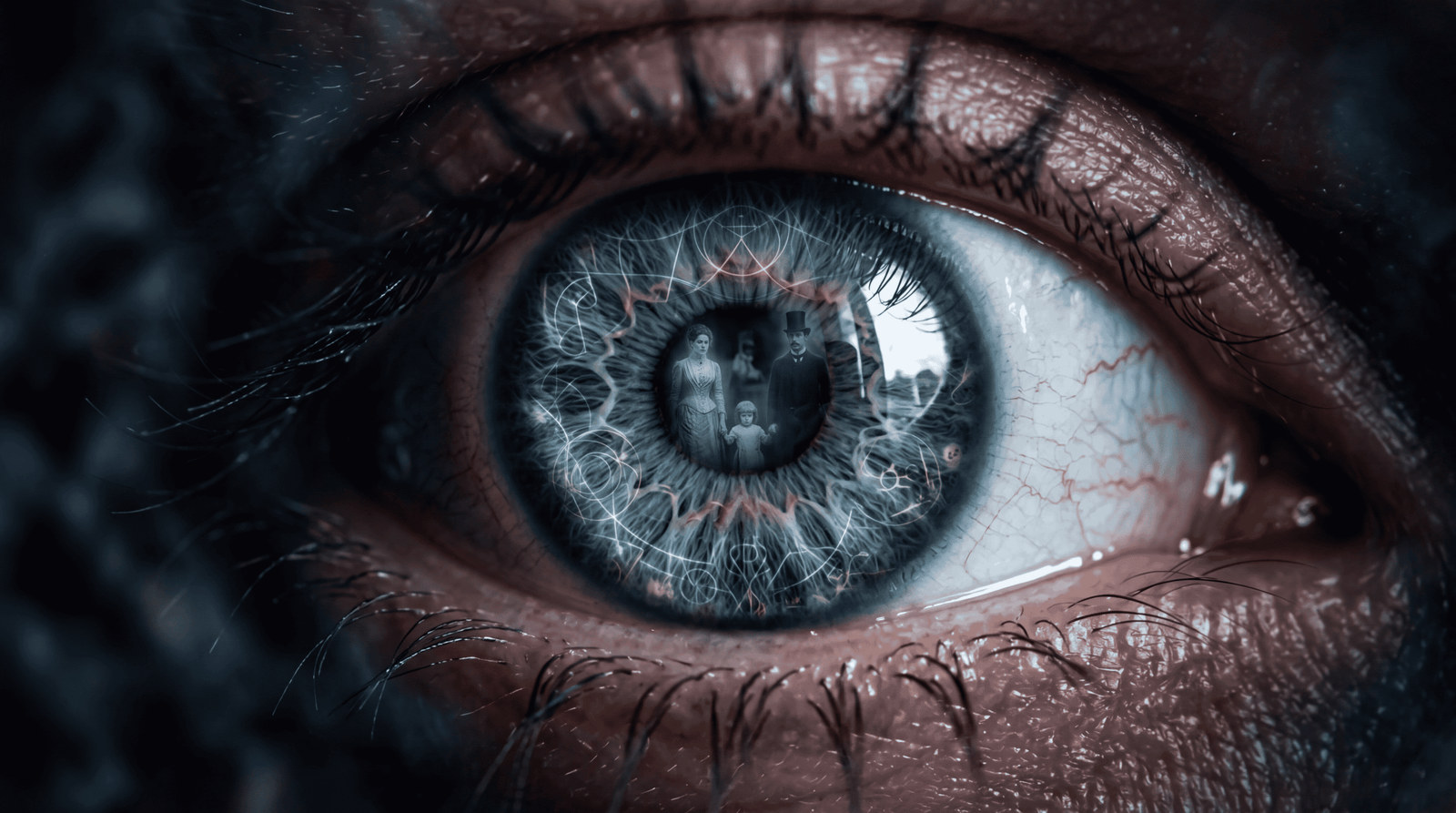

Here’s something most people refuse to believe until it happens to them: lose your vision, and your brain will start inventing what you see. Not metaphorically. Literally. You’ll see dragons, people in Victorian dress, geometric patterns that move like they’re alive—and you’ll know, with complete certainty, that none of it is real.
This is Charles Bonnet Syndrome, and it reveals one of the most unsettling truths about human consciousness: your brain would rather hallucinate than experience nothing at all.
What Charles Bonnet Syndrome Actually Is
Charles Bonnet Syndrome (CBS) occurs when people with significant vision loss begin experiencing vivid, complex visual hallucinations despite having full insight that what they’re seeing isn’t real. Unlike hallucinations caused by psychiatric conditions or drug use, people with CBS maintain complete awareness that their perceptions are false.
The syndrome typically affects older adults who’ve lost vision from conditions like age-related macular degeneration, glaucoma, diabetic retinopathy, or stroke affecting the visual system. Recent research published in JAMA Ophthalmology suggests CBS may affect up to 40% of people with severe vision impairment—far more common than previously estimated.
What makes CBS psychologically fascinating isn’t just that it happens. It’s what it tells us about how perception actually works.
The Psychological Mechanism: When Your Brain Fills the Void
Your brain is not a passive recorder of reality. It’s a prediction machine constantly generating its best guess about what’s out there based on incoming sensory data. When that data stream suddenly stops or dramatically reduces, something remarkable happens: the brain keeps predicting anyway.
This is called perceptual release phenomenon—a mechanism where the visual cortex, deprived of input from the eyes, begins generating its own content from stored visual memories and pattern templates. Think of it like a radio station: when the signal cuts out, you don’t hear silence, you hear static. CBS is your brain’s version of static, except instead of noise, it’s pulling from your visual memory bank.
Research from the Visual Neuroscience Laboratory shows that the hallucinations in CBS activate the same brain regions involved in normal visual perception. Your occipital cortex—the vision-processing center—is genuinely active during these episodes. You’re not imagining that you’re seeing something. You’re actually seeing something your brain manufactured.
This is eerily similar to phantom limb syndrome, where people feel sensation in amputated body parts. In both cases, the brain’s representation of the world includes elements that no longer exist in physical reality. The difference? People with CBS know their perceptions are false. That insight—that metacognitive awareness—is what separates CBS from psychosis.
What People Actually See
The content of CBS hallucinations varies dramatically, but certain patterns emerge repeatedly. People report seeing:
Geometric patterns: Repeating grids, dots, lines, or tessellated shapes that move and shimmer. These are thought to come from the spontaneous firing of neurons in the visual cortex’s early processing areas, which are organized to detect edges and patterns.
Faces and figures: People in period costume, children playing, or anonymous figures walking by. The brain’s fusiform face area—specialized for face recognition—may be generating these images when deprived of actual faces to process.
Landscapes and scenes: Mountains, waterfalls, gardens, or entire streetscapes. These complex scenes suggest activation of higher-level visual processing areas that normally integrate spatial information.
Animals and creatures: Cats, birds, insects, or sometimes fantastical creatures like dragons. One study in Psychosomatics found that animal hallucinations were particularly common in people with peripheral vision loss.
The hallucinations can last seconds or hours. They may appear in color or black-and-white. They can be pleasant—one patient described regular visits from a friendly Victorian lady—or disturbing, like swarms of insects crawling on walls.
What’s psychologically crucial: people with CBS don’t interact with their hallucinations or believe them to be real, even momentarily. They observe them with a kind of detached curiosity, like watching a movie they didn’t choose to play.
The Psychological Effects: Living With a Brain That Shows You Lies
The emotional impact of CBS varies dramatically based on one factor: whether people understand what’s happening to them.
The relief of diagnosis: Many people with CBS suffer silently for months or years because they fear the hallucinations mean they’re “going crazy.” Research from the American Psychological Association shows that simply receiving the diagnosis—learning there’s a name for this, that it’s caused by vision loss, not mental illness—produces immediate reduction in anxiety and distress.
Social isolation: People often stop talking about their hallucinations out of fear of being stigmatized or institutionalized. This secrecy creates profound loneliness. You’re experiencing something vivid and sometimes disturbing, but you can’t share it with anyone. The psychological term for this is private suffering—when fear of judgment prevents people from seeking support for manageable conditions.
Cognitive dissonance: There’s something deeply unsettling about seeing something so clearly and simultaneously knowing it’s not real. This creates a form of perceptual cognitive dissonance—your visual system and your reasoning system are giving you contradictory information. Over time, most people adapt, but initially it can feel destabilizing.
Unpredictable triggers: For some, hallucinations occur mainly when waking up or in dim lighting. For others, they’re unpredictable, which creates a low-level hypervigilance—you’re never quite sure when your brain will start its own show. This unpredictability can be more distressing than the hallucinations themselves.
The Research Says
A 2023 systematic review in Eye analyzed 25 studies on CBS prevalence and found that awareness of the condition—among both patients and healthcare providers—remains strikingly low. Only about 30% of people experiencing CBS symptoms discuss them with their doctors, primarily out of fear of being labeled mentally ill.
Neuroimaging research published in Brain has shown that CBS hallucinations involve activation of the ventral visual stream—the “what” pathway responsible for object recognition. This suggests the brain isn’t just producing random noise; it’s accessing stored visual representations of real objects and scenes.
A fascinating 2022 study from Frontiers in Aging Neuroscience found that people with CBS who engaged in regular conversation about their hallucinations—either with family members or support groups—reported significantly lower distress levels than those who kept their experiences private. The hallucinations didn’t decrease in frequency, but their psychological impact diminished.
Perhaps most importantly, CBS hallucinations don’t progress to psychiatric conditions. They remain stable or sometimes decrease over time as the brain adapts to vision loss. This distinguishes CBS from early signs of dementia or psychiatric illness, though the differential diagnosis can be challenging.
Why Your Brain Chooses Hallucination Over Nothing
Here’s the deeper psychological insight: CBS reveals that your brain has a fundamental intolerance for sensory deprivation. Given the choice between accurate perception of nothing and inaccurate perception of something, your brain will choose the something every time.
This isn’t a bug—it’s a feature. Throughout human evolution, missing important visual information was more dangerous than occasionally perceiving things that weren’t there. Your ancestors who hallucinated a predator that didn’t exist survived more often than those who failed to see the predator that did. CBS is your visual system running its evolutionary programming in an environment it wasn’t designed for: sudden, dramatic sensory deprivation in the absence of actual danger.
The syndrome also exposes the constructed nature of all perception. What you’re seeing right now—the screen, the room around you, the lighting—isn’t a direct representation of reality. It’s your brain’s best interpretation of fragmentary sensory data, filtered through expectations, memories, and attentional focus. CBS just makes this process visible by removing the usual constraint: actual input from the eyes.
Try This Today
If you or someone you know experiences visual hallucinations with vision loss, try this simple technique that leverages your brain’s attentional systems: rapid eye movement exercise.
When a hallucination appears, deliberately move your eyes left-right, up-down, without moving your head—quick, purposeful movements. Many people with CBS report this interrupts the hallucination, likely because voluntary eye movements require top-down attention that disrupts the spontaneous activity in visual areas generating the hallucinations.
Even if it doesn’t stop the hallucination immediately, the exercise gives you agency—a sense that you’re not passively victimized by your brain’s misfiring, but actively managing it. That psychological sense of control matters as much as the technique itself.
The Bottom Line
Charles Bonnet Syndrome isn’t a failure of your brain—it’s your brain doing exactly what it’s designed to do when suddenly deprived of visual information. Understanding this transforms the experience from something frightening to something fascinating: evidence that your mind would rather create reality than experience its absence.
Your brain, it turns out, is a storyteller that never stops telling stories, even when there’s nothing left to see.