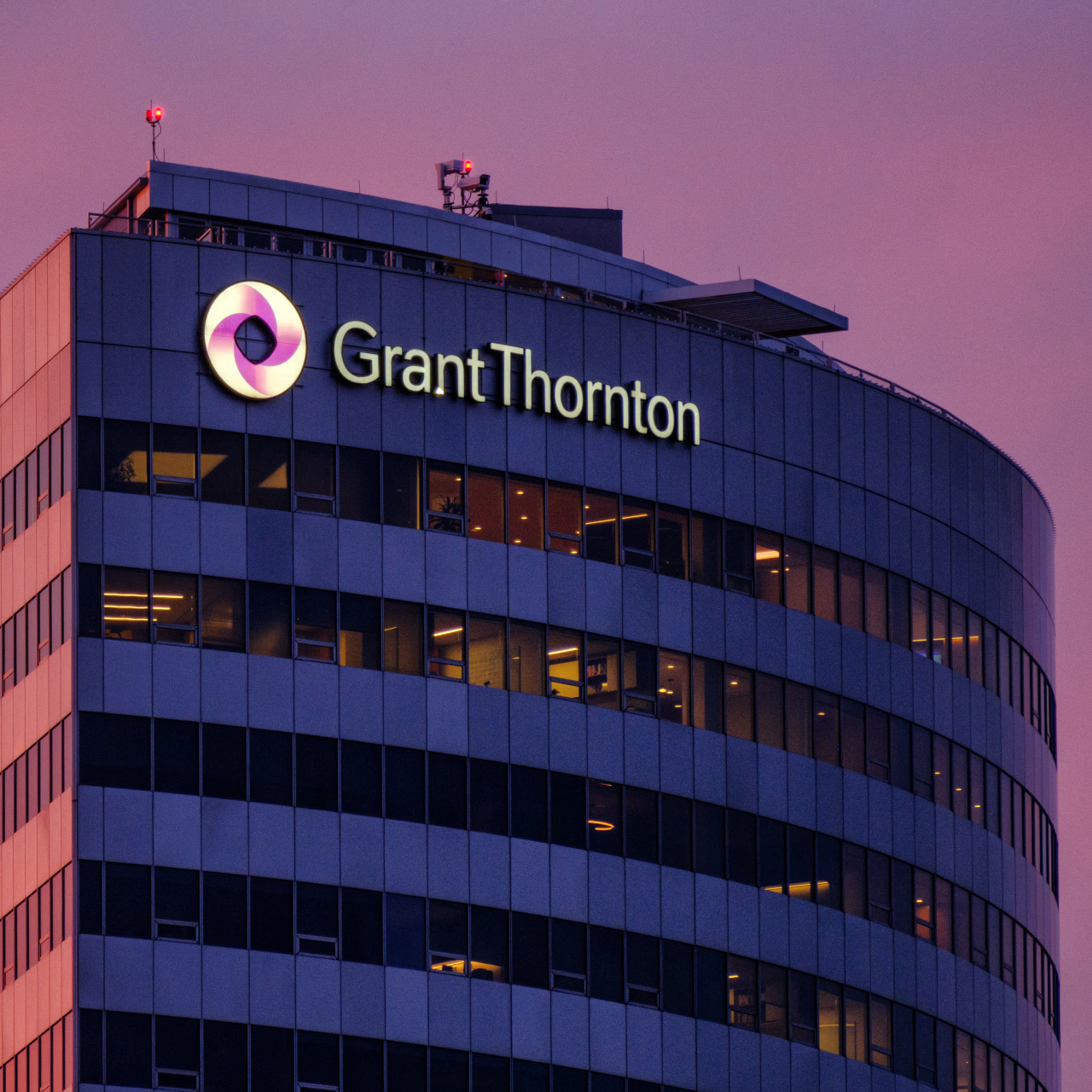

Major consulting firm Grant Thornton has taken an unprecedented step in the professional services industry by directly linking partner bonuses to their adoption and implementation of artificial intelligence tools. The strategic initiative, which affects the firm’s most senior staff members across its US operations, represents one of the most aggressive approaches yet to ensuring AI integration in the consulting sector.
The new compensation structure went into effect in January 2024, marking a fundamental shift in how the $8.5 billion global firm evaluates and rewards its leadership. Under the revised system, partners must demonstrate measurable progress in four key strategic areas, with AI adoption playing a central role in their annual performance reviews and year-end compensation.
**The Architect Behind the Change**
Leading this transformation is Tom Puthiyamadam, who joined Grant Thornton in April 2023 as the US head of advisory services after spending 28 years at PwC. His appointment reflects a broader industry trend where senior executives are leaving established Big Four firms to pursue more dynamic opportunities at mid-market players.
Puthiyamadam brings ambitious plans to position Grant Thornton as the dominant force in the middle market, specifically targeting companies with revenues between $500 million and $10 billion. His strategy centers on two fundamental pillars: aggressive technology adoption and expanded deal-making capabilities.
**Understanding the New Performance Framework**
The revised scorecard system evaluates partners across four strategic dimensions. First, commercial performance measures how effectively partners identify and develop successful client relationships. Second, partners must demonstrate their ability to deliver AI solutions to market and develop innovative applications that benefit clients. Third, the framework assesses how partners elevate and develop talent within their teams. Finally, partners must show concrete evidence of leveraging AI in their daily operations and service delivery.
While traditional financial targets and quality standards remain baseline requirements, the message is clear: AI adoption is no longer optional. Partners who fail to demonstrate any progress in AI implementation face serious consequences, regardless of their performance in other areas. Even doubling revenue won’t fully compensate for complete neglect of AI initiatives, though the evaluation process does consider overall performance holistically.
**Strategic Reasoning and Industry Context**
The consulting industry is experiencing a fundamental transformation as artificial intelligence reshapes service delivery models, pricing structures, and talent requirements. Traditional consulting approaches are being challenged by AI-powered analytics, automated processes, and enhanced decision-making tools. Firms that fail to adapt risk losing market share to more technologically advanced competitors.
Puthiyamadam’s approach specifically targets what he identifies as the “frozen middle” – experienced managers who might resist technological change. By applying pressure at the partner level, he expects the strategic priorities to cascade throughout the organization. Junior staff, often arriving with expectations of working with cutting-edge technology, are already predisposed to embrace these tools.
This top-down approach differs from initiatives at other firms. KPMG, for instance, has implemented cash prizes for consultants who demonstrate exceptional AI usage, focusing on individual innovation rather than systematic adoption at the leadership level.
**Rapid Growth and Market Positioning**
The results of Puthiyamadam’s first year suggest the strategy is gaining traction. Grant Thornton’s advisory business has expanded from $680 million in domestic revenue to $1.5 billion as a multinational practice. The firm has aggressively recruited talent, bringing in nearly 40 partners from competitors including Deloitte, KPMG, Accenture, and AlixPartners, all selected for their digital expertise.
Recent acquisitions have strengthened the firm’s capabilities in commercial and financial due diligence, supporting its ambition to compete more effectively in transactions and transformation work. The firm is also working to better align its global network to enhance collaboration across regions.
**Implications for the Professional Services Sector**
Grant Thornton’s approach represents a calculated bet that AI will fundamentally alter the economics of consulting. While AI may reduce costs per unit of work, Puthiyamadam anticipates it will dramatically increase the volume of clients the firm can serve effectively. This volume play, combined with enhanced capabilities, forms the basis of his market share acquisition strategy.
The firm’s positioning is particularly noteworthy given its place in the competitive landscape. While Grant Thornton ranks among the top 10 global accounting firms, its consulting arm competes against formidable rivals including McKinsey, Bain, Boston Consulting Group, the Big Four, and specialized firms like Alvarez & Marsal and LEK Consulting.
**Looking Forward**
The success or failure of Grant Thornton’s AI-linked compensation model will likely influence how other professional services firms approach technology adoption. If the strategy delivers the anticipated results – increased market share, improved efficiency, and enhanced client outcomes – it could become a template for the industry.
For partners at Grant Thornton, the message is unambiguous: embrace AI or find another firm. This bold stance reflects a broader reality facing the consulting industry – the question is no longer whether to adopt AI, but how quickly and comprehensively firms can integrate these capabilities into their core operations.