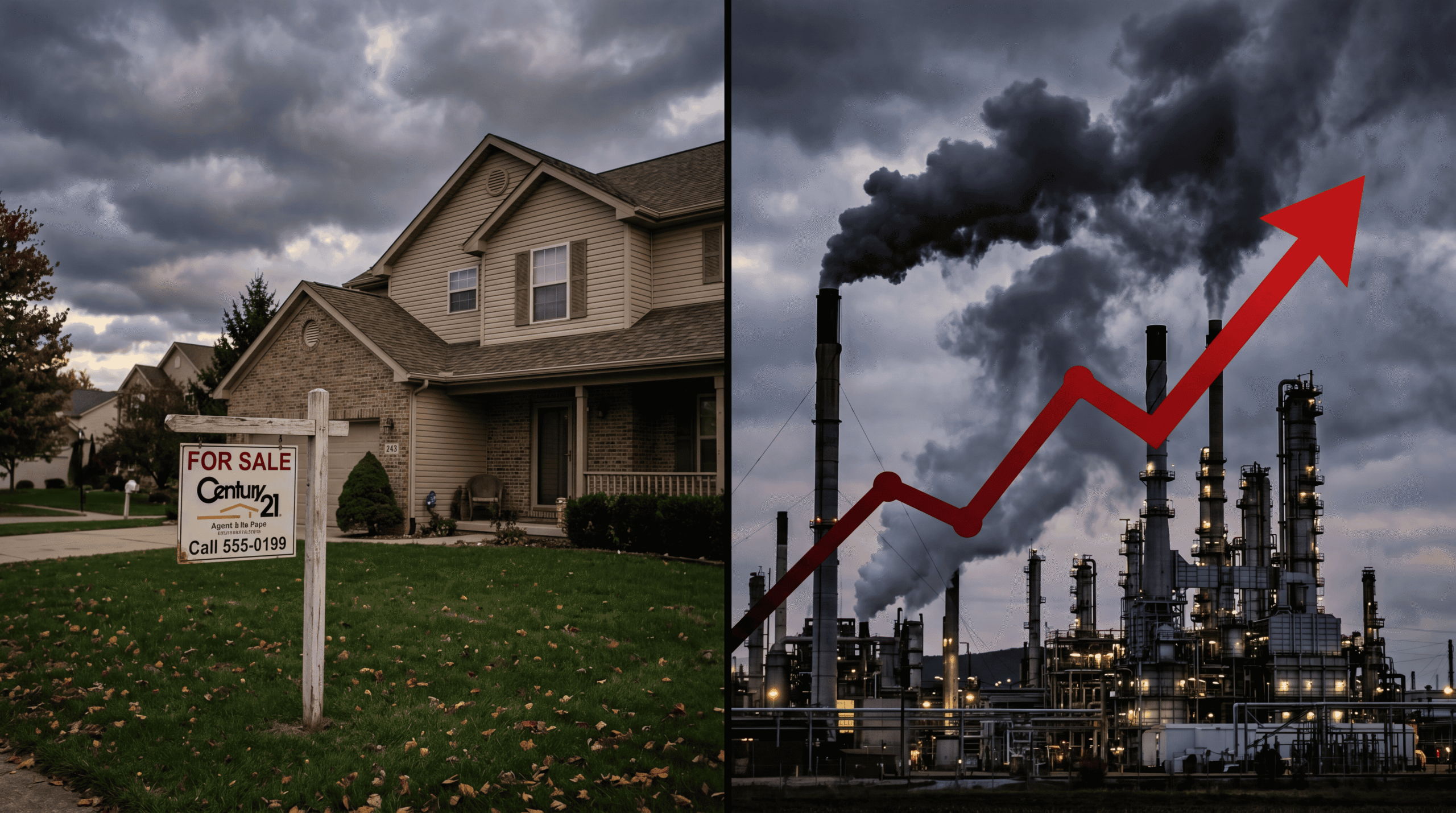

Here’s what Wall Street won’t tell you: the Iran conflict isn’t just about oil prices and defense stocks. It just made homeownership materially more expensive for every American, and the transmission mechanism reveals exactly how modern economies translate geopolitical shocks into kitchen-table pain.
US existing home sales collapsed 3.6% in March to 3.98 million units—the weakest print since last June—according to National Association of Realtors data. But that’s the symptom. The disease is what happened to mortgage rates the moment US-Israeli strikes hit Iranian infrastructure in February.
The 40-Basis-Point War Tax
Thirty-year fixed mortgage rates stood at 6.37% last week, up from 5.98% before the conflict erupted. That’s a 39-basis-point spike in eight weeks. Run the math on a median-priced home ($408,800), and that rate increase adds roughly $80 per month to mortgage payments—$28,800 over a typical loan’s life.
Multiply that by the roughly 4 million annual home sales the US was tracking toward, and you’re looking at $115 billion in additional debt servicing costs flowing through the residential real estate market. That’s not inflation. That’s a geopolitical risk premium being monetized in real time through the bond market.
The mechanism is straightforward: Iran conflict escalation triggers three simultaneous market reactions. First, IMF growth forecasts get revised downward as energy disruption scenarios get priced in. Second, inflation expectations rise as Brent crude trades above $95/barrel. Third—and this is the killer—Treasury yields climb because the Federal Reserve’s rate-cut timeline evaporates.
Why Central Banks Can’t Save You This Time
Under normal circumstances, weakening housing data would pressure the Fed to cut rates. But we’re not in normal circumstances. The Federal Reserve is trapped between conflicting mandates: support growth while containing inflation that could spike if Middle East energy supplies face sustained disruption.
This is post-Keynesian policy paralysis in action. When supply-side shocks dominate (war, energy disruption, supply chain fragmentation), traditional demand-management tools lose effectiveness. Cutting rates won’t conjure more oil or stabilize geopolitical risk. It will just add fuel to inflation expectations that are already running hot.
The 10-year Treasury yield—which mortgage rates track closely—has climbed 52 basis points since mid-February, according to US Treasury data. Bond markets are telling you they expect either higher inflation, higher risk premiums, or both. Mortgage lenders simply pass that through.
The Confidence Collapse Nobody’s Pricing
Here’s what makes this particularly dangerous: housing markets run on confidence, and confidence is evaporating. The University of Michigan consumer sentiment index has declined for three consecutive months. When potential homebuyers watch live footage of regional conflict and hear policy uncertainty from Washington, they don’t make leveraged 30-year bets.
Andrew Vallejo, a Redfin agent in Austin, told the BBC his clients “feel frozen.” That’s not irrational behavior—that’s proper risk assessment. In an environment where geopolitical shocks can materialize overnight and reshape economic conditions within weeks, delaying major financial commitments makes perfect sense.
The inventory situation amplifies this dysfunction. Total housing inventory remains 30% below pre-pandemic levels, according to NAR research. Sellers who were hoping for a “calmer” 2026 are now watching their equity appreciation stall as buyers vanish. The median home price rose just 1.4% year-over-year in March—barely ahead of general inflation.
What This Means For You
If you’re shopping for a house right now, you’re paying a war premium whether you realize it or not. That extra $80/month isn’t going to the seller, the bank’s profit margin, or even legitimate credit risk—it’s the market’s assessment of heightened macroeconomic uncertainty translated into your monthly payment.
If you’re a homeowner, your paper wealth isn’t growing like it was six months ago. Price appreciation has essentially stalled as affordability deteriorates and buyer psychology shifts defensive. The wealth effect that drives consumer spending gets weaker with every week this conflict extends.
If you’re a renter hoping to buy, the calculus just got worse. Not only are rates higher, but the Fed’s trapped position means we’re unlikely to see the rate cuts that were priced in for late 2026. The Brookings Institution recently noted that supply-side inflation episodes historically last longer and prove more persistent than demand-driven cycles.
The Energy Price Multiplier
What terrifies me as a macroeconomist isn’t the direct impact—it’s the second-order effects. If sustained Middle East instability pushes gasoline above $4.50/gallon nationally, you’re looking at a material hit to discretionary income. The same household that can barely afford a 6.37% mortgage will struggle even more when transportation costs eat another $150/month.
This is how geopolitical shocks become financial crises. Housing markets depend on employment stability. Employment depends on consumer spending. Consumer spending depends on real disposable income after energy costs. When energy prices spike, the whole chain weakens simultaneously.
The World Bank’s latest commodity outlook shows crude oil futures markets pricing in continued volatility through Q4 2026. That’s the market telling you this isn’t a short-term disruption—it’s a regime change in risk assessment.
What Happens Next: Three Scenarios
Scenario One: De-escalation (30% probability) – Diplomatic progress leads to conflict wind-down by June. Oil retreats to $75-80 range. Fed cuts rates twice in H2 2026. Mortgage rates drift back toward 6% by year-end. Housing market stabilizes with modest 2-3% price growth. This is the soft landing everyone’s hoping for but few are betting on.
Scenario Two: Containment (50% probability) – Conflict continues at current intensity without major escalation. Oil stays elevated at $85-95. Fed holds rates steady through 2026. Mortgage rates remain in 6.25-6.75% range. Housing market muddles through with flat prices and weak volume. This is the new normal—higher rates, lower activity, compressed affordability.
Scenario Three: Escalation (20% probability) – Regional conflict broadens, disrupting 2-3 million barrels/day of production. Oil spikes above $110. Inflation accelerates above 4%. Fed faces impossible choice between recession and runaway prices. Mortgage rates push above 7%. Housing market freezes completely with sales down 20%+ and prices falling in overleveraged markets. This is the tail risk that’s underpriced.
The Policy Failure Nobody Wants to Acknowledge
Here’s the uncomfortable truth: monetary policy was already poorly positioned before this conflict erupted. The Fed cut rates too slowly in 2023-2024, leaving real rates too high for too long. That created fragility in interest-rate-sensitive sectors like housing. When an external shock hits a fragile system, the damage propagates faster and farther.
The Bank for International Settlements has been warning about this dynamic for two years—central banks tightened financial conditions to fight inflation, but that left economies vulnerable to supply shocks. Now we’re watching that vulnerability play out in real time through the US housing market.
What’s particularly troubling is the distributional impact. Higher mortgage rates disproportionately affect first-time buyers and younger households with less equity. The wealth gap between homeowners (who locked in low rates in 2020-2021) and aspiring homeowners (facing 6%+ rates) is widening by the month. That’s not just an economic issue—it’s a social stability issue.
The Bottom Line
The housing market isn’t “frozen” because buyers are irrational or uninformed. It’s frozen because the risk-reward calculation for making a 30-year leveraged bet on US economic stability has fundamentally changed. When geopolitical shocks can add 40 basis points to borrowing costs in eight weeks, when oil markets can swing 25% in a month, when the Fed’s policy path depends on military developments in the Middle East—rational actors wait.
March’s sales data is backward-looking. Most of those deals were negotiated before the conflict escalated. April and May data will show the real impact. I expect existing home sales to fall below 3.8 million annualized—the weakest since the pandemic lockdowns—before we see any stabilization.
The American housing market just became a real-time barometer of geopolitical risk, and right now, it’s pricing in a world that’s materially less stable than the one we inhabited six months ago—and mortgage rates are just the beginning of how ordinary Americans will pay that price.