



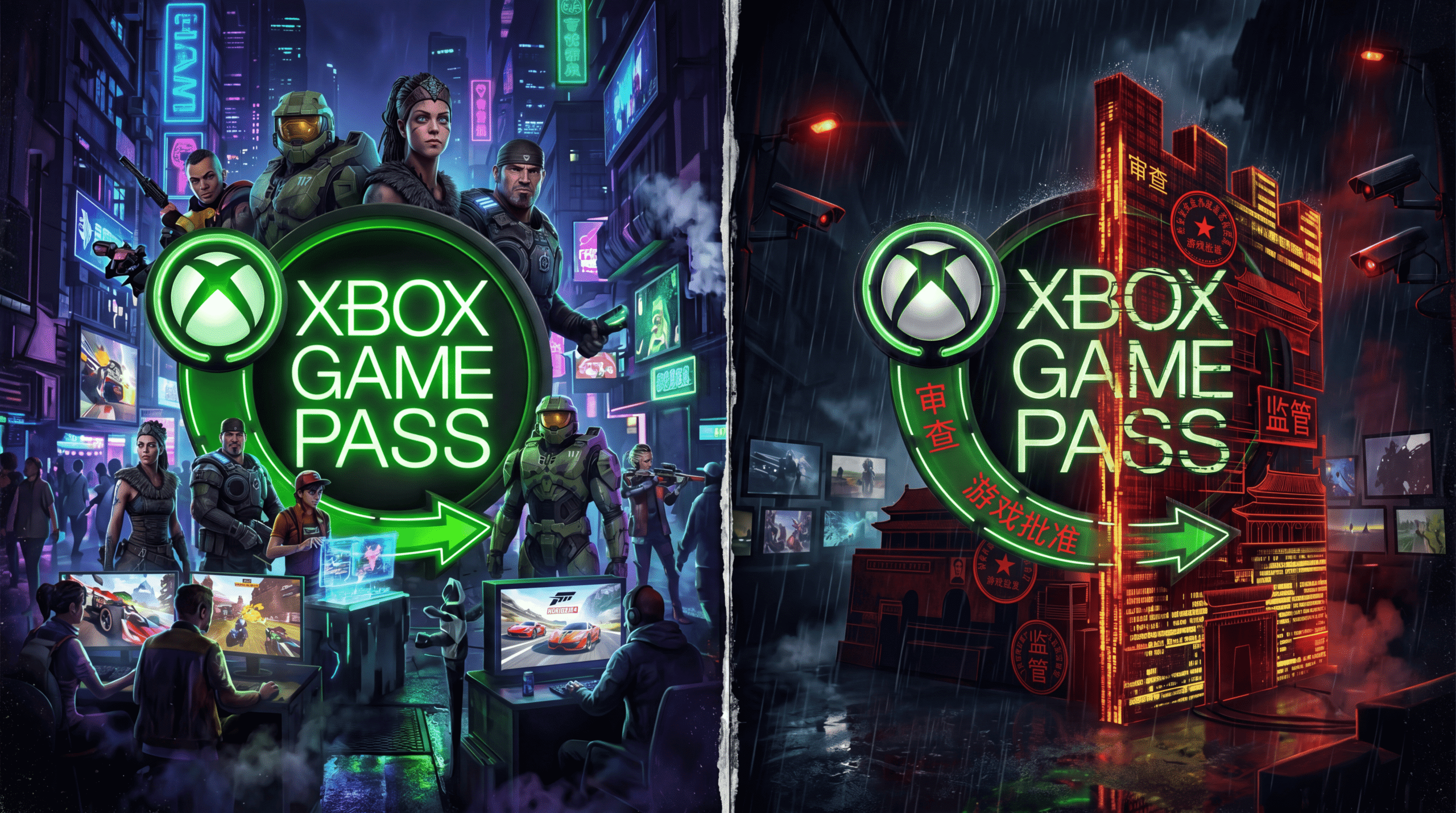

Microsoft quietly updated the Xbox PC app with references to China, and if you think this is just about expanding a subscription service, you’re missing the real story. This is Microsoft admitting that its entire Game Pass strategy needs a geographic reboot—and that the company finally understands it can’t export Western gaming infrastructure to the world’s largest gaming market without fundamental architectural changes.
The tech press is treating this as a simple market expansion. It’s not. It’s Microsoft acknowledging that cloud gaming and subscription services hit a wall when regulatory reality meets technical infrastructure.
What The App Code Actually Reveals
The Xbox PC app now contains strings referencing China-specific features, but here’s what matters: Microsoft isn’t just translating menus. The code references separate infrastructure endpoints, different content delivery networks, and what appears to be a completely isolated authentication system. This isn’t localization—it’s building a parallel platform.
Why does this matter? Because Microsoft’s Azure cloud gaming infrastructure doesn’t exist in China the way it does elsewhere. Chinese law requires foreign cloud services to partner with domestic companies and store all data within the country’s borders. Microsoft can’t just flip a switch and make Game Pass work in Shanghai the way it works in Seattle.
The real technical signal here: Microsoft is building what amounts to Xbox Game Pass 2.0 for China, with completely separate backend systems. That architecture will eventually become the template for other markets with data sovereignty requirements—India, Brazil, potentially the EU under future regulations.
The Content Licensing Nuclear Problem
Here’s the part every article is ignoring: Game Pass’s entire value proposition is its library. The Ultimate tier gives you access to hundreds of games. But Chinese gaming regulations require every single game to receive approval from the National Press and Publication Administration before release. That process takes months, sometimes years, and frequently results in content being blocked entirely.
Microsoft’s internal calculation probably looks like this: even if they get Game Pass approved in China, they might launch with 30-50 games instead of 300+. That fundamentally breaks the subscription value equation. At that point, you’re not selling Game Pass—you’re selling something that uses the same brand but delivers a completely different product.
The smart technical move would be to treat China as its own SKU entirely. Different pricing, different library, different infrastructure. But that creates a precedent Microsoft desperately wants to avoid: admitting that Game Pass isn’t a global platform, it’s a collection of regional platforms that happen to share branding.
Who Actually Wins And Loses
Winners: Tencent and NetEase. If Microsoft enters China with Game Pass, it will almost certainly need to partner with one of these companies to handle operations, payment processing, and regulatory compliance. That partnership gives Chinese companies deep insight into Microsoft’s cloud gaming technology stack and business model—insight they’ll use to build competitive products.
Sony loses harder than you’d think. PlayStation has barely made a dent in China compared to PC and mobile gaming. If Microsoft establishes Game Pass as the subscription gaming standard in China, Sony’s console-first approach becomes even less relevant in the world’s biggest gaming market.
Indie developers lose. The games most likely to clear Chinese regulatory approval are big-budget titles from established publishers. The weird, experimental games that make Game Pass interesting in Western markets won’t make the cut. China’s Game Pass will look more like EA Play than the current Ultimate library.
What The Press Got Wrong
Every article about this treats it as a pure business expansion story. But this is actually a technical capitulation. Microsoft spent years promoting Xbox Cloud Gaming as a unified global platform—you’d be able to play the same games on the same service anywhere with an internet connection.
That vision is dead. The China expansion reveals that cloud gaming has the same geographic fragmentation problems as every other internet service. There is no global cloud gaming platform. There are only regional implementations of a cloud gaming concept, each constrained by local infrastructure, regulation, and content restrictions.
The technical reality is brutal: Microsoft will need separate server infrastructure, separate game libraries, separate CDN arrangements, and separate business partnerships for every major market with data sovereignty requirements. The scale advantages of cloud gaming—consolidating compute in massive data centers—get eroded by regulatory requirements that force geographic distribution.
The Disc-To-Digital Distraction
The other feature discovered in the app code—disc-to-digital conversion—is interesting but secondary. It’s Microsoft acknowledging that physical game ownership remains important to Chinese consumers, who are skeptical of subscription services after years of games and content disappearing from platforms due to regulatory changes.
The technical implementation would likely work like this: scan your physical disc, verify ownership through Xbox servers, add the digital license to your account. But here’s the catch—this only works if publishers agree to honor physical licenses. In China, that’s a complicated negotiation involving both international publishers and their Chinese partners.
The Real Infrastructure Challenge
China’s internet infrastructure is fundamentally different from the West’s. The Great Firewall isn’t just censorship—it’s a technical architecture that adds latency to international connections and requires domestic caching of content. Cloud gaming already struggles with latency in ideal conditions. In China, you’re adding 50-200ms of additional latency for any content that needs to traverse the firewall.
Microsoft’s only viable option is to host everything domestically. That means building out data centers specifically for Game Pass, negotiating with Chinese ISPs for direct peering connections, and probably partnering with a domestic CDN provider. You’re looking at hundreds of millions in infrastructure investment before you sign up your first subscriber.
And here’s the kicker: Microsoft might build all that infrastructure and still get rejected. Chinese regulators have become increasingly skeptical of foreign gaming services. Tencent and NetEase dominate the market precisely because they understand how to navigate regulatory approval. Microsoft is betting that it can learn that same playbook fast enough to make the investment worthwhile.
Why This Matters Beyond China
The technical architecture Microsoft builds for China becomes the template for every other market with strong data sovereignty requirements. India’s updated data protection laws will likely require similar localization. Brazil is moving in the same direction. The EU’s various regulations around data residency and content filtering are heading there too.
What Microsoft is really building isn’t China Game Pass. It’s a framework for operating cloud gaming services in balkanized internet environments. The company that figures out how to run a subscription gaming service profitably across dozens of separate regulatory and technical environments wins the next decade of gaming.
But there’s a darker possibility: Microsoft builds this entire parallel infrastructure for China and discovers that the unit economics don’t work. Cloud gaming’s business model depends on scale—spreading the fixed costs of game licensing and infrastructure across millions of subscribers. If every major market requires separate licensing deals, separate infrastructure, and separate operations, you’ve destroyed the scale advantage that made subscriptions profitable in the first place.
The Question Nobody Is Asking
Why now? Game Pass launched in 2017. Microsoft has had nearly a decade to expand to China. The timing suggests one of two things: either Microsoft’s growth in Western markets has plateaued enough that China becomes necessary for hitting subscriber targets, or the company has finally assembled the partnerships and regulatory approvals needed to launch.
My bet: it’s the former. Microsoft’s recent moves toward putting Xbox games on PlayStation and Nintendo suggest a company that has stopped believing its own platform can win on exclusives alone. China represents a massive subscriber base, but more importantly, it represents growth Microsoft desperately needs to show Wall Street.
The alternative explanation—that Microsoft just finished years of regulatory groundwork—is less compelling because nothing about Chinese gaming regulation has become more permissive recently. If anything, scrutiny has increased. Microsoft launching now suggests urgency, not opportunity.
The Technical Debt Nobody Mentions
Building a separate infrastructure stack for China means maintaining two versions of everything: client apps, server infrastructure, payment systems, content delivery, customer support. Every feature Microsoft adds to Game Pass in the West requires a parallel implementation for China, with additional work to ensure regulatory compliance.
This is how platforms die. Not with a bang, but with the slow accumulation of technical debt as you maintain multiple versions of the same service for different markets. Microsoft has the engineering resources to handle this, but every engineer working on China-specific Game Pass features isn’t working on the core platform. The innovation velocity slows. The product becomes more complicated. The user experience fragments.
You’ve seen this movie before. It’s how Google’s products become bloated with features that only matter in specific markets. It’s how Facebook ended up with completely different apps for different regions. It’s the hidden cost of trying to build global platforms in an increasingly fragmented internet.
The Prediction Everyone Will Ignore
Here it is: Microsoft will launch Game Pass in China within 18 months, partnered with Tencent. It will launch with fewer than 50 games, priced at roughly one-third of the Western equivalent. Within three years, it will have fewer than 5 million subscribers—a rounding error compared to China’s 700+ million gamers.
But Microsoft won’t consider it a failure. Because the real goal isn’t subscriber count—it’s preventing Tencent from establishing its own cloud gaming service as the standard while Microsoft sat on the sidelines. This is a defensive move disguised as expansion. The company that wins cloud gaming in China isn’t the one with the most subscribers; it’s the one that prevents a Chinese company from building a platform that could eventually expand westward and compete globally.
Game Pass in China isn’t about Game Pass. It’s about making sure Tencent doesn’t build the next Steam.