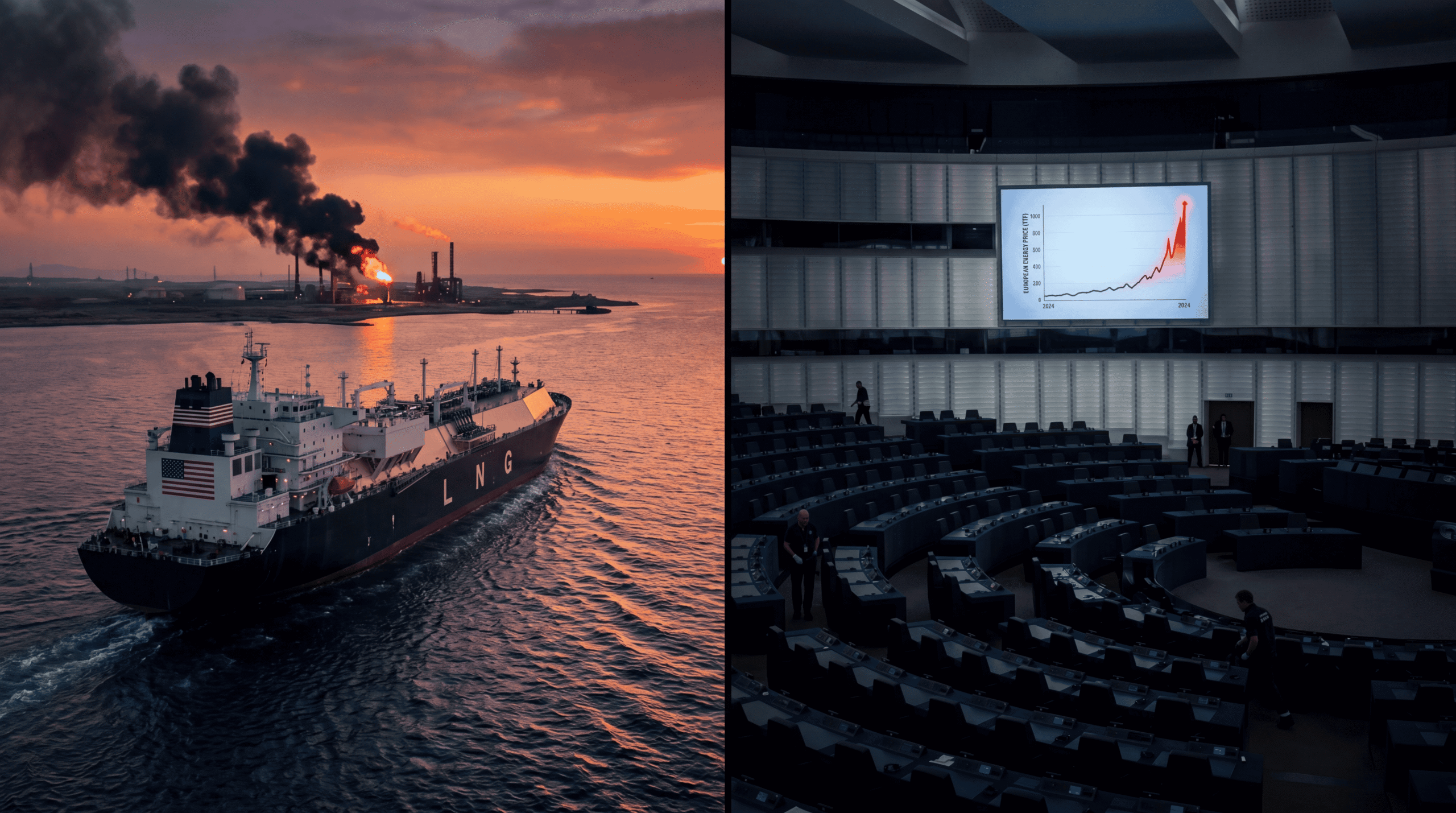

The United States did not defend the Strait of Hormuz because it no longer needed to. That single fact, revealed in the spring of 2026 as Iranian forces choked off one-fifth of the world’s traded oil, marks the end of an era in American grand strategy that began in 1945. What looked like abandonment was actually execution.
For seven decades, the implicit bargain was simple: America would guarantee that Middle Eastern oil flowed to the world, and in exchange, the world would accept American primacy. The Iran war didn’t break that bargain. It exposed that Washington had already rewritten the terms — quietly, methodically, and with a strategic clarity that most allies missed until the naval blockade was announced.
The Doctrine That Preceded the Crisis
On January 20, 2025, more than a year before the first Israeli strike on Iranian nuclear facilities, President Trump signed an executive order titled Unleashing American Energy. The language was blunt: “Energy Dominance” would replace energy security as the organizing principle of American policy. Two weeks later, he established a National Energy Dominance Council, chaired by Interior Secretary Doug Burgum, with a mandate to transform American energy from a strategic vulnerability into a geopolitical weapon.
This was not campaign rhetoric. It was operational planning. By November 2025, the National Security Strategy had formalized the shift in doctrine, stating explicitly that the Middle East was losing its historic claim on American attention because “energy supplies have diversified greatly, with the United States once again a net energy exporter.” The guarantee was being withdrawn in the same document that declared the commercial ambition.
When Iran began mining the Strait in April 2026, Washington’s response was not to secure the waterway for global commerce. It was to tell allies to buy American oil or secure the Strait themselves. Three days later, the Pentagon announced a naval blockade of Iranian ports — not to reopen the Strait, but to contain Tehran while American LNG tankers redirected to premium European and Asian markets.
The Material Foundation: Shale as Strategic Autonomy
The doctrine only worked because the geology had changed. By February 2026, the United States was producing more oil and gas than any country in history, exporting both at scale, and drawing far less from the Persian Gulf than at any point since 1945. The Strait of Hormuz had become, from Washington’s perspective, someone else’s problem.
American shale production, which barely existed in 2008, had fundamentally altered the strategic equation. The United States no longer needed Gulf oil to keep its economy running or its military fueled. What it needed was market share in a world suddenly desperate for non-Iranian supply. The crisis created the conditions for Washington to achieve through market mechanisms what previous administrations had pursued through military presence: primacy in global energy flows.
In 2025, the United States exported more than 100 million metric tons of LNG, the first country in history to reach that threshold. Export capacity was on track to double by 2028. Federal drilling permits surged 55 percent in the first year of the administration. On July 4, 2025, Trump signed the One Big Beautiful Bill Act, embedding the doctrine in statute through federal loan guarantees for fossil fuel infrastructure and eliminating clean energy tax credits that had supported competing technologies.
What the Carter Doctrine Actually Promised
To understand what changed, you need to understand what the original guarantee actually said. In January 1980, President Jimmy Carter declared that any attempt by an outside force to gain control of the Persian Gulf region would be “repelled by any means necessary, including military force.” The Carter Doctrine was born from dependency: America and its allies needed Gulf oil, and the Soviet invasion of Afghanistan had put that supply at risk.
But the Carter Doctrine never promised to keep the Strait open for everyone. It promised to prevent adversaries from controlling it. That distinction, invisible for decades, became operationally significant the moment Washington gained the capacity to profit from the Strait’s closure. The 2025 National Security Strategy preserved the commitment to deny rivals control of Gulf chokepoints while quietly abandoning the broader obligation to guarantee their openness for global commerce.
What Trump did in April 2026 was not a violation of American doctrine. It was its literal application under conditions where American interests had diverged from allied interests. The Strait didn’t need to be open for American ships. It needed to be closed to Iranian ships and contested enough to drive buyers toward American suppliers.
How Allies Learned They’d Been Reclassified as Customers
The shock in European capitals was not feigned. Germany, which still imported 34 percent of its natural gas from non-US sources in early 2026, watched prices spike 170 percent in three weeks as Strait tanker traffic dropped by half. Japan, dependent on Gulf oil for 89 percent of its crude imports, faced immediate shortages. South Korea activated strategic reserves that would last 90 days.
Washington’s response was consistent: long-term supply contracts at premium prices, payable in dollars, with delivery timelines contingent on allied support for the Iranian blockade. Energy had been reframed as a strategic instrument, not a public good. The Council on Foreign Relations noted in May 2026 that “the United States has effectively converted a security guarantee into a commercial transaction, with predictable consequences for alliance cohesion.”
France, which had maintained an independent military presence in the Gulf since the 1990s, proposed a European-led coalition to reopen the Strait. The Pentagon offered intelligence support but no carrier groups. Britain, more dependent on American security guarantees in other theaters, quietly signed a 15-year LNG import agreement with Texas-based exporters. The Dutch, who had opposed new LNG terminals on climate grounds in 2024, fast-tracked three in spring 2026.
What This Means For You
If you live in Europe or Asia, you are now paying the geopolitical risk premium that Americans no longer carry. Your gasoline prices, your heating costs, your industrial input expenses — all are now subject to Washington’s willingness to stabilize a region it no longer materially depends on. The era in which American security commitments and allied economic interests were structurally aligned has ended. You are no longer a partner in a shared system. You are a customer in someone else’s market.
If you live in the United States, you are living through the return of an old bargain: resource autonomy as the foundation of geopolitical independence. But autonomy is not the same as isolation, and dominance is not the same as security. The international order that your country built after 1945 was expensive to maintain but created a world in which American exports found willing buyers and American security guarantees were considered credible. That order depended on a perception that Washington’s interests and allied interests were, if not identical, at least compatible. The Iran crisis has demonstrated they are not.
What Happens Next: Three Scenarios
Scenario One: Market Lock-In. European and Asian buyers, having been burned by the Strait closure, sign long-term contracts with American LNG exporters at prices 30-40 percent above pre-crisis levels. Washington accepts a higher floor price for global energy in exchange for guaranteed market share and the strategic leverage that comes with it. The Strait eventually reopens under a narrow security arrangement that excludes Iranian traffic but allows other Gulf exporters to resume flows, maintaining just enough competition to prevent accusations of pure monopoly while keeping prices elevated. The NATO alliance survives, but its economic foundation shifts from shared prosperity to a creditor-debtor model.
Scenario Two: Fragmentation. France and Germany, unwilling to accept permanent dependency on American supply, accelerate investments in North African LNG, Russian Arctic gas, and East Mediterranean pipelines despite Washington’s objections. China, already moving this direction, formalizes an energy security architecture in Asia that explicitly routes around American chokepoints. The world fractures into competing energy blocs. American producers lose market share but gain pricing power in their remaining sphere. The dollar’s role as the global reserve currency comes under sustained pressure for the first time since Bretton Woods.
Scenario Three: Normalization. The Iran crisis resolves through a negotiated settlement that lifts the blockade and returns the Strait to normal operations within 12-18 months. Prices stabilize, allies rebuild strategic reserves, and the acute phase of the crisis passes. But the doctrine remains. The infrastructure investments made in 2025-2026 — the LNG terminals, the export permits, the pipeline expansions — are long-cycle assets that will shape energy flows for 30 years. Even if the crisis ends, the strategic positioning it revealed becomes the new baseline. Washington has demonstrated it will prioritize market dominance over alliance management when the two conflict. Allies plan accordingly.
Why the Brookings Consensus Got This Wrong
The think tank consensus in 2024-2025, including Brookings’ own Middle East forecasts, assumed that American disengagement from the Gulf would be gradual, managed, and coordinated with allies. The assumption was that Washington would reduce its forward presence while maintaining the core security guarantee, essentially doing less while promising the same. That was the Obama model, refined during the Biden years.
What actually happened was structurally different: Washington didn’t reduce its commitment and apologize for doing less. It redefined the commitment and monetized the reduction. The Carter Doctrine was amended, not abandoned. The new version says: We will prevent adversaries from controlling Gulf energy flows, but we will not guarantee those flows remain open to everyone, and we reserve the right to profit from disruptions we choose not to prevent.
The error was assuming that American grand strategy is driven primarily by alliance obligations rather than material interests. For 70 years, those two aligned closely enough that the distinction didn’t matter. Shale production broke the alignment. The Iran crisis made the break visible.
The Historical Parallel: Britain, 1956, Suez
There is a precedent for this moment, and it is not reassuring for America’s allies. In 1956, Britain and France launched a military operation to seize the Suez Canal after Egyptian President Nasser nationalized it. The operation was militarily successful. It was also strategically catastrophic, because it proceeded without American approval. President Eisenhower, unwilling to tolerate allied insubordination and concerned about Soviet reactions, threatened to collapse the British pound unless London withdrew. Britain withdrew. The Suez Crisis is remembered as the moment Britain learned it was no longer a great power.
The Strait of Hormuz crisis is the inverse scenario. This time, it is the guarantor power that has chosen to let the chokepoint close, and it is the dependent allies who must decide whether to accept the new terms or attempt an independent solution. The lesson from Suez is that the country controlling the reserve currency controls the terms of any energy crisis. In 1956, that was the United States, and it used that power to discipline allies who acted without permission. In 2026, it is still the United States, and it is using that power to convert a security crisis into a commercial opportunity.
The difference is that in 1956, America wanted the canal open and was willing to punish allies who jeopardized that goal. In 2026, America benefits from the Strait being contested and is willing to tolerate — perhaps even quietly prefer — a situation where allies must pay premium prices for American supply rather than relying on Gulf flows Washington no longer profits from securing.
The Verdict: Strategy, Not Accident
The question is not whether the Trump administration planned the Iran crisis. The question is whether it built a doctrine capable of exploiting such a crisis when it arrived, and whether that doctrine reflected a deeper shift in American material interests that transcends any single administration. The evidence suggests both are true.
Energy Dominance was not a slogan. It was a strategy document with institutional backing, statutory authority, and a clear theory of how energy autonomy could be converted into geopolitical leverage. The Iran crisis did not create that strategy. It validated it. What looked like improvisation — the refusal to secure the Strait, the pressure on allies to buy American, the blockade timed to maximize disruption while minimizing direct US military exposure — was actually the operational execution of a doctrine that had been publicly announced 15 months earlier.
The consequences will extend far beyond energy markets. The post-1945 order was built on a assumption that the hegemon’s interests and the system’s interests were synonymous, or at least compatible. When America guaranteed Middle Eastern oil flows, it was guaranteeing its own supply and allied supply simultaneously. That duality is what made the guarantee credible. The moment American supply autonomy broke that duality, the guarantee became conditional in ways that allies are only now beginning to process.
The Strait of Hormuz crisis was not the end of American primacy. It was American primacy operating under new rules, rules where alliance management is subordinate to market dominance, and where the security architecture is no longer a public good but a service provided to paying customers. The world that emerges from this crisis will be one where American power is more clearly transactional, more explicitly self-interested, and more willing to tolerate disorder in regions it no longer depends on.
The guarantee was always conditional; we just didn’t know the condition was prosperity.