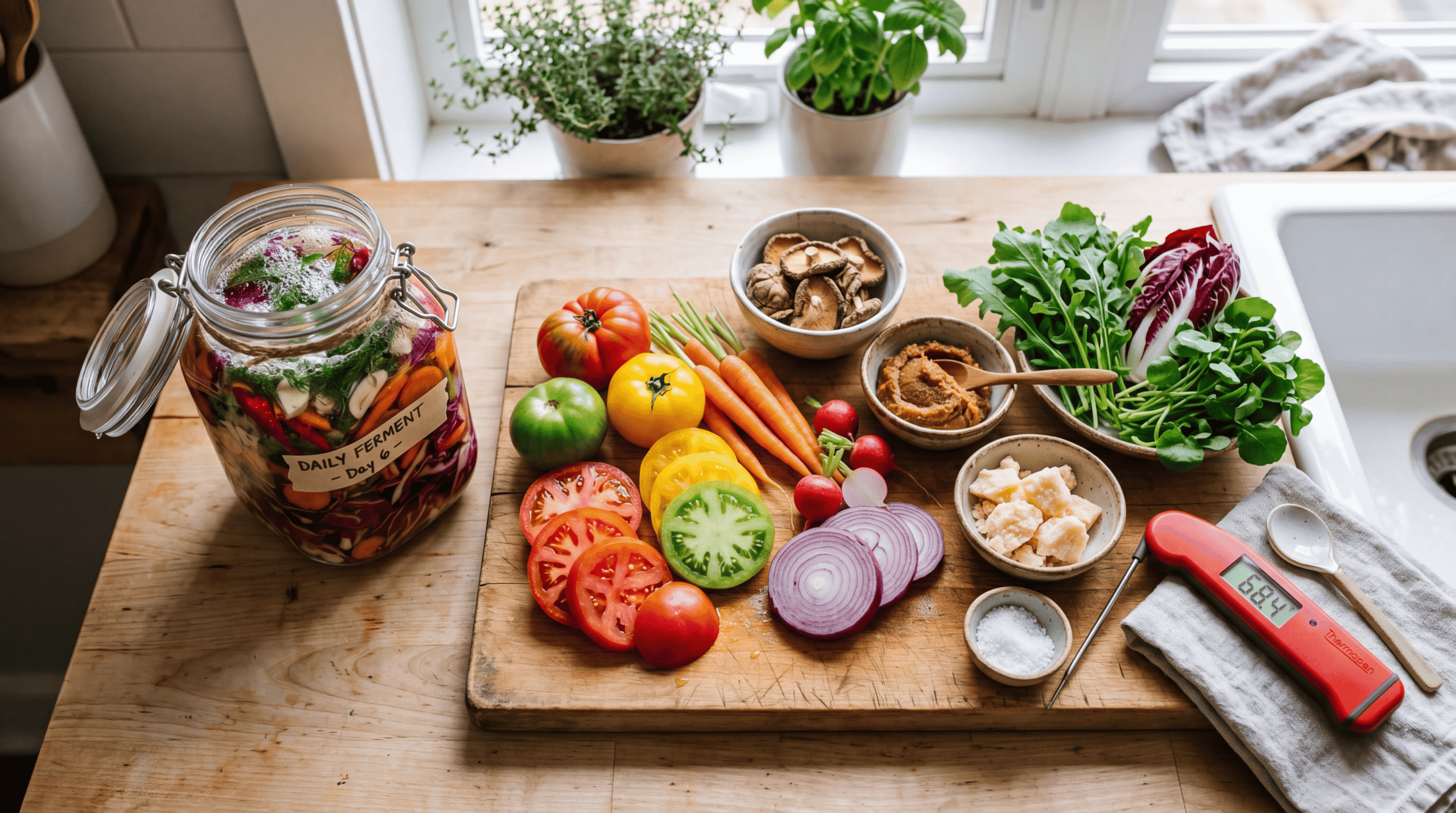

Here’s what most home cooks get catastrophically wrong about food trends: they chase Instagram aesthetics instead of understanding the transformative techniques beneath them. The food trends dominating 2026 aren’t just pretty plating or exotic ingredients—they represent fundamental shifts in how we extract flavor, preserve ingredients, and understand the chemistry of taste. I’ve spent twenty years in Michelin kitchens, and these trends excite me because they make everyone a better cook.
Let me show you why these trends matter for your kitchen, not just restaurant menus.
Fermentation Has Finally Gone Mainstream (And It’s About Time)
The fermentation revolution of 2026 isn’t about trendy kombucha bars—it’s about home cooks finally understanding that controlled microbial activity is the most powerful flavor amplifier in your arsenal. When you ferment vegetables, grains, or dairy, you’re not just preserving food; you’re creating entirely new flavor compounds that didn’t exist before.
According to research from food scientists at Serious Eats, fermentation produces over 400 volatile compounds during the transformation process. These compounds—organic acids, esters, alcohols—create layers of umami, sourness, and complexity that no amount of salt or acid can replicate.
Here’s the revelation: a simple 3-day cabbage ferment produces more flavor depth than any seasoning blend you can buy. The lactic acid bacteria break down complex sugars into simpler, sweeter compounds while simultaneously creating tangy acids. This dual action—sweetness plus acidity—is why properly fermented foods taste so extraordinarily balanced.
In my Barcelona kitchen, we’ve been fermenting tomato water for eighteen months. The result? A liquid so intensely savory that three drops transform a pasta dish. You don’t need eighteen months—a 48-hour fermented hot sauce will teach you more about flavor development than a semester of cooking classes.
Climate Cuisine: Why Regional Ingredients Actually Cook Better
The climate cuisine movement of 2026 represents the most significant shift in sourcing philosophy since farm-to-table. But here’s what the trend pieces miss: cooking with hyper-local, climate-adapted ingredients isn’t just ethical—it produces objectively superior results because these ingredients are biologically optimized for your environment.
When vegetables grow in their ideal climate zone, they develop higher concentrations of secondary metabolites—the compounds responsible for flavor, aroma, and color. A tomato grown in Mediterranean conditions develops 30-40% more lycopene and flavor volatiles than the same variety forced to grow in incompatible climates, according to agricultural research on secondary metabolites.
This matters in your kitchen because properly adapted ingredients require less manipulation. They taste right with minimal intervention. I’ve watched home cooks add sugar, salt, and acid to flavorless tomatoes when the real problem was buying tomatoes that never should have been grown in that region in the first place.
The 2026 climate cuisine movement prioritizes indigenous grains, drought-resistant legumes, and vegetables that thrive in local conditions. These ingredients aren’t just sustainable—they’re easier to cook because nature already did half your work. A heritage grain grown in its ancestral climate has structural integrity and nutty complexity that modern wheat, bred for industrial production, simply cannot match.
The Science Behind Umami Layering
The third major trend of 2026—and the one that will most dramatically improve your cooking—is the systematic layering of umami compounds. Professional kitchens have understood this for decades, but 2026 marks the year home cooks are finally mastering the science of synergistic umami.
Here’s the molecular truth: umami compounds work exponentially, not additively. When you combine ingredients rich in glutamates (like tomatoes or aged cheese) with ingredients rich in nucleotides (like mushrooms or dried fish), you don’t get double the umami—you get eight to ten times the savory intensity.
This synergy happens because glutamates and nucleotides bind to different taste receptors on your tongue. When both receptors fire simultaneously, your brain perceives a flavor intensity that’s mathematically disproportionate to the quantities used. Food & Wine’s comprehensive guide to umami science demonstrates this effect with precise measurements.
In practical terms: a soup made with just tomatoes tastes pleasant. A soup made with tomatoes plus dried mushrooms tastes transcendent. You’ve created a flavor cascade that registers as deeply satisfying in ways your conscious mind can’t fully articulate.
The 2026 trend isn’t about adding MSG (though there’s nothing wrong with that). It’s about understanding which ingredients contain which umami compounds and combining them strategically. Miso plus kombu. Parmesan plus anchovy. Tomato paste plus soy sauce. These aren’t random combinations—they’re molecular partnerships optimized for maximum savory impact.
Waste-Based Stocks: The Trend That Teaches Fundamental Technique
One of the most important trends of 2026 is the systematic use of vegetable scraps, bones, and trimmings to build foundational flavors. This isn’t just about reducing waste—it’s about understanding that the parts you’ve been throwing away often contain more flavor compounds than the parts you’ve been cooking with.
Onion skins contain more quercetin (a powerful antioxidant that also contributes bitter-sweet complexity) than onion flesh. Mushroom stems have higher concentrations of umami compounds than caps. Parmesan rinds contain crystallized amino acids that create profound savory depth. By discarding these elements, you’ve been literally throwing away flavor.
The technical principle: many flavor compounds are most concentrated in the protective outer layers and structural elements of ingredients. These parts evolved to be tough and intensely flavored as defense mechanisms. When you simmer them in water or fat, you extract those concentrated compounds without the textural drawbacks.
In my Tokyo training, we kept five different scrap stocks running continuously—vegetable, mushroom, seafood, chicken, and pork. Every dish started from a base of extracted flavor that represented weeks of accumulated aromatic compounds. You can achieve similar results by keeping a freezer bag of vegetable scraps and making stock every two weeks.
Precision Temperature Control Goes Mainstream
The democratization of sous vide equipment and precision cooking tools in 2026 represents more than convenience—it gives home cooks access to temperature control that was physically impossible in traditional cooking. This matters because protein structure, starch gelatinization, and enzymatic activity all happen at specific, narrow temperature ranges.
When you cook a steak in a pan, the exterior might reach 400°F while the center hits 130°F. This gradient is useful for creating crust, but it also means you’re overcooking 40-50% of your expensive protein. Precision temperature control allows you to cook the entire piece of meat to exactly 132°F (the temperature where myosin proteins denature but actin proteins remain intact), then apply high heat only for surface browning.
The result isn’t just more evenly cooked meat—it’s meat with objectively better texture because you’ve controlled protein denaturation at a molecular level. ChefSteps’ research on sous vide science documents the precise temperature points where different proteins transform.
This trend extends beyond sous vide. Temperature-controlled fermentation, precision candy making, and exact oil temperatures for frying all represent the same principle: when you control temperature precisely, you control chemical reactions precisely. Better reactions equal better food.
The Return of Bitterness (Finally)
Perhaps the most sophisticated trend of 2026 is the rehabilitation of bitter flavors in mainstream cooking. For thirty years, food companies have bred bitterness out of vegetables to appeal to children and unsophisticated palates. This has been a catastrophic mistake for flavor complexity.
Bitter compounds—glucosinolates in cruciferous vegetables, phenolic compounds in coffee and chocolate, alkaloids in citrus pith—provide essential flavor balance that makes other tastes more vibrant. Without bitterness, sweet tastes become cloying and savory tastes become flat. Bitterness is the frame that makes the painting visible.
The food science is unambiguous: bitter compounds stimulate different taste receptors than sweet, salty, sour, or umami. When you include measured bitterness in a dish, you’re literally activating more sensory pathways, which your brain interprets as greater complexity and interest. This is why properly made chocolate contains bitter notes, why great coffee isn’t smooth, and why the best cocktails include bitters.
In 2026, chefs are reintroducing bitter greens, charred vegetables, and roasted spices with bitter undertones. Home cooks are discovering that a hint of burnt garlic or a handful of radicchio transforms a one-dimensional pasta into a multi-layered experience. The trend isn’t about making food unpleasantly bitter—it’s about using bitterness as a flavor tool the same way you use salt.
Common Mistakes With 2026 Food Trends
Mistake 1: Fermenting Without Understanding Temperature Control
Most failed fermentation attempts happen because home cooks don’t maintain the 65-72°F range where beneficial lactobacillus bacteria outcompete harmful microbes. Too warm, and you get off flavors from the wrong bacteria. Too cold, and fermentation stalls completely. Use a thermometer probe or find a consistently cool spot in your home.
Mistake 2: Thinking Local Means Limited
Climate cuisine doesn’t mean eating only three ingredients. It means building your foundational ingredients—grains, dried legumes, preserved vegetables—from regional sources, then supplementing with traded goods like spices and citrus. The Romans built an empire on this model. Your pantry can too.
Mistake 3: Adding Umami Ingredients Without Considering Moisture
Dried mushrooms, miso, and tomato paste contain concentrated umami, but they also affect the water content of your dish. Add them too late, and they don’t properly hydrate and distribute. Add them early, let them bloom in fat or liquid, and they integrate seamlessly. This timing difference determines whether you taste individual ingredients or unified depth.
Mistake 4: Over-Relying on Technology Without Building Technique
A sous vide circulator won’t teach you how to season properly or build a sauce. These tools control one variable—temperature—while you must still control seasoning, timing, and flavor balance. Master traditional techniques first, then use precision tools to refine results.
Mistake 5: Avoiding Bitterness Entirely
If every element of your dish tastes sweet or savory, you’ve created monotony. One component with subtle bitterness—charred lemon, toasted spices, dark leafy greens—provides contrast that makes other flavors more vivid. Start with small amounts and train your palate to appreciate complexity.
The Ingredient Quality Revolution
Underlying all 2026 trends is a fundamental shift in how we evaluate ingredient quality. The old model—pristine appearance, year-round availability, low cost—is giving way to a new standard: flavor density, appropriate seasonality, and production methods that enhance rather than diminish inherent qualities.
This matters because ingredient quality determines the ceiling of what you can achieve. No technique, no matter how sophisticated, can create flavor that doesn’t exist in your raw materials. When you buy tomatoes bred for shipping rather than taste, you’re starting from a deficit that no amount of cooking skill can fully overcome.
The 2026 approach: buy fewer ingredients of dramatically higher quality. One exceptional olive oil used sparingly will transform more dishes than five mediocre oils used generously. A single heritage breed chicken roasted perfectly teaches you more about cooking than a dozen industrial chickens cooked with complex techniques.
This isn’t about spending more money—it’s about spending money differently. Skip the exotic ingredients you’ll use once. Invest in the flour, olive oil, salt, and tomatoes you’ll use every week. Quality in foundational ingredients compounds with every dish you make.
The One Technique That Unites All 2026 Trends
If there’s a single principle connecting fermentation, climate cuisine, umami layering, precision cooking, and ingredient quality, it’s this: intentional patience. Every trend of 2026 requires you to slow down and let time do work that rushing cannot replicate.
Fermentation needs days. Proper stocks need hours. Dry-aging needs weeks. Sous vide cooking needs precise time at precise temperatures. These aren’t inconveniences—they’re opportunities for chemical transformations that create flavors impossible to achieve through speed and force.
The revelation for home cooks: you don’t need to be in the kitchen for this time. A ferment works while you sleep. A stock simmers while you work. Precision cooking happens while you do anything else. The time investment isn’t active labor—it’s planning and patience.
This represents a fundamental shift from industrial food production, which prioritizes speed and consistency, to craft food preparation, which prioritizes flavor development and complexity. The trends of 2026 are simply the culinary world catching up to what chemistry has always told us: the best reactions need time.
Why These Trends Make You a Better Cook
What excites me about 2026’s food trends is that they’re not about innovation for its own sake—they’re about rediscovering and refining techniques that create objectively better food. Fermentation, regional ingredients, umami synergy, waste reduction, and patience aren’t new ideas. They’re ancient practices supported by modern understanding of food chemistry.
When you ferment vegetables, you’re not being trendy—you’re harnessing microbial transformation to create new flavor compounds. When you layer umami ingredients, you’re exploiting receptor biology to maximize savory intensity. When you use precision temperature control, you’re managing protein denaturation at a molecular level. These aren’t fads. They’re applications of food science that remain true regardless of what’s popular on Instagram.
The trends of 2026 make you better because they teach you to think about why techniques work, not just what to do. Once you understand that fermentation creates flavor through bacterial metabolism, you can ferment anything. Once you grasp umami synergy, you can build depth into any dish. Once you control temperature precisely, you can cook any protein perfectly.
Start with one technique: keep a jar of fermenting vegetables on your counter for three days, and taste how flavor compounds develop over time—that’s when you’ll understand that cooking isn’t just heating food, it’s conducting chemistry that makes the raw materials taste like what they were always meant to become.