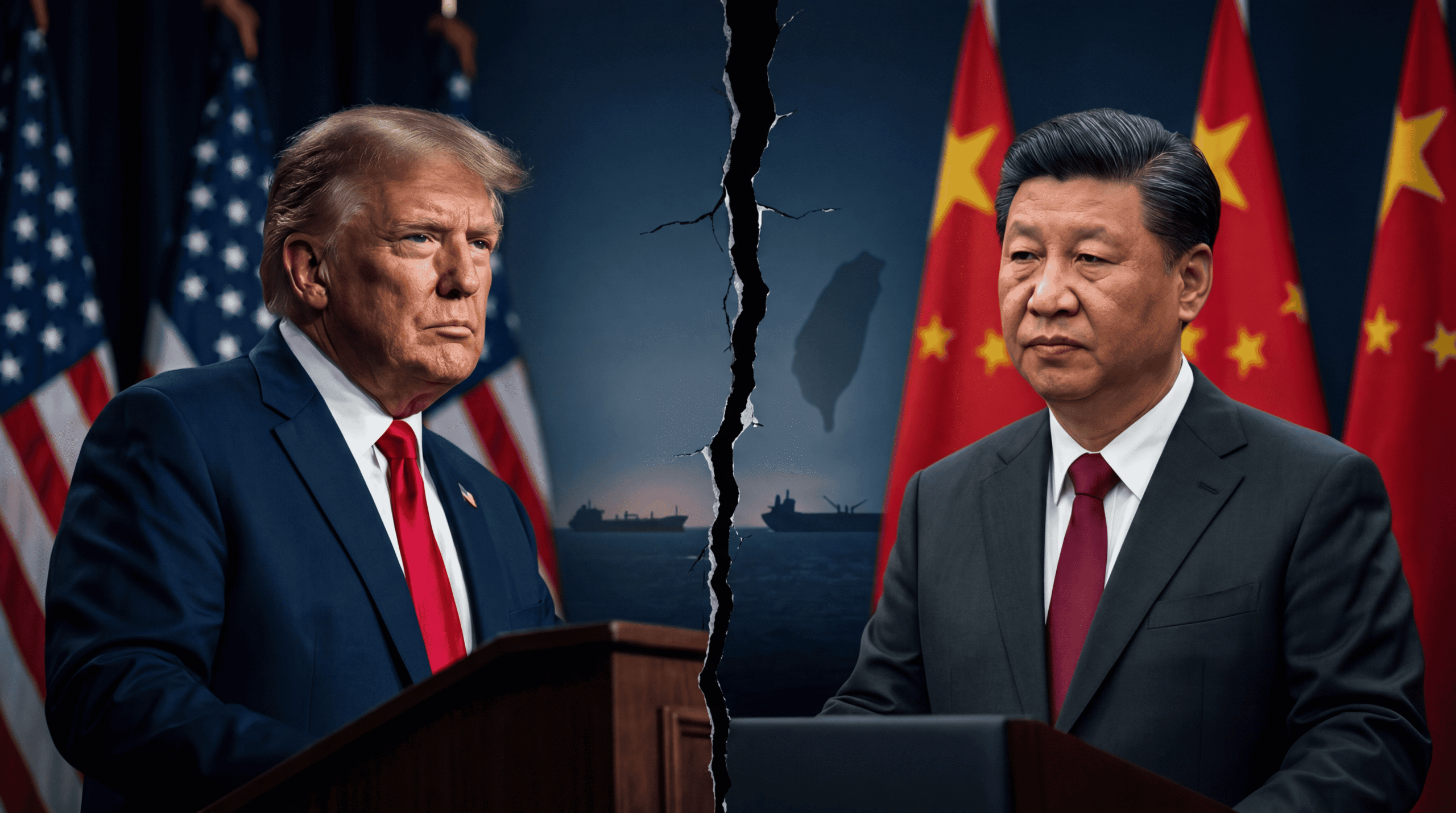

The handshake between Donald Trump and Xi Jinping this week won’t just be a photo opportunity—it will be the opening move in a negotiation that will determine whether the 21st century becomes a Chinese century or descends into something far more dangerous. When Trump touches down in Beijing for the first presidential visit to China since 2017, he arrives not as a supplicant, but not quite as an equal either. And that ambiguity is precisely what makes this moment so combustible.
China has been preparing for this visit with the meticulous precision of a nation that views diplomacy as warfare by other means. The White House calls it “tremendously symbolically significant.” Beijing calls it overdue. Both are right, and both are playing a game where the rules are being rewritten in real time.
The Seven-Year Silence That Changed Everything
The last time an American president set foot in China for a state visit was 2017, when Trump himself made the journey during his first term. Back then, the bilateral relationship was already fraying, but trade remained the primary battlefield. Today, the landscape has transformed beyond recognition. The tariff war that began in 2018 never truly ended—it simply metastasized into a comprehensive strategic competition spanning technology, military power, and ideological influence.
In those seven years, China has militarized the South China Sea with impunity, absorbed Hong Kong’s autonomy, threatened Taiwan with daily incursions, and built a surveillance apparatus that would make Orwell blush. The United States, meanwhile, has weaponized semiconductor exports, constructed alliance networks across the Indo-Pacific, and watched its manufacturing base continue its eastward migration despite all the rhetoric about decoupling.
The suspension of high-level diplomatic engagement didn’t freeze the relationship—it allowed it to deteriorate without the friction of accountability. According to Brookings Institution analysis, the absence of structured dialogue created what scholars call “competitive drift”—a situation where both sides assume the worst about the other’s intentions because there’s no mechanism to test those assumptions.
Iran: The Crisis That Forced Trump’s Hand
What finally broke the diplomatic stalemate wasn’t Taiwan or trade—it was Iran. The expanding conflict in the Middle East, with its devastating impact on global energy markets, has created an emergency that neither Washington nor Beijing can ignore. China imports approximately 10 million barrels of oil per day, with roughly 45% originating from the Persian Gulf region. The Strait of Hormuz closure has sent shockwaves through China’s industrial heartland.
Beijing’s calculus is brutally simple: China needs the Strait of Hormuz reopened more desperately than it needs to demonstrate solidarity with Iran. This creates a rare moment of convergent interests with Washington, but convergence is not alliance. China wants the oil flowing again without appearing to abandon a partner it has cultivated for decades through the Belt and Road Initiative and strategic investments in Iranian infrastructure.
Trump, for his part, needs Chinese pressure on Tehran in a way that his maximum pressure campaign never anticipated. The administration has discovered what every American president since Nixon has learned: you can’t solve Middle Eastern crises without Beijing’s acquiescence, and increasingly, you can’t solve them without Beijing’s active cooperation. This is the new mathematics of great power competition—your adversary’s leverage is precisely equal to your dependence on their restraint.
Taiwan: The Issue Beijing Won’t Compromise On
While Iran may have provided the diplomatic opening, Taiwan remains the issue that could detonate this entire engagement. China’s Foreign Ministry has made clear that any discussion of “more stability” globally must begin with American acceptance of Beijing’s position on Taiwan. This isn’t negotiating theater—it’s a fundamental recalibration of what China considers non-negotiable.
The parallel to Cold War Berlin is instructive but incomplete. During the 1961 Berlin Crisis, Kennedy and Khrushchev engaged in high-stakes brinkmanship over a divided city that neither side could fully control. The resolution came through tacit mutual recognition: the Wall could stand because both superpowers accepted they couldn’t eliminate the other’s presence without triggering Armageddon. Taiwan today occupies a similar psychological space—but with one critical difference. China believes time is on its side in a way the Soviet Union never did.
Beijing’s positioning ahead of this summit signals a new phase in its Taiwan approach. Rather than demanding immediate reunification, Xi is pressing for what Chinese strategists call “irreversibility”—binding commitments from Washington that would make future American support for Taiwan independence politically impossible. This might include restrictions on arms sales, limits on official contacts, or explicit language in joint communiqués that goes beyond the strategic ambiguity of previous decades.
Trump’s team faces an impossible trilemma: agree to Chinese demands and alienate congressional Republicans who view Taiwan as a civilizational frontline; refuse and watch the summit collapse before addressing Iran; or attempt some middle path that satisfies no one and creates ambiguity that could prove catastrophic in a future crisis. The smart money is on option three, which means we’re likely building toward rather than away from a Taiwan confrontation.
What This Means For You
If you’re a consumer, prepare for continued inflation volatility tied to geopolitical events you can’t control. The supply chains that deliver everything from your iPhone to your prescription medications run through the Taiwan Strait and the South China Sea. Any miscalculation in this summit’s aftermath could trigger disruptions that make pandemic-era shortages look minor.
If you’re an investor, understand that US-China decoupling is no longer a policy debate—it’s operational reality. Companies are being forced to choose sides in ways that will reshape global commerce for a generation. The notion that you can remain neutral while operating in both markets is becoming untenable, as recent actions against firms like Micron and Apple demonstrate.
If you’re a citizen concerned about war and peace, recognize that this summit isn’t preventing conflict—it’s managing the transition to a new form of sustained competition that sits uncomfortably between peace and war. Your children will live in a world where US-China tensions are the ambient background of international relations, much as the Cold War defined an earlier generation.
The Three Scenarios That Follow This Summit
Scenario One: The Grand Bargain
Trump and Xi announce a framework agreement that trades American restraint on Taiwan for Chinese pressure on Iran and a partial tariff reduction. This buys 12-18 months of relative stability but papers over fundamental contradictions. Probability: 25%. Both leaders want to claim victory, but their domestic political constraints make genuine compromise nearly impossible.
Scenario Two: Managed Deterioration
The summit produces vague joint statements about dialogue and cooperation while both sides continue militarizing their positions. High-level engagement resumes but changes nothing substantive. Think of it as the diplomatic equivalent of a long-term separation rather than either reconciliation or divorce. Probability: 60%. This is the path of least resistance for leaders who need to show engagement without making concessions their bases would reject.
Scenario Three: The Breaking Point
Negotiations collapse over Taiwan language or Iran coordination, leading to an accelerated decoupling spiral. Within six months, we see the first major military incident in the Taiwan Strait or South China Sea as both sides conclude that deterrence has failed. Probability: 15%. Low likelihood but catastrophic consequences—the scenario that keeps national security professionals awake at night.
What Happens Next
The immediate aftermath of the summit will reveal more through what isn’t said than what is. Watch for three indicators: First, does China actually reduce its oil purchases from Iran in the following months, or does it maintain current levels while offering diplomatic cover? Second, do US arms sales to Taiwan accelerate, pause, or take on new qualitative characteristics like longer-range strike capabilities? Third, do American and Chinese military aircraft and vessels continue their dangerous close encounters, or do we see new protocols emerge?
The medium-term trajectory depends on variables neither Trump nor Xi fully controls. If the Iran conflict expands or economic conditions deteriorate in either country, domestic political pressure could overwhelm whatever understanding they reach. Conversely, if both leaders face serious challenges at home—Trump with a difficult reelection campaign, Xi with slowing growth—they might find temporary common cause in avoiding additional crises.
The structural drivers of competition haven’t changed. China’s rise continues to constrain American freedom of action in Asia. America’s alliance network continues to encircle China strategically. The semiconductor wars, the rare earth elements struggle, the battle for technological standards, the competition for influence in the Global South—none of these dissolve because two leaders shake hands in Beijing.
The Unspoken Reality
Here’s what won’t appear in any joint communiqué but everyone in that room understands: the era of American unilateral dominance is over, but the era of Chinese predominance hasn’t begun. We’re in the most dangerous phase—the transition itself. History suggests that rising powers and declining hegemons rarely navigate this passage peacefully. The exceptions, like Britain’s accommodation of American rise in the early 20th century, required extraordinary statesmanship and usually a common enemy that made cooperation essential.
Trump and Xi have no common enemy of sufficient magnitude, and neither man has demonstrated the kind of restraint and strategic patience that managed transitions require. What they do have is mutual awareness that uncontrolled escalation serves neither side’s interests—at least not yet. The question isn’t whether this summit solves US-China tensions. The question is whether it creates enough breathing room to prevent the next crisis from becoming the last crisis.
The symbolism of an American president returning to China after seven years matters, but symbols without substance are just expensive theater. What this visit really tests is whether great power competition can be bounded by rational calculation or whether it follows its own inexorable logic toward confrontation. Nixon went to China in 1972 to reshape the Cold War chessboard. Trump goes to China in 2026 to prevent the board from catching fire—and that’s a far more desperate mission than anyone in Washington wants to admit.