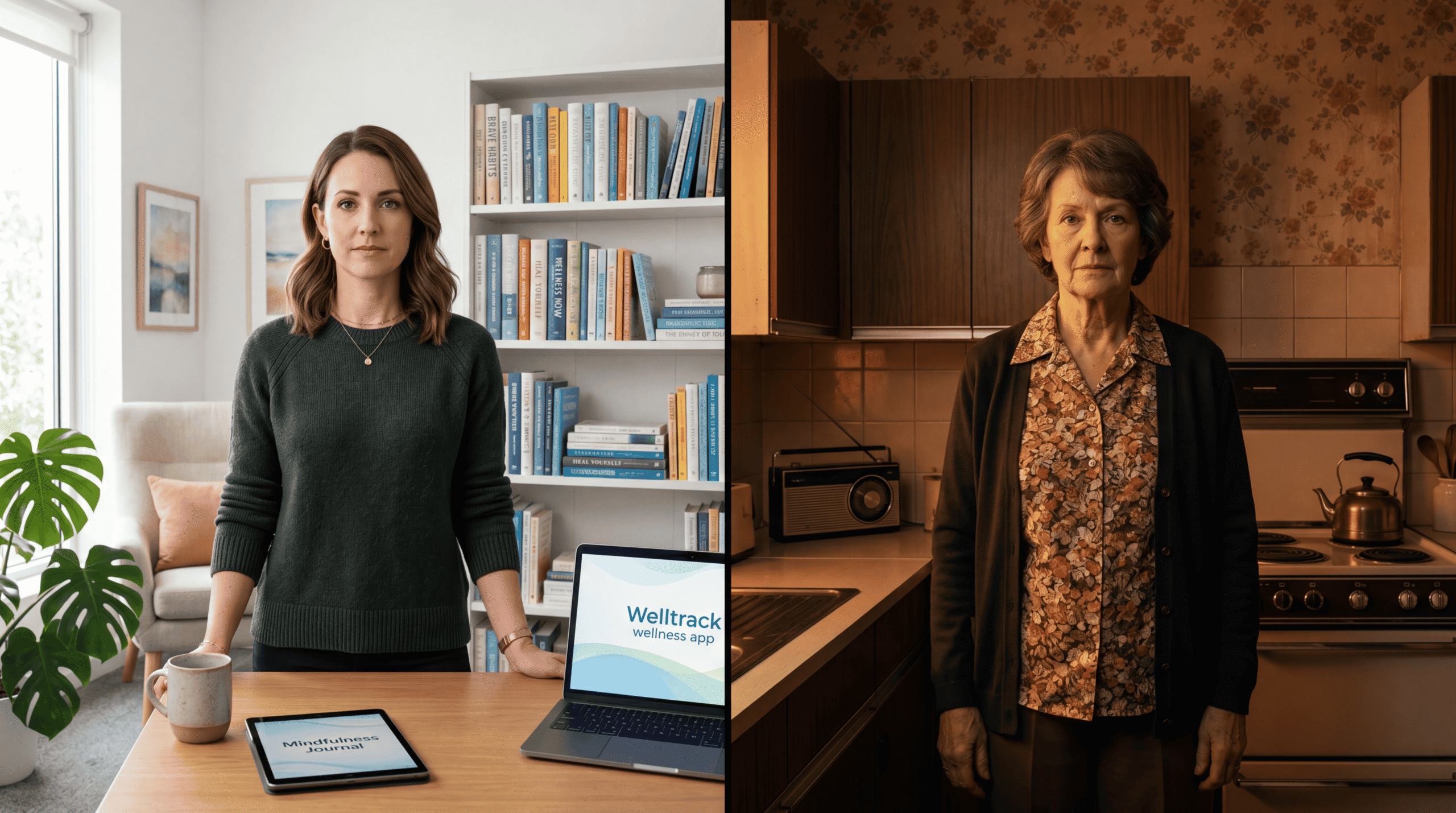

Your grandmother survived conditions that would break most people today, and she’ll never call it strength because no one ever taught her the word for what she did.
I’ve spent fifteen years studying resilience across age groups, and the data keeps showing me something most people refuse to believe: women over 60 possess a form of psychological endurance that didn’t just fade with their generation — it can’t be replicated under modern conditions. These women built mental toughness in an environment that has been completely dismantled, using survival strategies they were never given permission to name.
The Silence Shaped Different Neural Pathways
Women born before 1965 developed their coping mechanisms in what psychologists call a “low-articulation, high-expectation environment.” They had no therapy culture, no emotional vocabulary, no permission to discuss mental health. Research from the American Psychological Association shows that this created fundamentally different stress-response patterns than what we see in younger generations.
Here’s what actually happened in their brains: when you can’t talk about your stress, you can’t externalize it. That forces a cognitive adaptation called “silent processing” — your brain learns to metabolize psychological pain without social support or validation. It’s like building muscle by lifting weights no one acknowledges exist.
My client Margaret, 68, once told me about losing her first job in 1978 after requesting equal pay. She never told her husband, found new work within three days, and didn’t speak about it for forty years. When I asked how she managed the emotional impact, she looked genuinely confused. “You just did,” she said. “What else was there?”
They Mastered What Psychologists Call Pragmatic Resilience
Modern resilience training focuses on emotional regulation, positive reframing, and building support networks. That’s not what shaped women over 60. They developed something called pragmatic resilience — the ability to function at high capacity while experiencing sustained distress, without expecting the distress to change.
Think about what that means. These women raised children while experiencing postpartum depression that nobody named. They stayed in marriages where they had no legal right to shared property. They worked jobs where sexual harassment was called “office culture.” They did all of this without the assumption that their feelings mattered or that conditions would improve.
That creates a different kind of toughness than what younger women develop. It’s not resilience through recovery — it’s resilience through continuation. You don’t bounce back because you never had permission to acknowledge you were down.
The Invisible Labor That Rewired Their Stress Response
Current neuroscience research on chronic stress and aging reveals something striking: women who experienced sustained, unacknowledged stress in their formative adult years show different cortisol patterns than younger cohorts. Their stress response doesn’t spike as dramatically because their baseline adapted to constant low-level threat.
These women spent decades managing what psychologists now call “invisible labor” — the mental load of running households, managing emotional climates, remembering birthdays, tracking everyone’s needs, anticipating problems. All while holding jobs that paid them 59 cents on the male dollar. All while being told their primary identity was wife and mother.
The cognitive load was staggering, and it was never acknowledged as work. That combination — extreme demand plus zero recognition — created a psychological adaptation that modern women simply don’t develop. You can’t build that kind of endurance in an environment that validates your effort.
The Research Says This Isn’t Just Survival Bias
Some people argue we only notice the tough ones who survived, but that’s not what the data shows. Longitudinal studies from the National Institute on Aging that tracked women from their 30s through their 70s found that this generation showed consistent patterns of what researchers call “silent adaptation” — functioning at high levels without corresponding increases in self-reported well-being or decreased stress perception.
In other words, they kept going without feeling better. That’s not a bug — that’s the feature. They learned to operate without the reward of feeling okay about it.
Compare that to how younger generations approach mental health. We’ve been taught (correctly) to recognize our limits, seek support, prioritize self-care, set boundaries. Those are healthy adaptations to a world that offers them. But they’re fundamentally different survival strategies than what was required in an environment that offered none of those options.
Why They Don’t Call It Toughness
Here’s the part that gets me every time: when you ask women over 60 about their resilience, most genuinely don’t know what you’re talking about. They’ll tell you about other women who had it worse. They’ll minimize their own experiences. They’ll say they were just doing what everyone did.
This isn’t modesty. It’s a cognitive bias called situational attribution — the tendency to see your own behavior as a response to circumstances rather than a reflection of character. Because their entire generation was operating under the same impossible conditions, they never developed the framework to see their adaptation as exceptional.
They also lived in a culture that explicitly told them their worth came from service, not strength. The language of female empowerment, assertiveness, and leadership didn’t exist in their formative years. Toughness was a masculine trait. Women were supposed to be gentle, accommodating, emotional. So even when they were exhibiting extraordinary psychological endurance, the cultural vocabulary gave them no way to name it.
I think about my client Ruth, 72, who worked full-time as a nurse, raised four kids alone after her husband left, put two through college, and never once used the word “strong” to describe herself. When I pointed out what she’d accomplished, she said, “Well, what choice did I have?” As if that somehow diminished it. As if choosing to keep going when you have no choice is anything other than the definition of toughness.
The Conditions That Shaped Them Can’t Be Recreated
Modern women face plenty of challenges — don’t misunderstand me. But we’re operating in a fundamentally different psychological environment. We have language for burnout, gaslighting, emotional labor. We have therapy, HR departments, workplace protections. We have the concept of work-life balance and the expectation that our feelings deserve consideration.
Women over 60 built their toughness in the absence of all that. Not because they chose to, but because none of it existed yet. That created a kind of psychological architecture you can’t build with modern materials.
It’s like trying to develop calluses while wearing gloves. The protection prevents the adaptation. Our increased awareness of mental health, our emphasis on self-care, our validation of emotional needs — these are good things. They prevent suffering. But they also prevent the specific type of hardening that comes from functioning without them.
What Younger Women Can Actually Learn
This isn’t about romanticizing suffering or suggesting we should go back to conditions that damaged women. But there’s something worth understanding in how these women developed their capacity to endure.
Research on intergenerational resilience suggests that younger women can develop similar psychological endurance through what’s called “voluntary discomfort” — deliberately practicing functioning under non-ideal conditions rather than always optimizing for comfort.
The difference is that it’s a choice now, not a requirement. You can build capacity for discomfort while still maintaining the support systems and boundaries that protect your mental health. You can practice not always needing to feel okay while still having access to resources when you need them.
The Vocabulary They Never Had
One of my current research interests is what happens when women over 60 finally encounter the psychological language that didn’t exist in their formative years. When they learn words like “boundaries,” “emotional labor,” “trauma response” — suddenly they have a framework for experiences they lived but couldn’t name.
The responses fall into two camps. Some women feel validated, even relieved — finally their experience has language. Others feel almost angry, grieving for the support they didn’t know they deserved. Both reactions reveal the same thing: the absence of vocabulary shaped their entire adaptation strategy.
Without words for what you’re experiencing, you can’t ask for help. You can’t set boundaries. You can’t even conceptualize that things could be different. You just develop the capacity to withstand whatever comes, indefinitely, without naming what it costs you.
Try This Today
If you’re over 60: Write down three things you did in your 20s or 30s that you now recognize as psychologically demanding. Not the big dramatic moments — the sustained, quiet difficulties. Name them with the psychological vocabulary you have now. Notice what it feels like to finally give language to experiences you carried silently.
If you’re under 60: Ask an older woman in your life about her first job, her first year of marriage, or her first year of motherhood. Don’t ask how she felt — ask what she did. Listen for the strategies she used that she never calls strategies. Notice the strength she describes as just normal.
The mental toughness of women over 60 isn’t just a different degree of resilience — it’s a different species entirely, forged under conditions that shaped minds in ways modern psychology is only beginning to understand and that modern life can no longer create.