




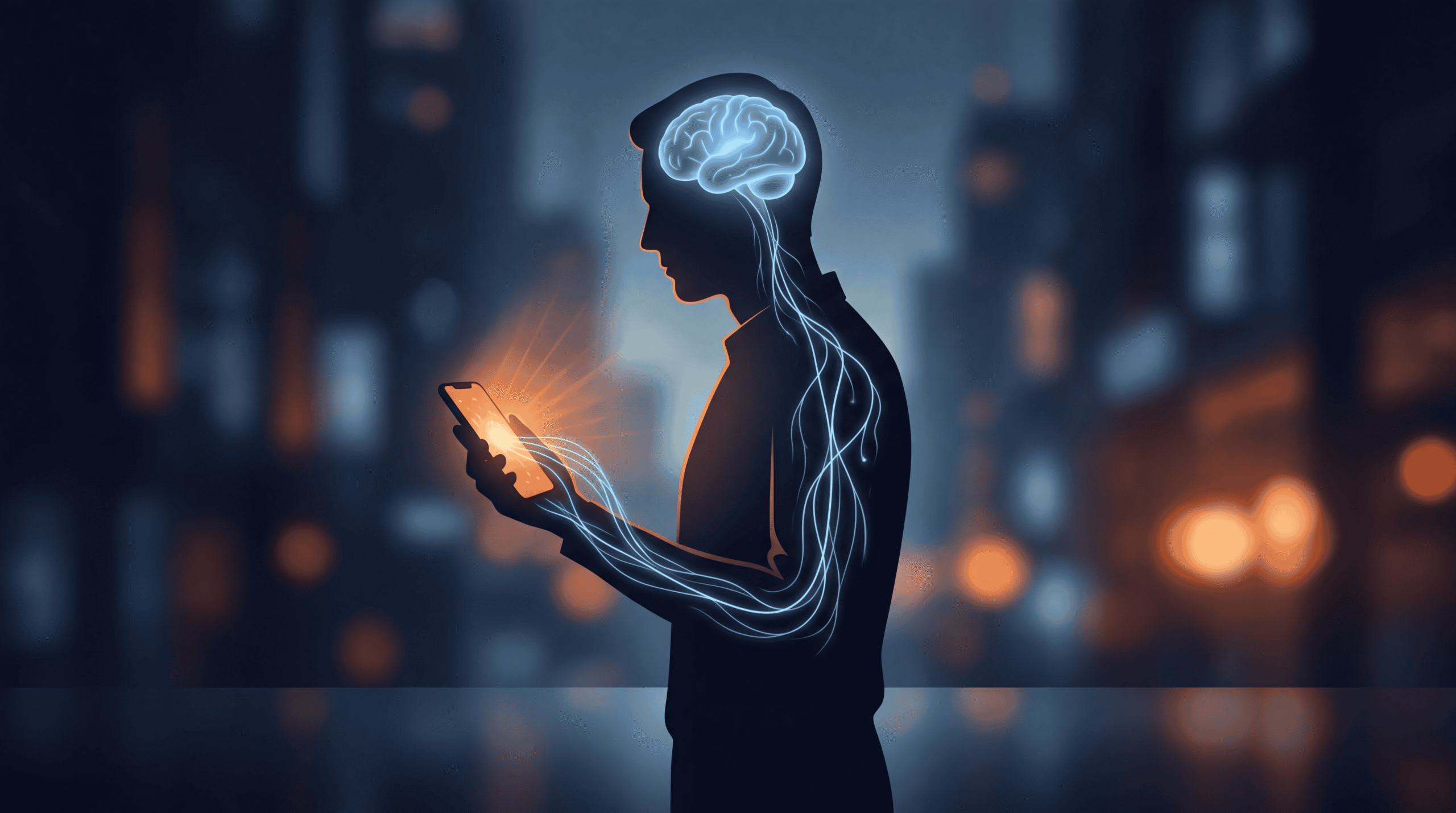

You check your phone within three minutes of waking up. You know this because you’ve caught yourself doing it for years now, and you’ve stopped pretending it’s about “checking the weather” or “seeing if anything urgent came in.” The truth you don’t want to admit: you’re looking for a dopamine hit before your feet touch the floor, and your brain has been rewired to need it.
Here’s what most people miss about phone addiction—it’s not about screen time. It’s about attention fragmentation, and the psychological mechanism at work is far more insidious than you realize.
The Attentional Blink You Can’t See
Every time you switch from a work task to your phone and back again, your brain doesn’t just pause—it experiences what cognitive psychologists call attentional residue. Part of your cognitive capacity stays stuck on the previous task, reducing your effective IQ by an average of 10 points, according to research from the University of California, Irvine.
That TikTok you watched at lunch? Your brain is still processing it during your 3 PM meeting. That text thread you checked between emails? It’s occupying working memory you need for actual thinking.
The mechanism isn’t about phone time—it’s about cognitive task-switching costs. Each interruption creates a debt your attention must repay, and most people are operating in constant cognitive deficit without knowing it.
What Actually Happens During a Digital Detox
A 2024 study published in Scientific Reports tracked 619 participants who reduced their phone use by just one hour per day for one week. Not a full detox—just 60 minutes less.
The results weren’t subtle. Participants showed measurable improvements in sustained attention capacity within three days. Their scores on the Sustained Attention to Response Task (SART) improved by an average of 23%, equivalent to the cognitive difference between being well-rested versus sleep-deprived.
But here’s what shocked researchers: the benefits persisted for weeks after the intervention ended. Why? Because reducing phone use doesn’t just give you more time—it restructures how your attention system operates.
The Paradox of Digital Anxiety
Most people assume phone use reduces anxiety by keeping them connected. The research says the opposite. A 2023 meta-analysis in Behavioral Sciences found that excessive smartphone use is associated with increased anxiety symptoms, particularly through a mechanism called fear of missing out (FOMO).
But FOMO isn’t what you think it is. It’s not actually about missing events—it’s about the psychological threat of being disconnected from ongoing social validation. Your brain treats notification silence the same way it treats social rejection.
This creates a vicious cycle: you check your phone to reduce anxiety about missing something, which increases baseline anxiety by training your nervous system to expect constant stimulation, which makes you need to check more frequently to feel okay.
The behavioral term for this is negative reinforcement—you’re not checking your phone because it feels good, but because not checking feels intolerable.
The Research Says
A groundbreaking 2023 study from Frontiers in Psychology examined the neurological effects of brief digital detoxes using fMRI imaging. Participants who reduced phone use by just 30% for two weeks showed increased activity in the dorsolateral prefrontal cortex—the brain region responsible for executive function and impulse control.
Translation: small reductions in phone use don’t just change your behavior—they change your brain’s architecture for self-regulation.
Meanwhile, research from the American Psychological Association’s 2023 Stress in America survey found that adults who took regular breaks from news and social media reported significantly lower stress levels and better sleep quality than those who maintained constant connectivity.
The mechanism? Reduced exposure to what psychologists call vicarious trauma—the emotional toll of constantly consuming others’ distressing experiences through your screen.
Why Extreme Detoxes Usually Fail
If you’ve ever tried going completely phone-free for a week, you probably didn’t make it. That’s not weakness—it’s biology. Your brain interprets sudden, complete digital disconnection as a threat to social survival.
The problem with cold-turkey detoxes is they trigger what’s called psychological reactance—when you feel your freedom is being restricted, you experience an overwhelming urge to restore it. This is why people who do week-long digital detoxes often end up using their phones more afterward.
A 2024 study in Social Media + Society found that gradual reduction strategies were 3.4 times more effective than complete abstinence for creating lasting behavior change. The sweet spot? Reducing usage by 20-40%, not eliminating it entirely.
The Attention Span Myth
You’ve probably heard that our attention spans have shrunk to eight seconds—less than a goldfish. That statistic is completely fabricated, but something real is happening to your attention.
What’s actually declining isn’t your capacity for focus—it’s your tolerance for boredom. Research from the University of Virginia found that people would rather give themselves mild electric shocks than sit alone with their thoughts for 15 minutes.
Your phone hasn’t destroyed your attention span. It’s destroyed your ability to be present with discomfort, which is where all deep thinking happens. The moments between stimulation—the “boring” gaps—are when your brain consolidates memory, generates insight, and regulates emotion.
When you eliminate those gaps with constant phone checking, you’re not just wasting time. You’re preventing the cognitive processes that make you smarter, more creative, and emotionally resilient.
The Social Comparison Trap
Every time you scroll Instagram, your brain is performing thousands of unconscious social comparisons. This isn’t new—humans have always compared themselves to others. What’s new is the volume and asymmetry of those comparisons.
You’re comparing your internal experience (messy, anxious, uncertain) to everyone else’s curated external presentation (polished, confident, successful). This creates what researchers call upward social comparison—measuring yourself against people who appear to be doing better.
A 2023 study in the Journal of Social and Clinical Psychology found that limiting social media use to 30 minutes per day led to significant reductions in loneliness and depression over three weeks. The mechanism? Reduced social comparison frequency.
Your brain wasn’t designed to benchmark itself against 500 people’s highlight reels before breakfast. That level of comparative assessment would have been cognitively impossible for 99.9% of human history.
The Notification Hijack
Every notification you receive triggers a small cortisol spike—your stress hormone. Your brain interprets that buzz or ding as a potential threat that requires immediate attention. Over time, you develop what’s called vigilance fatigue—your nervous system stays in a low-grade state of alert, waiting for the next ping.
This is why you feel exhausted even on days when you “didn’t do anything.” You did do something—you maintained constant threat surveillance for 12 waking hours.
Research from the University of British Columbia found that people who checked email just three times per day reported significantly lower stress than those who kept notifications on. The mechanism? Reduced anticipatory anxiety—the psychological state of waiting for something to happen.
Why You Can’t Stop Mid-Scroll
You’ve experienced this: you open Instagram “just for a second,” and 40 minutes disappear. That’s not an accident—it’s the result of variable ratio reinforcement, the most powerful behavior-shaping tool in psychology.
Slot machines use the same principle: you don’t know which pull will pay off, so you keep pulling. Your social media feed operates identically—you don’t know which scroll will reveal something interesting, so your brain compels you to keep scrolling.
This creates what behavioral scientists call compulsive continuation—you literally cannot stop because your reward prediction system hasn’t been satisfied. You’re not weak-willed. You’re up against the same psychological mechanisms that create gambling addiction.
The Memory Offloading Problem
When was the last time you tried to remember a phone number? Probably years ago. Your phone has become your external hard drive, and that’s changing how your brain processes and stores information.
Research on cognitive offloading—the tendency to use external devices to reduce mental effort—shows that relying on your phone for memory tasks actually weakens your internal memory systems. It’s use-it-or-lose-it neurology.
But here’s the troubling part: people who habitually use their phones to store information show reduced activity in the hippocampus, the brain region essential for forming new memories. The long-term implications? We don’t fully know yet, but the trajectory isn’t encouraging.
The Hidden Benefits of Boredom
The psychological state you’re most afraid of—boredom—is actually when your brain does its most important work. During unstimulated moments, your brain activates the default mode network, responsible for self-reflection, future planning, and meaning-making.
A 2024 study in PNAS found that people who experienced regular periods of boredom showed enhanced creativity and improved problem-solving abilities compared to those who maintained constant stimulation.
When you fill every waiting moment—every elevator ride, every grocery line, every traffic light—with your phone, you’re not just passing time. You’re preventing the cognitive state where insight emerges.
Try This Today
Don’t try to quit your phone. Instead, do this: for the next seven days, wait three minutes after waking before checking any device. Just three minutes. Sit up, breathe, notice how you feel without reaching for external stimulation.
That tiny delay interrupts the automatic behavior pattern and gives your brain’s prefrontal cortex time to engage before your habit circuits take over. Research on implementation intentions—specific if-then plans—shows that small behavioral buffers like this are significantly more effective than vague goals like “use my phone less.”
After one week, notice what changed. You probably won’t use your phone less overall, but you’ll use it more deliberately. That’s the difference between being controlled by your device and controlling it.
The Real Question
The goal isn’t to demonize technology or pretend we can live without our phones. The goal is to recognize that every tool changes the person who uses it. Your phone isn’t neutral—it’s actively reshaping your attention, your relationships, your sense of self.
The question isn’t whether you should do a digital detox. The question is: who do you become when you’re constantly connected, and is that who you want to be?
Your brain is more plastic than you think—three days of reduced phone use can measurably change how your attention works. Which means the person you are right now, reading this, isn’t permanent. You’re not stuck with the attention span you have today.
You’re just stuck with it until you decide not to be.