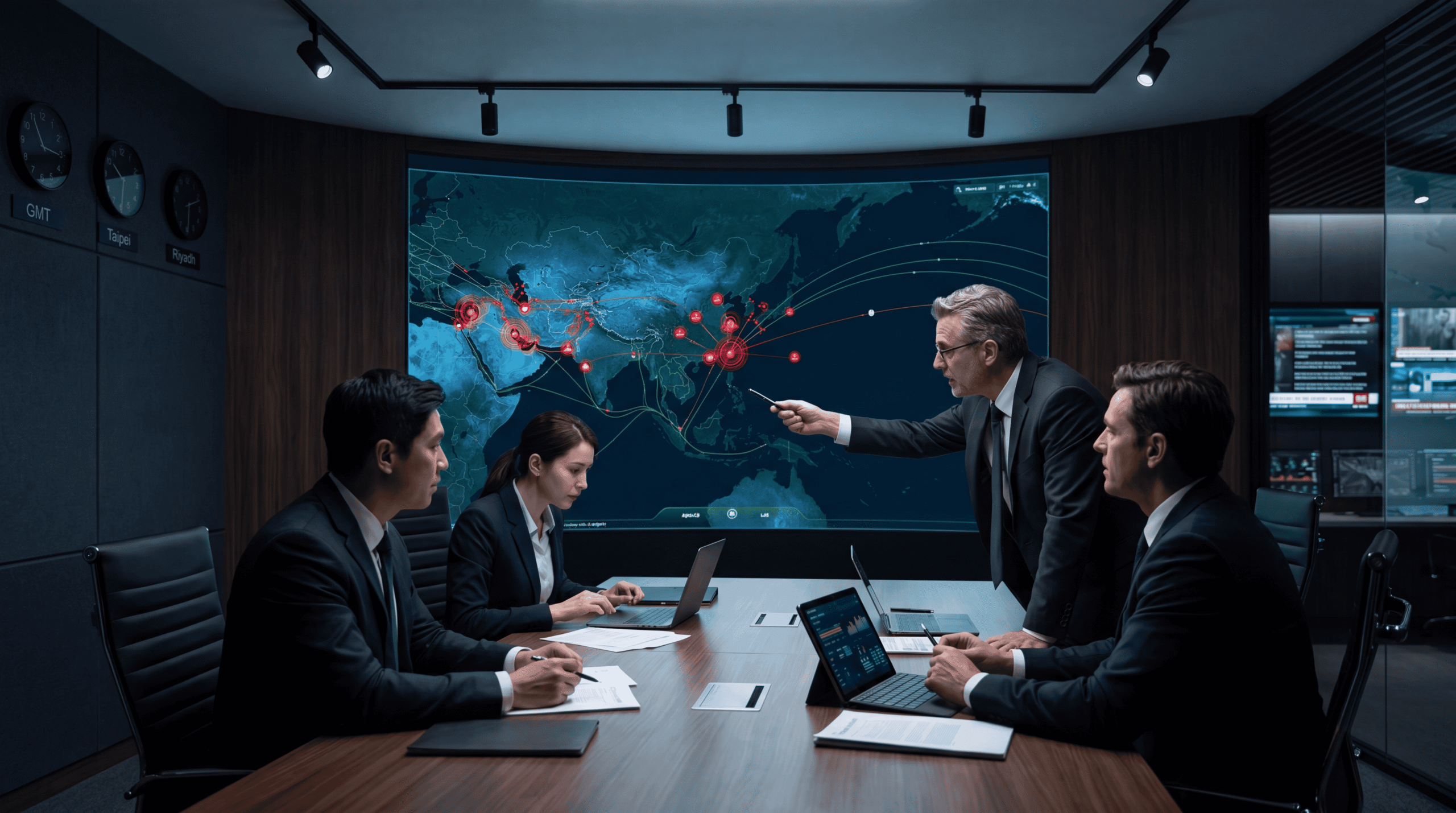

The world’s most powerful boardrooms are running simulations you’re not supposed to know about. While CEOs smile through earnings calls, their strategy teams are modeling Taiwan invasions, Middle East conflagrations, and the unraveling of the global trading system. This isn’t paranoia—it’s fiduciary duty in an age when geopolitics moves faster than supply chains can adapt.
I’ve spent 18 years watching how conflicts metastasize from diplomatic tensions into economic shockwaves. What’s different now is the speed. Boards that once reviewed geopolitical risk annually are now receiving monthly briefings. The question is no longer if major disruption comes, but which scenario hits first—and whether your company survives it.
Scenario One: The Taiwan Semiconductor Singularity
Every sophisticated war game ends the same way: China moves on Taiwan, and the global economy enters a coma. Taiwan Semiconductor Manufacturing Company produces 90% of the world’s advanced chips. A blockade—not even an invasion—would halt production of everything from iPhones to F-35 fighters within weeks.
Boards are modeling three sub-scenarios here. First: Beijing announces an “Air Defense Identification Zone” around Taiwan and conducts indefinite military exercises that make shipping insurance impossible. No shots fired, but TSMC’s Hsinchu facilities become commercially unreachable. Second: selective strikes on undersea data cables and power infrastructure that make chip fabrication technically impossible without triggering automatic U.S. treaty obligations. Third: full amphibious assault, which every serious analyst knows would be catastrophically bloody but which Xi Jinping may calculate as necessary for domestic political survival.
The corporate response plans I’ve reviewed are chilling in their honesty. Major tech firms have 45-90 day chip inventories. After that, production lines go dark. Automotive manufacturers are even more exposed—just-in-time manufacturing means some assembly plants could shut down within two weeks. One Fortune 100 company has modeled revenue loss at 60% in quarter one of a Taiwan crisis, with 18 months to restore even partial supply chains through hastily constructed fabs in Arizona and Germany.
History offers one parallel: the 1973 oil embargo. OPEC’s supply cut lasted six months and triggered a decade of stagflation. A Taiwan chip embargo would be the 1973 crisis on methamphetamine—shorter in duration, perhaps, but far more economically violent because semiconductors are embedded in everything the modern economy does.
Scenario Two: The Middle East Becomes the Middle East Again
The second scenario assumes the Abraham Accords collapse and the region returns to its default state: war. Specifically, direct Israel-Iran conflict that closes the Strait of Hormuz and sends oil to $200 per barrel.
Twenty percent of global oil passes through Hormuz daily. Iran has made clear it will mine the strait if attacked. War games consistently show that even with U.S. Navy minesweepers working at maximum capacity, it would take 30-45 days to clear the channel sufficiently for tanker traffic to resume. During that window, Brent crude doesn’t just spike—it becomes rationed. European economies with minimal strategic reserves face industrial shutdown within six weeks.
Corporate boards are planning for second-order effects that make headlines about oil prices look quaint. Petrochemical feedstocks disappear, which means plastics production halts, which means medical device manufacturers can’t produce IV bags and syringes. Airlines ground 40% of flights within three weeks as jet fuel allocations kick in. Inflation doesn’t gradually rise—it detonates, with consumer prices jumping 3-5% monthly in oil-dependent economies.
The nightmare scenario within this scenario: Saudi Arabia enters the war directly against Iran, and Houthi forces in Yemen successfully strike Ras Tanura, the world’s largest oil port. That single facility exports 5 million barrels daily. Its destruction would remove 5% of global supply for potentially 18 months. No strategic petroleum reserve is built for that.
Scenario Three: The Unraveling—Tariffs and the Death of Globalization
This scenario doesn’t require missiles. It only requires elections and the return of economic nationalism in multiple major economies simultaneously. The simulation: the United States implements comprehensive 25% tariffs on manufactured imports, the EU retaliates with equivalent measures, China responds by restricting rare earth exports, and India closes its market to protect domestic industry.
Within six months, boards are modeling 15-20% cost increases across virtually all manufactured goods. But the real damage is the death of global value chains that took 40 years to build. An iPhone contains components from 43 countries. Under this scenario, Apple faces a choice: eat the tariffs and watch margins collapse, or restructure supply chains at a cost of tens of billions while prices jump 30%.
The historical echo is Smoot-Hawley, the 1930 U.S. tariff act that trading partners retaliated against, shrinking global trade by 66% in three years and deepening the Great Depression. Modern economies are far more interdependent than 1930s economies, which means the unraveling would be faster and more chaotic. Companies that offshore to avoid tariffs in one jurisdiction trigger tariff responses in others, creating a doom loop where every optimization makes the system more fragile.
Boards are specifically modeling political contagion: one major economy going protectionist gives political cover to nationalists everywhere. The scenario doesn’t require coordination—it requires permission. Once the United States or China abandons trade rules, everyone else rushes to protect their own.
Scenario Four: The Grid Dies—Cyber Armageddon Against Infrastructure
The fourth scenario is the one that keeps directors awake: a coordinated cyberattack on electrical grids in multiple NATO countries, conducted by Russia or proxies, in response to Western support for Ukraine or some future escalation. Not a brief outage—a months-long collapse requiring physical infrastructure replacement.
In December 2015, Russia demonstrated this capability by taking down Ukraine’s power grid. That was a proof of concept. U.S. cybersecurity officials have confirmed that Russian actors have mapped U.S. electrical infrastructure and maintain access to systems that could be weaponized. The war game assumes they activate those tools in conjunction with a major geopolitical crisis—say, direct NATO involvement in a Russia-Ukraine endgame.
Boards are modeling consequences that cascade faster than governments can respond. First 48 hours: panic buying depletes food and fuel within major cities. First week: hospital generators run out of diesel; mortality rates spike among elderly and ill. First month: supply chains collapse completely as fuel production and distribution becomes impossible; most companies simply shut down. The economic damage from a 90-day grid collapse in the U.S. East Coast is estimated at $1-2 trillion—roughly 5% of annual GDP evaporated.
The corporate response plans are primitive because there is no good response. Some boards are mandating distributed backup generation, but that protects individual facilities, not the supplier networks they depend on. Others are creating crisis inventories of critical supplies, but you can’t warehouse 90 days of food and fuel for your entire workforce. The honest assessment I’ve heard from multiple CHROs: we can protect executives for maybe three weeks, then we’re improvising.
What This Means For You
If you think these scenarios don’t affect your daily life, you’re not paying attention. Your employer is gaming out which facilities close first. Your bank is calculating how quickly ATMs run out of cash in a grid-down scenario. Your local hospital is deciding which patients get generator power and which don’t.
The practical steps: maintain a genuine emergency fund—not in stocks, in cash you can physically access. Keep a month of shelf-stable food not because you’re a prepper, but because boards who see classified briefings are doing exactly that for their executive teams. If you work in manufacturing, semiconductors, or energy, understand that your job is in the blast radius of any of these scenarios.
More fundamentally, recognize that the 30-year period of relative geopolitical stability that made global just-in-time supply chains possible is over. The companies that survive the next decade will be those that prioritize resilience over efficiency. That means shorter supply chains, larger inventories, and higher costs. Which means your cost of living is going up regardless of which scenario triggers first.
What Happens Next: Three Pathways
Pathway One: Muddle Through. No major scenario triggers in the next 24 months. China doesn’t move on Taiwan because they watch Russia’s Ukraine disaster and recalculate. The Middle East stays at a simmer, not a boil. Trade tensions rise but stop short of full economic divorce. In this world, boards waste billions on contingency planning that never activates—but the waste is cheap insurance, and companies quietly build more resilient supply chains that serve them well in smaller crises. Probability: 40%.
Pathway Two: Controlled Crisis. One scenario triggers but is contained before maximum damage. Taiwan faces a blockade that lasts eight weeks before diplomatic settlement; oil spikes to $150 but Hormuz stays open; tariffs rise but stop short of full economic war; or a major cyberattack hits but is mitigated within days. Companies with strong contingency plans survive with heavy damage. Those without them face potential bankruptcy. The global economy enters recession but avoids depression. This becomes the new normal—regular geopolitical shocks that require permanent crisis management. Probability: 35%.
Pathway Three: Cascade Failure. Two scenarios trigger simultaneously—say, Taiwan and the Middle East, or cyberattack during a trade war. The compounding effects overwhelm response capacity. Multiple major economies enter simultaneous crisis. Global trade doesn’t just contract; it seizes. Even sophisticated contingency plans fail because they assumed one crisis at a time. We enter a multi-year period of deglobalization, political instability, and economic reordering that makes 2008 look like a practice run. Probability: 25%.
The Verdict
Here’s what separates this moment from previous periods of geopolitical tension: the convergence. Taiwan, the Middle East, trade wars, and cyber vulnerabilities aren’t separate risks—they’re interconnected. A crisis in one domain makes crises in others more likely and more severe. Boards understand this. They’re running simulations because the old playbook of diversification and hedging doesn’t work when everything correlates to one.
The uncomfortable truth is that major corporations are more prepared for these scenarios than governments. They have to be—shareholders demand it, and business doesn’t stop for geopolitical chaos. But corporate resilience doesn’t protect ordinary citizens. When TSMC’s chips stop flowing, Apple’s stockpiles might last 90 days. Yours will last about 90 hours once panic sets in.
The signal to watch is corporate behavior, not rhetoric. When major multinationals start announcing massive supply chain restructuring at obvious cost to margins, or when banks begin hardening infrastructure well beyond regulatory requirements, that’s boards seeing something in classified briefings that makes them willing to sacrifice profit for survival. We’re already seeing early signs. The question is whether you’ll recognize them before the scenario they’re preparing for actually triggers.
The era when geopolitics was something that happened to other people in faraway places is over—and your boardroom knows it even if your politicians won’t say it.