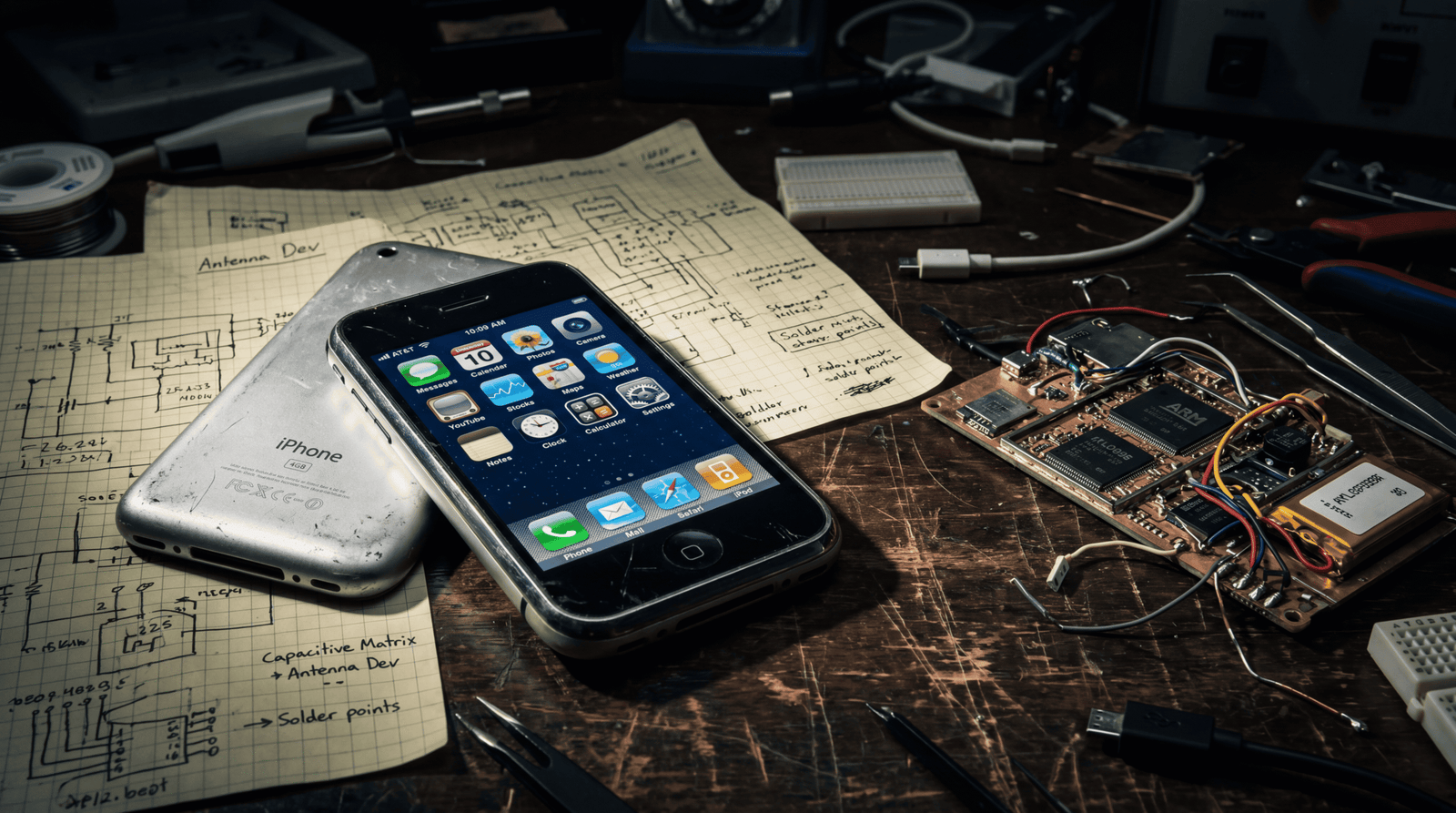

Steve Jobs didn’t want to build a phone. The iPod team fought it. The board thought it was suicide. Yet the iPhone became the most successful consumer product ever shipped — not because of vision, but because Apple’s back was against the wall.
Here’s what actually happened, and why it matters more today than ever.
The Crisis Nobody Talks About: Apple Was Losing The iPod War
By 2005, Apple had a problem. The iPod printed money — $4.5 billion in revenue that year — but everyone at 1 Infinite Loop knew it was living on borrowed time. Motorola’s ROKR, a phone that played iTunes, was supposed to be the bridge. It was a disaster.
Tony Fadell, the iPod’s creator, saw it clearly: phones would eat the iPod’s lunch. Not because phones were better music players — they weren’t — but because people only carry one device. The question wasn’t if Apple should build a phone. It was whether Apple could survive if it didn’t.
According to Wired’s comprehensive oral history, Jobs greenlit the iPhone project in late 2004, but with a condition: it had to work perfectly on day one. No partial launches. No “good enough.” This constraint almost killed the project six times.
What The Press Got Wrong: It Wasn’t About The Touchscreen
Every iPhone retrospective focuses on multi-touch. That’s missing the plot. The hard part wasn’t the screen — FingerWorks had already solved that, and Apple bought them in 2005. The nearly impossible part was making OS X run on a phone.
Scott Forstall’s team spent 18 months shrinking a desktop operating system into 128MB of RAM. For context, that’s like fitting your entire house into a closet while keeping everything functional. They succeeded through brutal tradeoffs: no background apps, no copy-paste, no MMS. These weren’t oversights — they were survival tactics.
The original Ars Technica review from 2007 praised the interface but noted the phone crashed constantly. What reviewers didn’t know: the demo units Jobs showed on stage in January 2007 had a golden path — a specific sequence of actions that wouldn’t crash. Deviate from that path, and the phone died.
Engineers had a term for this: “the demo route.” For six months after launch, iOS updates were just crash fixes. The touchscreen got the headlines. The operating system kept the lights on.
The Technical Debt That Changed Everything
Here’s the part that matters for today’s product decisions: Apple shipped the iPhone with massive technical debt, and it worked. Not despite the debt — because of it.
The original iPhone couldn’t do 3G. It couldn’t run third-party apps. It couldn’t send MMS or copy-paste text. These weren’t features Apple forgot. They were features Apple deliberately cut to ship on time. The initial Macworld announcement focused on what it could do, not what it couldn’t.
Traditional product thinking says you don’t ship until you have feature parity. Apple proved you can win by shipping something that does three things perfectly instead of thirty things adequately. The iPhone nailed: touch UI, visual voicemail, and mobile Safari. Everything else was negotiable.
This created a playbook every startup now copies: ship the minimum viable excellence, then iterate in public. But most miss the key insight — Apple could only pull this off because they controlled the entire stack. The iPhone worked because OS X, iTunes, and the App Store were all Apple. No partners to coordinate. No carrier negotiations for features. Just vertical integration.
Who Actually Wins and Loses
Winners:
Apple’s stock went from $12 in January 2007 to over $200 today (split-adjusted). The iPhone generates more revenue than all of Microsoft. Not some of Microsoft — all of it. In Q4 2023, iPhone revenue was $69 billion. Microsoft’s total quarterly revenue: $62 billion.
But here’s the overlooked winner: ARM. Apple chose ARM processors over Intel, making ARM the default architecture for mobile computing. Today, ARM powers 95% of smartphones. Even Apple’s laptops ditched Intel for ARM-based M-series chips. That single decision in 2005 reshaped the entire computing industry.
Losers:
Nokia. In 2007, Nokia had 40% smartphone market share. By 2013, they sold their phone division to Microsoft for $7 billion. Microsoft wrote off the entire acquisition two years later. The Symbian operating system, which powered over 400 million devices, is dead. Not declining — dead.
BlackBerry went from 50% US smartphone market share in 2009 to 0% by 2016. They now make software. Their last phone shipped in 2016. According to The Verge’s autopsy, RIM’s leadership saw the iPhone as a toy. They were right about the keyboard being faster. They were wrong about what users wanted.
The deeper loss: hardware companies. Before the iPhone, phone makers had power. Nokia, Motorola, Samsung — they told carriers what to sell. After the iPhone, carriers had one question: “Are you Apple?” If no, you negotiated from weakness. Apple reversed the entire power dynamic. They dictated terms to AT&T, not the other way around.
The Impact On Apple’s Culture Nobody Discusses
The iPhone didn’t just change Apple’s revenue. It changed who worked there and how they thought.
Pre-iPhone Apple was a computer company with a hot MP3 player. Post-iPhone Apple was a phone company that happened to make computers. This shift broke the company’s culture twice. First, when the iPhone became bigger than the Mac — Mac veterans left in droves. Second, when services became bigger than hardware innovation — the last of the original iPhone team departed.
Forstall, who ran iOS, was fired in 2012. Fadell left in 2008. The original iPhone team is gone. What remains is a company optimizing an established platform, not inventing new categories. The Bloomberg investigation into Apple’s innovation pipeline revealed a company terrified of disrupting itself the way the iPhone disrupted the iPod.
The iPhone created a different type of employee too. Before 2007, Apple hired hardware obsessives. After 2007, they hired App Store economists and supply chain optimizers. The skill set shifted from “build impossible products” to “scale proven products to a billion users.” Both are hard. They’re not the same hard.
Why The Lesson Matters More Now
Every founder I talk to wants to build “the next iPhone.” They’re asking the wrong question. The iPhone succeeded because Apple was willing to burn its most profitable product line to build a new one. The iPod wasn’t a side project Apple protected. It was the cash cow they killed.
Today’s tech giants won’t do this. Google won’t kill Search for AI. Meta won’t kill Instagram for VR. Microsoft won’t kill Azure for quantum computing. They’ll do hybrid approaches. They’ll have AI features in Search, VR content on Instagram, quantum services on Azure.
This is rational! But it’s why the next category-defining product probably won’t come from them. It’ll come from someone with nothing to lose, the way Apple had nothing to lose in 2005 when the iPod’s demise was inevitable.
The Overlooked Technical Implication
Here’s what the tech press missed then and still misses now: the iPhone succeeded because Apple removed features, not added them. They shipped a phone without a keyboard, without a stylus, without expandable storage, without a removable battery.
Every competitor tried to match the iPhone’s features while keeping their existing ones. Samsung added touchscreens to keyboard phones. Palm added gestures to stylus-based UI. Everyone tried to bridge old and new. Apple burned the bridge.
The current AI wars are playing out identically. OpenAI builds chat-first interfaces. Google adds AI features to Search. Anthropic builds AI-native products. Microsoft adds Copilot to everything. One of these strategies will win. History suggests it’s the one that forces users to learn new behavior, not the one that makes AI feel familiar.
What This Means For Your Product Strategy
If you’re building something new, the iPhone’s lesson is not “add multi-touch.” It’s “remove everything that isn’t essential.” The original iPhone didn’t have apps, and people bought it anyway. It didn’t have 3G, and people bought it anyway. It didn’t have copy-paste, and people bought it anyway.
What it did have: a Safari that rendered real websites, a visual voicemail that saved 45 seconds per message, and a UI that didn’t require a stylus. Three things. That’s it. Three things done so well that missing features didn’t matter.
The modern playbook tries to ship feature parity with incumbents. That’s why most products fail. The iPhone proved you win by shipping something that makes existing solutions look broken, not by matching their feature list.
The Prediction Nobody Wants To Hear
Apple’s biggest product wasn’t the iPhone. It was the realization that you can ship incomplete products if the core experience is magical. This insight launched a thousand half-baked startups and broke software quality as an industry standard.
We’re living in the world the iPhone created: products ship broken, updates fix them, users accept it. The original iPhone crashed constantly. Now every app crashes constantly. We normalized it. The iPhone’s legacy isn’t the touchscreen — it’s the idea that “shipping” and “working” are different milestones.
The next platform shift won’t come from building a better iPhone. It’ll come from someone willing to abandon everything the iPhone taught us about product development and start over with nothing but a problem worth solving and the conviction to ship something that only does one thing: that one thing perfectly.
The uncomfortable truth: Apple can’t build the next iPhone because they’re too successful at building the current one.