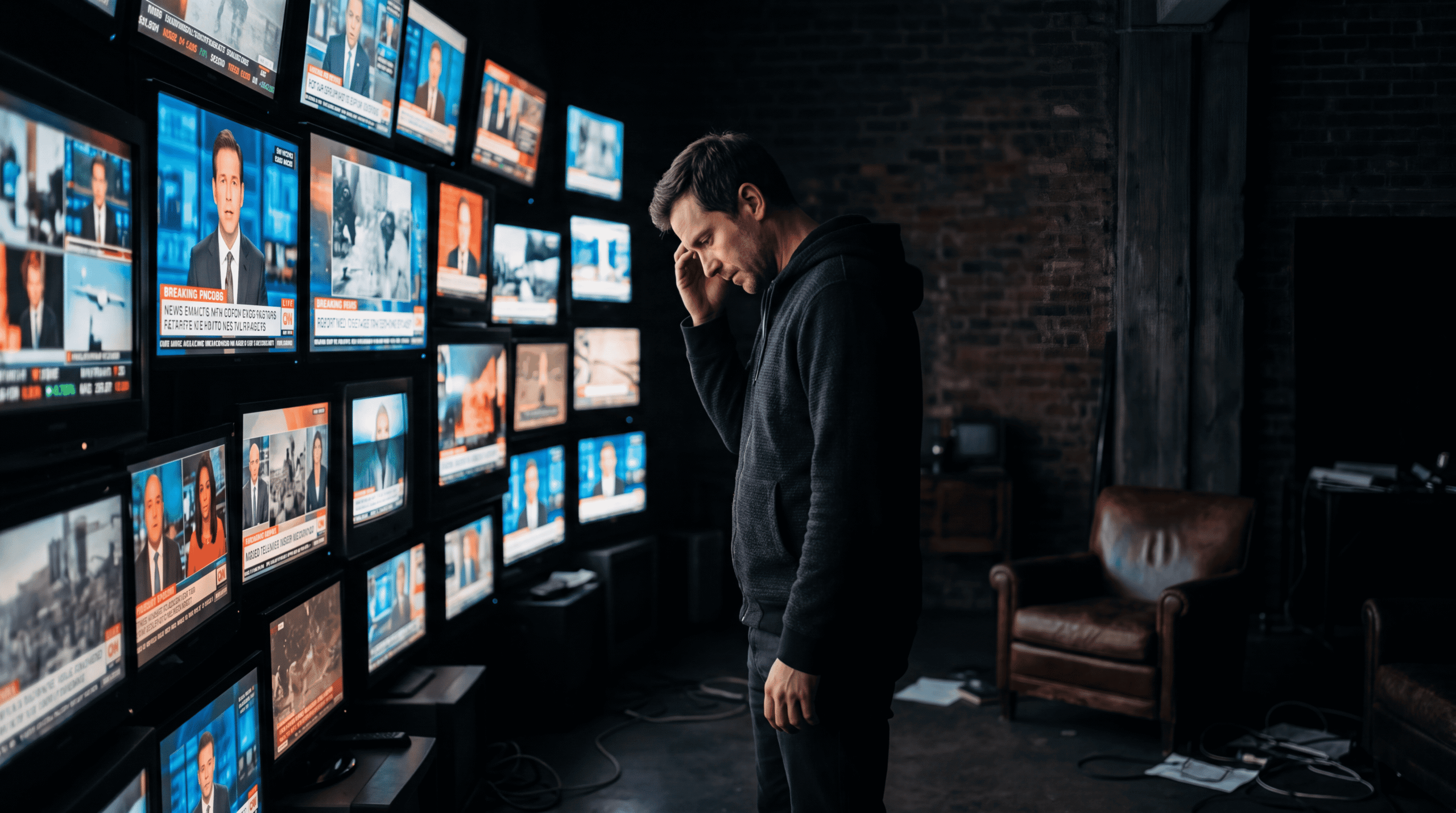

Your Brain Thinks the News Is Trying to Kill You
Here’s what nobody wants to admit: nearly half of us are actively avoiding the news, and it’s not because we’re lazy or uninformed. It’s because our brains have correctly identified that consuming news in 2025 feels like being attacked.
Recent research from the Reuters Institute confirms that 40% of people now selectively avoid news content. But the more interesting question isn’t who’s avoiding it—it’s why our psychology makes avoidance feel like the only rational response.
The Negativity Bias Is Working Exactly as Designed
Your brain evolved with a simple survival rule: pay more attention to threats than opportunities. This negativity bias kept our ancestors alive when missing a predator was fatal, but noticing an extra berry bush was just a nice bonus.
News organizations know this instinctively. A 2023 study in Nature Human Behaviour found that negative words in headlines increase click-through rates by 30%. Your amygdala—your brain’s threat detector—literally lights up more for “crisis” than “solution.”
The problem? In our ancestral environment, threats were immediate and local. You either escaped the lion or you didn’t. Today’s news cycle delivers an infinite stream of threats you can’t escape, can’t solve, and can’t stop thinking about.
Learned Helplessness Is Not a Character Flaw
When psychologist Martin Seligman first described learned helplessness in the 1960s, he observed that repeated exposure to uncontrollable stressors caused subjects to stop trying to escape—even when escape became possible. They had learned that their actions didn’t matter.
Sound familiar? Climate change, political polarization, economic inequality, global pandemics—the news consistently presents problems so vast that individual action feels meaningless. Research published in 2023 shows that prolonged exposure to news about uncontrollable negative events significantly predicts both anxiety and avoidance behaviors.
News avoidance isn’t apathy. It’s a psychological defense mechanism against the crushing weight of helplessness. Your brain is protecting you the only way it knows how: by shutting down the source of the overwhelm.
The Compassion Fatigue Nobody Talks About
There’s a limit to how much suffering the human brain can process before it simply stops responding. Emergency room doctors know this. Humanitarian workers know this. Now, the rest of us are learning it too.
Compassion fatigue—the reduced ability to empathize after prolonged exposure to others’ trauma—was once considered an occupational hazard of caregiving professions. A 2022 American Psychological Association survey found that 76% of adults report that news about national issues causes them significant stress.
Your empathy is not unlimited. When the news delivers a constant stream of suffering—war, disaster, injustice, tragedy—your brain eventually stops generating the emotional response. Not because you’ve become cold, but because you’ve run out of the neurochemical resources required to care at that intensity.
People often interpret their own numbness as moral failure. It’s not. It’s resource depletion.
The Doomscrolling Paradox
Here’s where it gets psychologically twisted: many people who avoid news still can’t stop checking their phones. They’re simultaneously fleeing from and compulsively seeking the very thing that distresses them.
This is approach-avoidance conflict in action—the psychological state where a stimulus is both attractive and threatening simultaneously. Research on problematic news consumption shows that checking news can trigger both stress responses and dopamine release, creating an addictive cycle even as it harms wellbeing.
You want to stay informed (approach motivation), but the content makes you feel terrible (avoidance motivation). Your brain tries to resolve this by developing erratic consumption patterns—binging and then abstaining, checking obsessively and then going cold turkey.
Neither extreme works, but your psychology keeps oscillating between them because the underlying conflict hasn’t been resolved.
Identity-Protective Cognition Makes Everything Worse
We like to think we consume news to become informed. But research on motivated reasoning reveals a different truth: we often consume news to protect our existing beliefs and social identities.
When news contradicts your worldview, your brain experiences it as a threat to your identity. The technical term is identity-protective cognition—the tendency to process information in ways that protect your sense of who you are and which group you belong to.
This creates an impossible situation: engaging with news increasingly requires engaging with information that your brain interprets as an attack on your identity. So avoidance becomes not just about protecting your mood, but about protecting your sense of self.
We’re not avoiding news because we don’t care about truth. We’re avoiding it because truth, as delivered by modern news media, often requires psychological sacrifice we’re not equipped to make.
The Research Says: Your Avoidance Makes Sense
A 2023 Reuters Institute study tracking news avoidance across 46 countries found that the most common reasons people give are: “it lowers my mood” (58%), “I feel powerless” (40%), and “I don’t trust it” (29%).
But here’s what matters: these aren’t three separate problems. They’re three expressions of the same psychological reality. When information consistently makes you feel bad, offers no sense of agency, and comes from sources your brain flags as unreliable, avoidance is the rational response.
Research published in the Journal of Communication confirms that news avoidance is highest among people who score high on measures of both anxiety and external locus of control—the belief that outcomes are determined by forces outside your influence.
Your avoidance isn’t a bug in your psychology. It’s a feature responding exactly as designed to an information environment that’s psychologically toxic.
The Real Cost Nobody Mentions
Here’s the part that keeps me up at night as a psychologist: news avoidance doesn’t solve the underlying problem. It just shifts where the damage occurs.
People who avoid news report lower levels of acute stress, which sounds good until you realize they also report feeling more disconnected from their communities, less confident in their ability to participate in civic life, and more vulnerable to misinformation when they do encounter news.
The mere exposure effect—the psychological principle that familiarity breeds liking and comfort—works in reverse too. The less you engage with news, the more foreign and threatening it becomes. Avoidance creates a positive feedback loop where distance breeds discomfort breeds more distance.
You’re not just losing information. You’re losing the psychological capacity to process information at all.
What Actually Works: Selective Engagement
The solution isn’t to white-knuckle your way through every headline. It’s to fundamentally change your relationship with news consumption.
Recent research on news consumption strategies identifies “selective engagement” as the healthiest approach: deliberately choosing what, when, and how much news you consume based on your psychological capacity and actual need for information.
This means treating news like any other potentially harmful substance—something to be consumed intentionally, in doses your system can metabolize, for specific purposes.
Not all news is equal. Your brain responds differently to solution-focused journalism versus crisis-focused journalism, to local news versus national news, to depth versus breadth. The people handling this best aren’t avoiding news entirely—they’re becoming dramatically more selective about what enters their attention.
Try This Today: The 3-Question Filter
Before you click on any news story, ask yourself three questions:
1. Can I do anything about this? If the answer is no and the story will only increase your sense of helplessness, that’s your brain’s cue to skip it.
2. Do I need to know this right now? Just because something happened doesn’t mean you need to know about it immediately. Your brain can’t distinguish between urgent and merely recent.
3. Will this information help me make a decision or take an action today? If not, you’re consuming it for emotional reasons, not practical ones—and those emotional reasons might be hurting you.
This isn’t about becoming uninformed. It’s about becoming strategic. Your attention is finite. Your capacity for distress is finite. Your empathy is finite. Treating them as unlimited resources is how you end up depleted, avoidant, and disconnected.
The people who tell you that avoiding news makes you a bad citizen don’t understand what’s actually happening in your brain when you read that next headline. You’re not avoiding reality—you’re avoiding psychological damage.
The question isn’t whether you should care about the world. It’s whether the way you’re currently consuming information about the world is sustainable for your nervous system, and the honest answer for 40% of people is no.