
You Think You’re Just Killing Time. Your Brain Thinks It’s Already on Vacation.
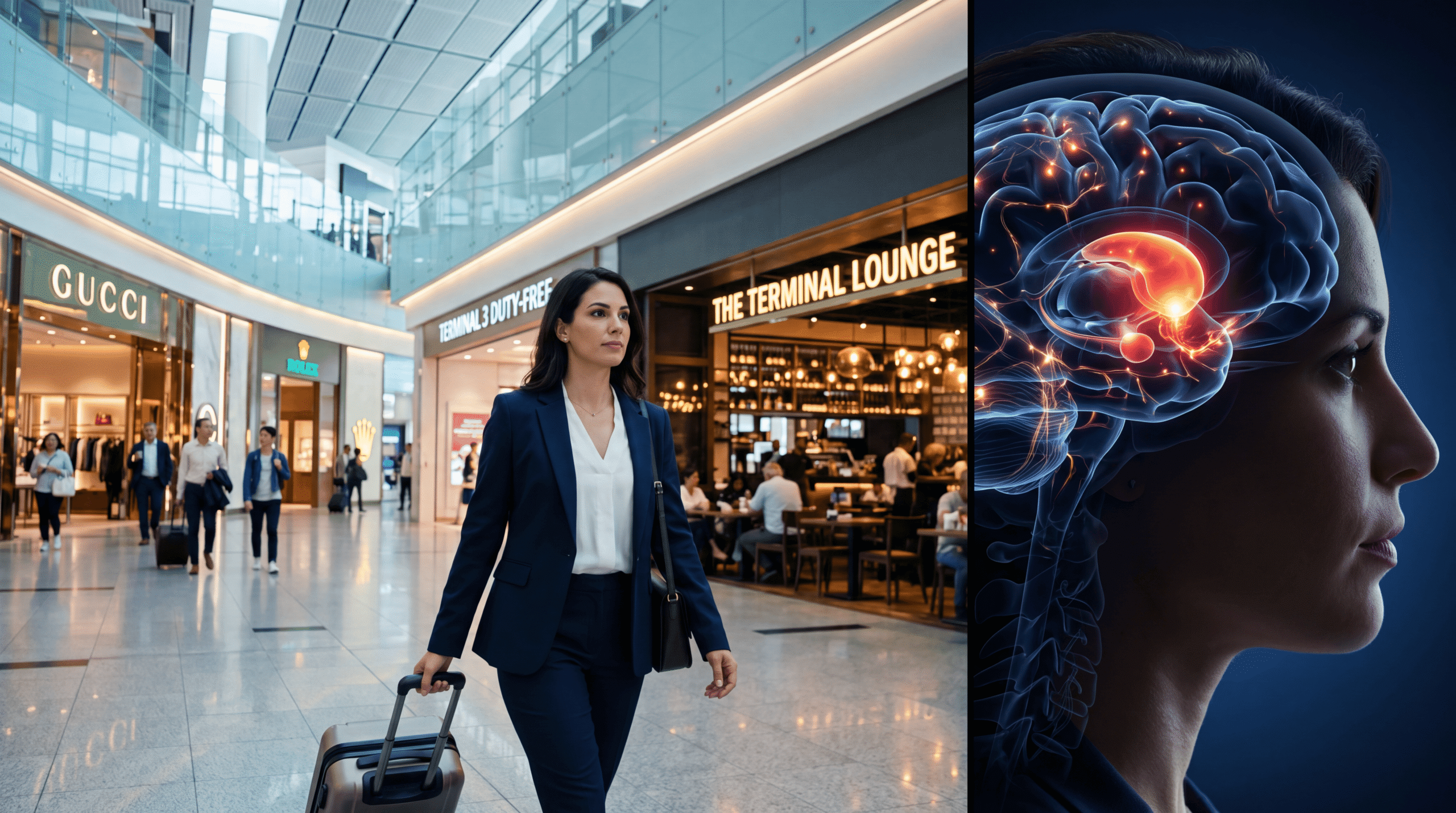
Here’s what nobody tells you about airports: they are not neutral spaces. Every square foot, every lighting choice, every maze-like path to your gate has been engineered to exploit a very specific vulnerability in your decision-making system. And it works because you genuinely believe you’re immune to it.
I’ve spent 15 years studying why intelligent people make predictably irrational choices. Airport spending isn’t about willpower or financial discipline. It’s about a perfect storm of psychological conditions that airports deliberately create—and your brain is wired to respond exactly as designed.
The Temporal Discounting Trap: Why Future You Doesn’t Exist Right Now
The moment you pass through security, your brain enters what behavioral economists call a “temporal bubble.” You’re no longer in your normal life, but you haven’t arrived at your destination. You exist in psychological limbo.
This triggers a cognitive bias called temporal discounting—our tendency to devalue future consequences when making present decisions. That $18 sandwich feels inconsequential because “regular life you” seems impossibly distant. The version of you who will check their credit card statement next month literally doesn’t feel real right now.
Research published in the Journal of Consumer Research shows that people in transitional spaces spend 30-50% more than they would in their home environment, even on identical products. The airport itself creates a mental accounting error where normal spending rules don’t apply.
The Licensing Effect: You’ve Earned This (Your Brain Insists)
Here’s where it gets insidious. You just navigated TSA. You arrived early like a responsible adult. You’re about to endure hours in a cramped seat. Your brain is running a unconscious moral ledger, and it’s decided you’ve earned a reward.
This is the licensing effect—when past good behavior gives us psychological permission for present indulgence. Airports are brilliantly designed to maximize this feeling. The stress of security creates the perfect setup for post-stress reward-seeking behavior.
Studies from behavioral psychology research demonstrate that people who experience mild stress followed by relief are 60% more likely to make impulse purchases within the next 30 minutes. Airport designers know this. That’s why the duty-free shops start immediately after security.
The Scarcity Illusion: Last Chance Before Nowhere
Walk through any airport and notice the messaging: “Last chance for fresh food.” “Final stop for duty-free prices.” “Get it now before boarding.” This isn’t accident—it’s weaponized scarcity psychology.
Your brain has an ancient scarcity detection system designed to make you grab resources when they might not be available later. Airports trigger this system relentlessly, even though you logically know there will be food at your destination.
The mechanism here is called loss aversion, and it’s stronger than reward-seeking by a factor of two. Your brain’s threat detection system treats “missing out” as a genuine loss, not a neutral non-purchase. So you buy the overpriced water bottle not because you want it, but because your amygdala is screaming that you might regret not having it.
The Paradox of Choice Meets Decision Fatigue
By the time you reach your gate, you’ve already made hundreds of micro-decisions: which security line, where to put your belongings, whether to remove your belt, which gate, whether to sit or stand. Your prefrontal cortex—the part responsible for rational decision-making—is quietly exhausted.
This is decision fatigue, and it has a predictable effect: you default to easy, impulsive choices. That’s why airport shopping feels so frictionless. You’re not carefully weighing options. You’re accepting whatever your depleted brain suggests feels good right now.
Research from the Proceedings of the National Academy of Sciences shows that judges are significantly more likely to grant parole early in the day versus late in the day, when decision fatigue has set in. Your spending decisions work the same way—except airports have designed the environment to maximize your fatigue right when you encounter spending opportunities.
The Anchoring Effect of Inflated Prices
Here’s a question: Why do airports display $12 bottles of water next to $8 bottles of water? Because the $12 bottle makes the $8 bottle seem reasonable, even though you’d never pay $8 for water at home.
This is the anchoring effect—our tendency to rely too heavily on the first piece of information we encounter when making decisions. Airports deliberately set absurdly high anchor prices to make their regular (still inflated) prices seem acceptable by comparison.
Your rational brain knows you’re being manipulated. But the anchoring effect operates below conscious awareness. The $12 bottle creates a reference point that your brain uses automatically, whether you want it to or not.
The Research Says: Your Environment Overrides Your Intentions
A landmark study published in Psychological Science examined consumer behavior in transitional spaces versus stable environments. The findings were unambiguous: physical environment overrides stated intentions in 73% of purchasing decisions.
Another study from the American Psychological Association tracked travelers’ pre-airport spending intentions versus actual behavior. Only 31% of participants stuck to their stated budget. The average overage was 340%.
What makes airports particularly effective is the combination of factors: temporal displacement, decision fatigue, scarcity messaging, and emotional licensing all happening simultaneously. No single bias would be sufficient. But together, they create an environment where your executive function is systematically dismantled.
The Identity Shift: You Become the Traveler
Here’s the deepest layer: airports don’t just manipulate your decision-making. They manipulate your identity. The moment you’re in the departure lounge, you unconsciously adopt “traveler” as a temporary self-concept.
And travelers, your brain believes, buy airport food. They browse duty-free. They spend money on convenience. This is identity-based decision-making—we make choices consistent with our current self-concept, even when that self-concept is temporary and externally imposed.
Research on situational identity shows that people make wildly different choices based on which aspect of their identity is currently activated. At home, you’re “responsible budgeter.” At the airport, you’re “busy traveler who deserves convenience.” Different identity, different choices.
The Sunk Cost Fallacy: You’ve Come This Far
By the time you’re at your gate, you’ve already invested time, money, and stress into this journey. Your brain unconsciously calculates that a little more spending is trivial compared to what you’ve already committed.
This is the sunk cost fallacy—our tendency to continue investing in something because we’ve already invested so much, even when additional investment isn’t rational. Airports are the perfect environment for this bias because your travel costs are already substantial. What’s another $30?
The mechanism here is emotional accounting. Your brain doesn’t evaluate the $30 purchase in isolation. It evaluates it as a tiny percentage of your total trip cost, which makes it feel insignificant. Airports maximize this by clustering shopping opportunities after you’ve already passed the point of maximum investment (buying your ticket, arranging time off, getting to the airport early).
Why Your Rational Brain Can’t Save You
Here’s what makes airport psychology so effective: knowing about these biases doesn’t immunize you against them. Awareness is not the same as immunity.
These mechanisms operate at the automatic, pre-conscious level. By the time you’re consciously aware you’re making a decision, your brain has already been primed, fatigued, and emotionally manipulated. You can know you’re being influenced and still be influenced.
The environmental design is too powerful. You’d need to maintain perfect prefrontal cortex vigilance for hours in a space deliberately engineered to deplete that exact resource. It’s not a fair fight.
Try This Today: The Pre-Commitment Strategy
Since willpower fails in airports, don’t rely on it. Instead, use pre-commitment—making binding decisions before you enter the psychologically manipulative environment.
Before your next flight, do this: Decide exactly what you’ll buy and set a specific dollar limit. Write it down. Bring your own water bottle and snacks. Give yourself permission for one specific indulgence (a magazine, a coffee) but pre-decide what it is.
The key is removing real-time decision-making. Your future airport self will be cognitively compromised. Your current self is not. Make the decisions now, when your executive function is intact. Then your airport self just executes a plan rather than making vulnerable choices in a hostile environment.
This works because it circumvents all the biases at once. You’re not fighting temporal discounting or decision fatigue in the moment—you’ve already made the decision in a different psychological context.
The Uncomfortable Truth About Your Mind
Airport spending reveals something we desperately don’t want to believe: our environment shapes our choices far more than our values or intelligence. You’re not weak-willed. You’re human, operating in a space designed by people who understand your cognitive vulnerabilities better than you do.
The real insight isn’t about airports. It’s about recognizing that you are always somewhat at the mercy of your environment. Your brain is constantly being shaped by contexts you didn’t choose and biases you can’t fully control.
The question isn’t whether you’ll be influenced—you will be. The question is whether you’ll design your environments and decisions proactively, or let someone else do it for you. At airports, someone else already has.
Every dollar you spend in a departure lounge is a small reminder that you are not the rational decision-maker you believe yourself to be—you’re a biological system responding to environmental cues, just like everyone else who emptied their wallet in that same terminal.