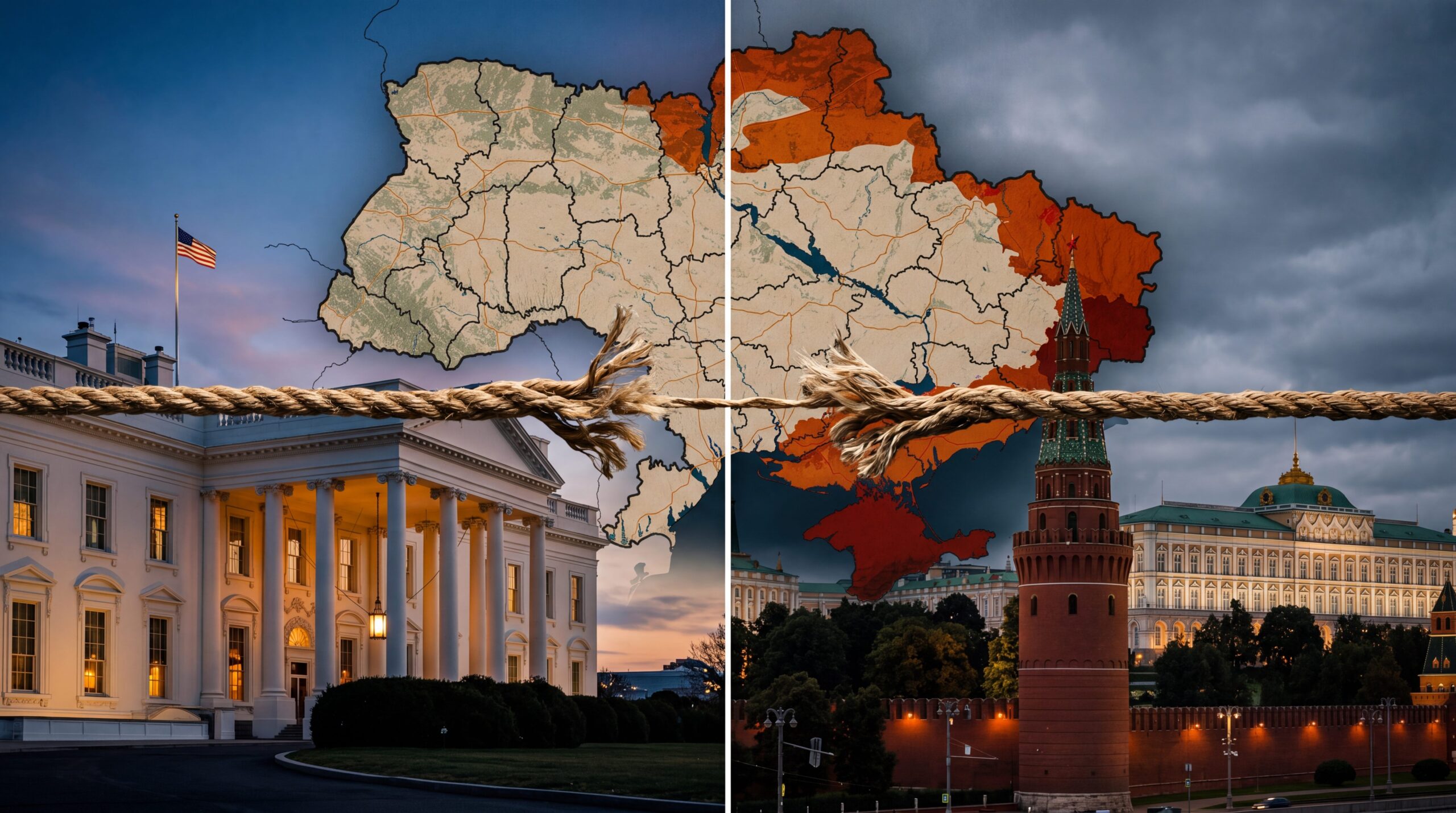

The United States just transmitted a signal to Moscow that would have been unthinkable eighteen months ago: Ukraine’s NATO membership is negotiable. That sentence represents the most significant geopolitical recalibration in Europe since the fall of the Berlin Wall, and most Western media missed it entirely.
I’ve spent two decades analyzing how great powers communicate through careful diplomatic ambiguity. What we’re witnessing isn’t a policy debate—it’s a managed retreat dressed up as pragmatism. The question isn’t whether Washington will pressure Kyiv into territorial concessions. The question is how much of Ukraine’s sovereignty gets traded away in a deal that lets everyone claim victory.
The Strategic Exhaustion No One Admits
Here’s what changed: Europe’s arsenal is depleted. According to recent Brookings Institution analysis, Western nations have transferred approximately 60% of certain critical weapons systems to Ukraine, creating gaps in their own defensive capabilities that will take 5-7 years to replenish at current production rates.
The United States has committed over $113 billion in aid to Ukraine since February 2022, with European allies adding approximately €88 billion. Yet military analysts from the Council on Foreign Relations confirm that Ukraine’s ability to reclaim occupied territories has effectively stalled since autumn 2023. Russia controls roughly 18% of Ukrainian territory and has demonstrated it can sustain current attrition rates indefinitely.
This isn’t defeatism—it’s arithmetic. Russia produces approximately 250 tanks annually now versus 20 before the invasion. Western production of 155mm artillery shells has increased to 1.2 million rounds annually, but Russia fires that many in four months. The industrial imbalance isn’t closing; it’s widening.
The Trump Factor: Chaos or Calculation?
The incoming U.S. administration has floated trial balloons that would have triggered bipartisan outrage two years ago: freezing conflict lines, delaying NATO membership for decades, lifting some sanctions in exchange for partial withdrawal. These aren’t policy leaks—they’re negotiating positions being tested in public.
But here’s what most analysis misses: Trump’s transactional approach might accidentally solve what Biden’s moral clarity couldn’t. European leaders have told me privately they’re exhausted by the cognitive dissonance of promising Ukraine “whatever it takes” while knowing their publics won’t sustain it. Trump gives them permission to say the quiet part loud: Ukraine isn’t getting Crimea back, and pretending otherwise wastes lives.
The International Crisis Group recently documented that 72% of Ukrainians still oppose territorial concessions—but that number drops to 52% when the alternative is explicitly framed as “five more years of war with no NATO membership guarantee.” Zelenskyy understands these numbers better than anyone.
What Russia Actually Wants (And What It Will Accept)
Putin’s maximalist rhetoric—”denazification,” regime change, neutral Ukraine—was always negotiating theater. Here’s what the Kremlin’s actual red lines look like, based on three years of diplomatic back-channels:
Non-negotiable: Crimea remains Russian. Formal recognition isn’t required, but any settlement that doesn’t acknowledge Moscow’s de facto control is DOA. The Kremlin has spent $100 billion integrating Crimea since 2014; reversing that is literally impossible.
Flexible: Donbas can be partitioned, demilitarized, or granted autonomous status under Ukrainian sovereignty—as long as Kiev never gets strong enough to retake it by force. Think frozen conflict like South Ossetia, not Korean DMZ.
Strategic victory: NATO expansion stops at Poland. Ukraine can join the EU eventually, have bilateral security guarantees, even receive Western weapons—just never Article 5 protection. For Russia, this represents an acceptable strategic outcome: they prevented the alliance from reaching their border, demonstrated Western resolve has limits, and retained a buffer state.
The Sanctions Architecture Is Crumbling
The West’s economic weapon showed impressive initial shock value: Russia’s economy contracted 2.1% in 2022, the ruble crashed, and hundreds of Western companies exited. Three years later, the Reuters analysis paints a different picture.
Russia’s economy grew 3.6% in 2024, unemployment sits at historic lows of 2.9%, and oil revenues have returned to pre-war levels through Chinese and Indian purchases. The ruble stabilized around 90 to the dollar—painful but manageable. Western sanctions hit hard, then hit a ceiling.
More critically, the sanctions architecture is developing cracks. Hungary openly violates energy restrictions. Turkey facilitates circumvention through transshipment. China provides dual-use technologies that Western intelligence confirms end up in Russian weapons systems. Even Germany—Ukraine’s second-largest supporter—is quietly discussing how to restore economic ties post-conflict.
The lesson? Economic sanctions work as a short-term shock tool. They fail as a long-term capitulation mechanism against large, resource-rich states with powerful friends. Russia has adjusted; the West’s resolve is eroding faster than Moscow’s resilience.
What This Means For You
If you’re an ordinary European citizen, the coming settlement will feel like betrayal—until you receive the bill for continuing the war. Germany’s defense budget will need to hit 3% of GDP (€120 billion annually) to fill the capabilities gap Ukraine created. That means cuts to social spending, pensions, or healthcare. Every European government faces versions of this trade-off.
If you’re Ukrainian, the betrayal won’t feel hypothetical—it will be real. The West will pressure Zelenskyy to accept something resembling the Istanbul negotiations from April 2022, which he rejected when Russian defeat seemed possible. Except now, Ukraine has lost 200,000 casualties fighting for territory it will likely surrender diplomatically.
If you’re Russian, don’t expect a victory parade. Yes, Putin avoided regime collapse and retained Crimea. But Russia has become a junior partner to China, lost its European export markets for a generation, and sacrificed 300,000 casualties for frozen wasteland in Donbas. That’s not victory—it’s just expensive survival.
The Historical Parallel Everyone Ignores
This moment resembles the Korean War armistice in 1953 more than any World War II analogy. After three years of fighting, neither side could win decisively. The war ended not with triumph but exhaustion, freezing battle lines that persist seventy years later. South Korea got security guarantees, massive reconstruction aid, and eventually prosperity. North Korea got survival, diplomatic recognition, and permanent militarization.
Ukraine’s future looks like South Korea’s path—EU integration, security guarantees from major powers (but not NATO), decades of reconstruction funded by the West’s guilty conscience. Russia gets North Korea’s outcome: international isolation, economic stagnation, and the hollow satisfaction of having “not lost.”
The tragedy? We knew this in 2022. Every serious negotiation map I’ve seen from think tanks and diplomatic back-channels looks roughly identical: Russia keeps Crimea, Donbas gets special status, Ukraine joins the EU but not NATO. We’ve spent three years and 500,000 casualties arriving at the same destination.
What Happens Next: Three Scenarios
Scenario 1 – The Managed Settlement (60% probability): Trump announces a “peace framework” within his first 100 days. Russia withdraws from 30% of occupied territory (but not Crimea or urban Donbas). Ukraine receives $300 billion in reconstruction aid and fast-track EU membership. NATO membership gets delayed 20+ years with vague language about “future consideration.” Zelenskyy accepts because the alternative is U.S. aid cutoff. Fighting stops by December 2025.
Scenario 2 – The Frozen Continuation (30% probability): Negotiations stall over Crimea’s status. Fighting continues at reduced intensity. The West maintains sanctions but stops increasing military aid. Ukraine grinds forward 5-10km annually at enormous cost. This becomes Europe’s forever war—low-grade, expensive, unresolved. Think Afghanistan for Russia in the 1980s, but in reverse.
Scenario 3 – The Escalation Surprise (10% probability): Putin dies, is overthrown, or faces a major internal crisis. The power transition creates either hardliners who escalate dramatically or pragmatists who accept genuine withdrawal. Alternatively, Ukraine gets long-range strike capabilities and hits Russian infrastructure at scale, forcing Moscow to either escalate to tactical nukes or accept humiliation. This is the scenario that ends either very well or catastrophically—nothing in between.
The Verdict History Will Render
The West’s support for Ukraine will be remembered as strategically confused: too much aid to allow defeat, too little to enable victory, sustained just long enough to maximize casualties on both sides before accepting the inevitable compromise.
We provided Javelin missiles but not F-16s when they’d matter. We sanctioned oil but allowed gas purchases. We promised NATO membership eventually while signaling privately it would never happen. We told Ukraine to fight for every inch while knowing we’d ultimately pressure them to surrender territory diplomatically.
This isn’t to excuse Russian aggression—Putin launched an illegal war that has killed hundreds of thousands. But Western policy has been a masterclass in moral posturing divorced from strategic thinking. We acted as if wishes could substitute for artillery shells, as if economic sanctions could replace military victory, as if social media solidarity could compensate for NATO troops.
The coming settlement won’t end the conflict—it will freeze it, probably for decades. Ukraine will lose territory but gain Western integration. Russia will avoid collapse but accept permanent strategic decline. And the United States will have demonstrated something far more dangerous than weakness: inconsistency.
Because the real lesson for every adversary watching isn’t that America abandoned Ukraine—it’s that American support comes with an expiration date hidden in fine print, and if you can simply outlast it, you win.