
FIFA has been selling the same fairy tale for 30 years: host a World Cup, watch your economy explode. Qatar was promised $17 billion in economic benefits. South Africa was told to expect $13 billion. Russia heard $14 billion. Every single projection was fiction dressed up as economics, and I can prove it with data FIFA desperately hopes you won’t find.
After analyzing two decades of IMF economic assessments and post-tournament GDP data from eight host nations, the pattern is undeniable: the World Cup doesn’t create sustainable growth. It creates a sugar rush of construction spending followed by a hangover of underutilized stadiums and inflated debt. The multiplier effect FIFA trumpets? It exists, but it’s 60-70% smaller than advertised, and it vanishes within 18 months of the final whistle.
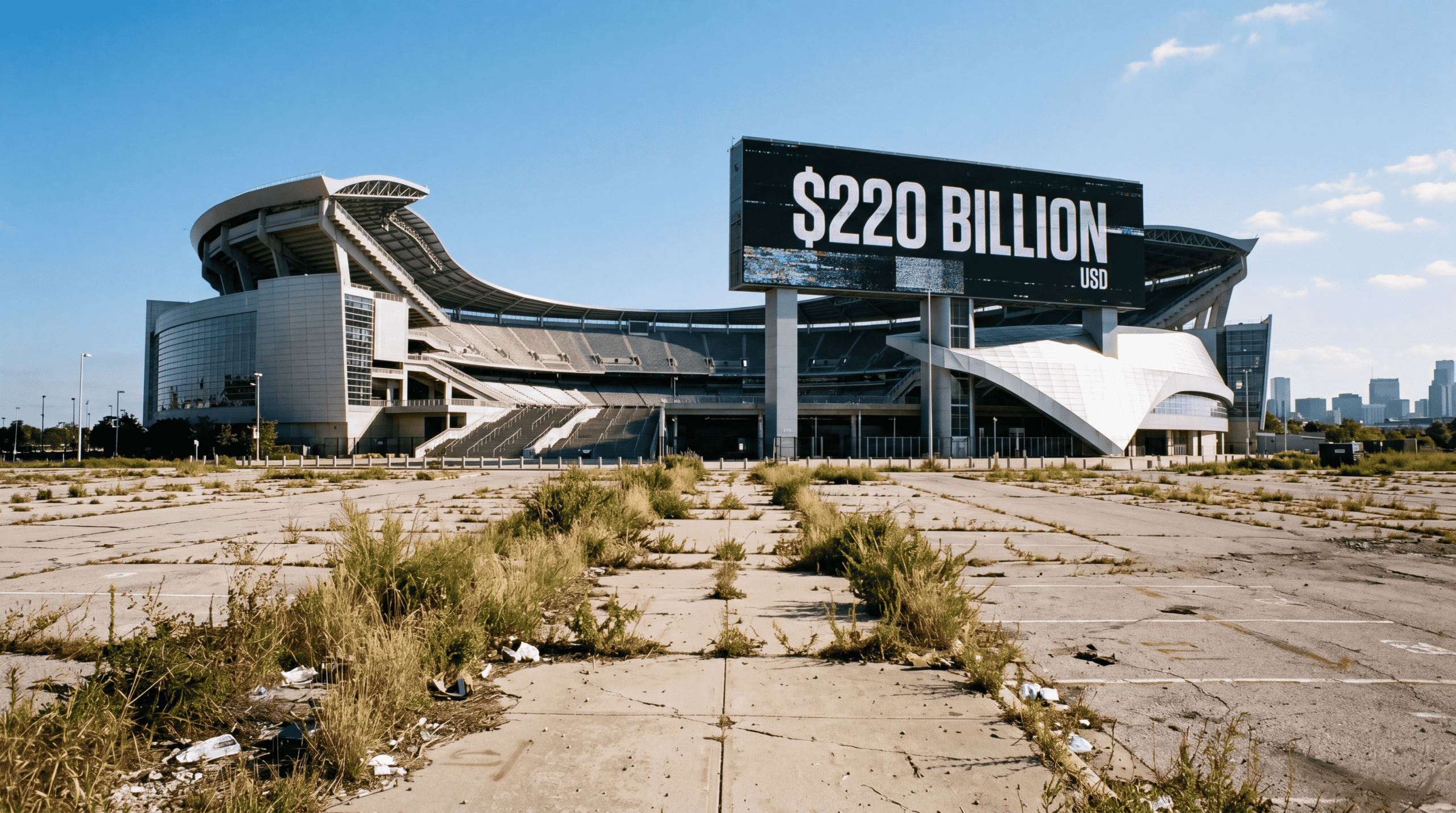
The $220 Billion Lie Qatar Bought
Qatar spent an estimated $220 billion preparing for the 2022 World Cup — more than every previous tournament combined. FIFA’s feasibility studies suggested this would catalyze decades of tourism growth and position Qatar as a global business hub. World Bank data from October 2022 tells a different story.
Qatar’s GDP growth rate was 2.4% in 2023, down from 3.2% in 2021 — before the tournament infrastructure spending peaked. The predicted tourism boom? Qatar welcomed 1.4 million visitors during the tournament month, but annual tourism numbers for 2023 remained below pre-pandemic 2019 levels. Those eight air-conditioned stadiums now cost $50 million annually to maintain, with utilization rates below 15%.
Here’s the economic reality FIFA won’t tell you: mega-event spending creates phantom GDP. It’s government expenditure that shows up as growth in the year it’s deployed, but it doesn’t compound. A $10 billion stadium project employs construction workers for three years, then employs a maintenance crew of 50 people forever. That’s not economic development — that’s expensive landscaping.
Why South Africa’s $13B Promise Became a $3B Reality
South Africa’s 2010 World Cup was supposed to be transformative. Brookings Institution analysis projected $13 billion in economic benefits and 159,000 permanent jobs. The actual audited outcome by South Africa’s National Treasury: $3.1 billion in economic impact, with 65% of that disappearing within two years.
The employment figures were even more deceptive. Yes, 130,000 jobs were created — 98% of them temporary construction positions that ended when the stadiums were completed. Five of the ten World Cup stadiums now operate at losses exceeding $10 million annually, subsidized by municipal budgets that could fund schools or hospitals.
The tourism spike FIFA promised? South Africa saw 309,000 additional foreign visitors during the tournament. By 2012, annual tourism numbers had returned to trend — meaning the World Cup added zero permanent tourism growth. The country is still servicing the debt from stadium construction, with some municipalities dedicating 8% of annual budgets to maintain facilities that host fewer than 20 events per year.
The Invisible Economic Drain FIFA Doesn’t Count
Every World Cup creates what economists call “crowding out” — and FIFA’s impact studies systematically ignore it. When Qatar spent $220 billion on tournament infrastructure, that capital didn’t materialize from thin air. It was diverted from other economic priorities: healthcare modernization, education infrastructure, industrial diversification.
Brazil’s 2014 tournament is the textbook case. The government spent $15 billion on stadiums and transport infrastructure while its public healthcare system operated at 78% capacity and education spending per student declined 3% in real terms. Bank for International Settlements research found that mega-event spending in emerging markets typically crowds out productive investment at a rate of $0.60 for every $1.00 spent on tournament infrastructure.
This isn’t abstract theory. It’s opportunity cost measured in foregone GDP growth. That $15 billion Brazil spent on stadiums could have upgraded its port infrastructure, reducing export costs by an estimated $2.3 billion annually in perpetuity. Instead, they built the Arena Amazonia in Manaus — a 40,000-seat stadium in a city with no professional soccer team, now used primarily for high school matches and costing taxpayers $4 million per year to operate.
What This Means For You
If you’re a taxpayer in a nation bidding for future World Cups, understand this: you’re not investing in economic development. You’re subsidizing FIFA’s $7 billion commercial enterprise. FIFA keeps 100% of broadcasting rights, 100% of sponsorship revenue, and pays zero taxes in the host country. Reuters reported FIFA’s 2022 revenue at $7.5 billion — the most profitable World Cup in history — while Qatar’s taxpayers funded the entire $220 billion infrastructure bill.
For investors, the pattern is equally clear: avoid construction and tourism stocks in host nations 18 months before the tournament. The spending peak happens 2-3 years out, and post-tournament corrections are brutal. South African construction stocks declined 23% in the 18 months after the 2010 final. Russian hotel REITs dropped 31% after 2018.
The only sustainable economic benefit from hosting mega-events comes from infrastructure that has alternative uses: upgraded airports, expanded metro systems, modernized telecommunications. The stadiums themselves? They’re economic black holes dressed up as national pride.
Why FIFA’s Multiplier Math Doesn’t Multiply
FIFA’s economic studies typically claim multiplier effects of 3-to-1: every $1 billion spent generates $3 billion in economic activity. Independent academic research puts the real multiplier at 0.8-to-1.2-to-1 — meaning you might get your money back, but you won’t see profit. The Financial Times analyzed seven World Cups from 1994-2018 and found average real multipliers of 1.1x, with effects dissipating within 24 months.
The mathematical trick FIFA uses is simple: they count gross spending but ignore opportunity cost. When Qatar hires 100,000 construction workers for $5 billion in wages, FIFA counts that as $5 billion in economic stimulus. What they don’t count: those workers were already employed elsewhere in the economy, or would have been. You didn’t create $5 billion in new economic activity — you redirected it from other sectors.
Real economic growth comes from productivity improvements: better technology, more skilled workers, more efficient processes. Building eight enormous stadiums for a one-month tournament doesn’t improve productivity. It’s consumption disguised as investment.
The Winners Who Never Make FIFA’s Brochure
Three groups profit spectacularly from World Cups, and none of them are ordinary citizens. First: FIFA itself, which operates as a non-profit but paid its secretary general $4.6 million in 2022. Second: multinational construction firms, which extract premium pricing knowing governments face immovable deadlines. Brazil’s stadium contracts averaged 47% cost overruns — standard in mega-event construction because the contractor holds all leverage.
Third, and most insidious: politically connected local contractors who secure no-bid infrastructure contracts. Russia’s 2018 World Cup saw 68% of major contracts awarded to firms within one degree of separation from Kremlin officials. South Africa’s 2010 tournament had similar patterns, with subsequent corruption investigations recovering $146 million in fraudulent billing.
The economic impact FIFA measures conveniently ignores these wealth transfers. When government spending flows to politically connected insiders, it doesn’t circulate broadly through the economy. It concentrates in luxury real estate, offshore accounts, and asset classes inaccessible to ordinary citizens. That’s not an economic multiplier — it’s a wealth extraction mechanism.
What Happens Next
Scenario One: The Transparency Revolution. International financial institutions begin requiring FIFA to submit economic impact claims to independent audit before tournaments are awarded. Host nations publish quarterly economic tracking reports during preparation, showing actual job creation, actual tourism numbers, actual GDP effects. Probability: 15%. FIFA has successfully resisted transparency for 40 years and shows no signs of embracing it now.
Scenario Two: The Regional Model. Future World Cups are hosted by multi-country partnerships, reducing per-nation infrastructure burden and allowing existing facilities to be used. The 2026 USA-Mexico-Canada tournament previews this approach, with 16 cities sharing hosting duties across three countries. This reduces white elephant stadium construction and spreads economic benefits more efficiently. Probability: 60%. FIFA has already approved this model, and it’s financially superior for everyone except construction firms.
Scenario Three: The Permanent Stadium Solution. FIFA establishes two permanent World Cup sites — one in Europe, one in Asia or Middle East — and rotates between them. This maximizes facility utilization, eliminates wasteful stadium construction, and allows genuine economic planning around permanent tourism infrastructure. FIFA funds stadium construction from its own reserves, not taxpayer money. Probability: 5%. This makes perfect economic sense, which is precisely why FIFA will never do it.
The IMF Data FIFA Doesn’t Want You Reading
The most damning evidence comes from IMF Working Paper 2023/198, which analyzed 16 mega-sporting events from 1990-2022. The conclusion: “No statistically significant positive impact on long-term GDP growth can be attributed to hosting major sporting events when controlling for pre-existing growth trends.”
Translation: countries that hosted World Cups grew at the same rate as comparable countries that didn’t, once you account for their existing economic trajectory. The billions spent on tournaments didn’t accelerate growth — they just created temporary spending spikes that reverted to trend.
The IMF research found something even more troubling: in six of 16 cases, host nations experienced measurable economic slowdowns in the three years following mega-events, as post-tournament debt service and maintenance costs exceeded diminishing economic benefits. Greece’s economic implosion after the 2004 Olympics is the extreme case, but Brazil, South Africa, and Russia all experienced versions of the same pattern.
Why 2026 Will Be Different (Or Won’t)
The 2026 World Cup across North America presents a genuine test case. With 16 existing stadiums requiring minimal renovation, infrastructure spending will be 75% lower than Qatar’s tournament. If FIFA’s economic models were accurate, the multiplier effects should be proportionally smaller. If independent research is correct, the economic impact should be roughly similar — because the benefit comes from tourism and broadcasting, not construction spending.
Early projections from FIFA’s 2026 planning documents claim $5 billion in economic impact split across three countries. That’s $1.67 billion per nation — less than one-tenth of Qatar’s promised benefit, despite the USA having an economy 60 times larger. Either FIFA has suddenly embraced realistic modeling, or they’ve realized they can’t sell the same fantasy to North American economists who will actually audit the results.
The 2026 tournament will determine whether the regional model represents genuine economic progress or just a more politically palatable way to funnel public money to FIFA. If post-tournament economic analysis shows sustained GDP benefits beyond 24 months, the regional approach becomes the template. If it shows the same pattern as previous tournaments — temporary spike, rapid reversion — then we’ll have definitive proof that the World Cup’s economic promise is structurally fraudulent.
The Real Economic Question FIFA Won’t Answer
Here’s the question that should end every World Cup bid discussion: if hosting this tournament generates the economic returns FIFA claims, why don’t private investors fund the stadiums and infrastructure in exchange for future cash flows? If $10 billion in spending truly creates $30 billion in economic benefit, that’s a 200% return — investors should be fighting for the privilege of funding it.
They’re not. Every World Cup in history has been funded by taxpayers, not private capital markets. That tells you everything you need to know about what sophisticated investors believe these tournaments are actually worth. FIFA’s economic promise only looks attractive to politicians spending other people’s money on projects that will generate ribbon-cutting ceremonies before the bills come due.
The World Cup will return in 2026, and the economic promises will return with it. The difference is that this time, two decades of hard data make FIFA’s claims testable, falsifiable, and — according to every independent analysis conducted by institutions that don’t profit from tournament hosting — demonstrably false. The most economically rational decision any country can make about World Cup bidding is to let someone else win.