
The Trump T1 phone isn’t a phone. It’s a masterclass in brand arbitrage.
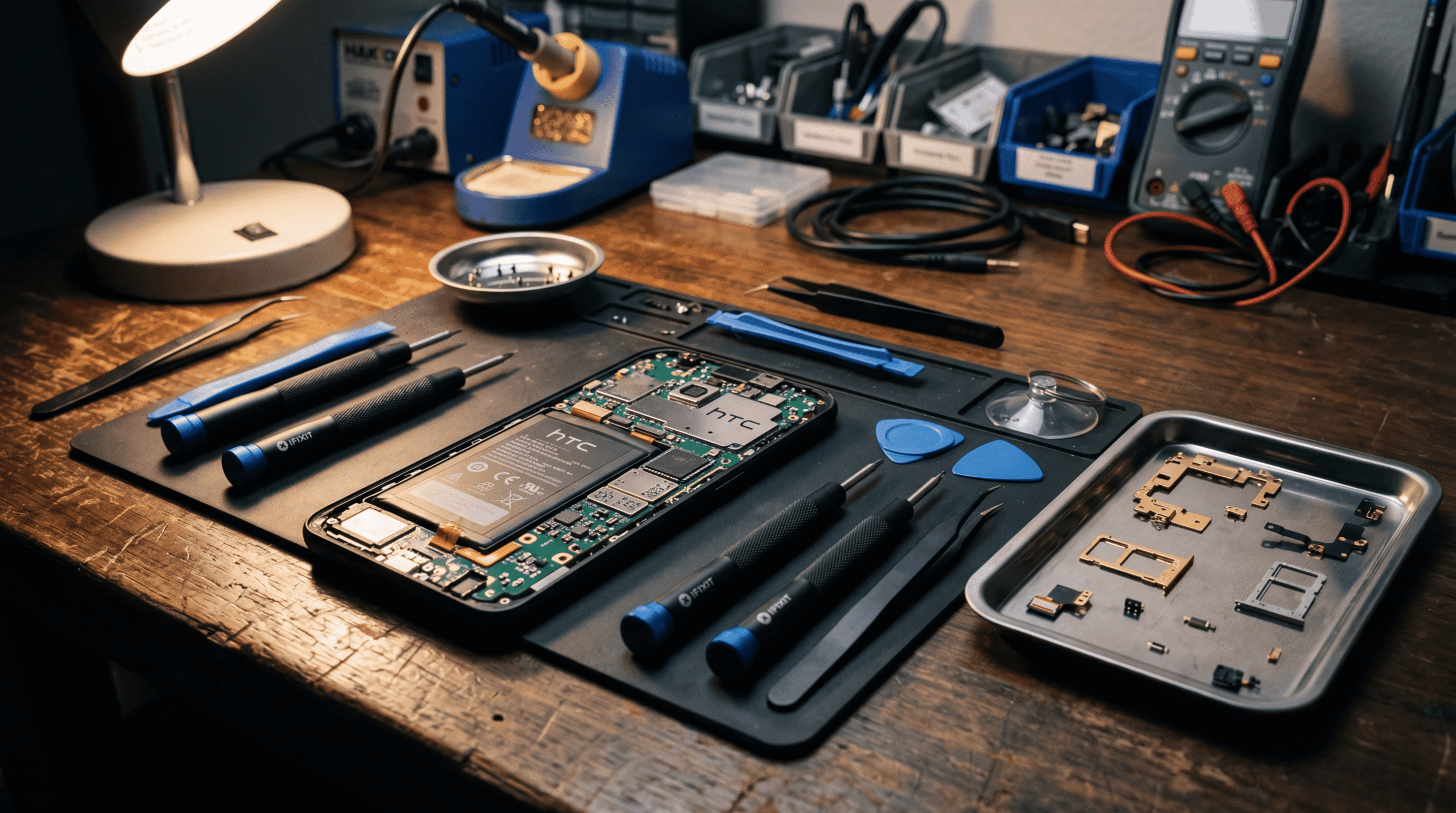
iFixit just tore down the $799 “Trump Phone” and found exactly what anyone who has shipped a hardware product expected: a perfectly competent HTC U24 Pro that retails for $350-400, wrapped in gold-accented plastic and sold at a 100%+ markup. The device ships with a Qualcomm Snapdragon 7 Gen 3 processor, 12GB RAM, and 256GB storage — respectable mid-range specs that were competitive when HTC designed this phone in 2023.
What makes this story worth dissecting isn’t the grift. It’s what the internals reveal about the economics of political merchandise and why this model works despite being transparently overpriced.
What The Teardown Actually Shows
The iFixit teardown is clinically thorough. They found an HTC U24 Pro motherboard with all original component markings, standard adhesive assembly, and zero custom engineering beyond cosmetic changes to the rear panel and boot screen.
The camera module is HTC’s standard 50MP + 8MP + 50MP telephoto array. The 4600mAh battery uses off-the-shelf cells. The display is a 6.8″ OLED that HTC sources from the same Samsung Display supply chain as dozens of other mid-range Androids. Even the charging circuit is stock HTC — 60W wired, 15W wireless, identical to the U24 Pro specification sheet.
The only customization is software-level: a modified boot animation, pre-loaded conservative news apps, and cosmetic UI tweaks. Total engineering investment to rebrand this phone: probably under $50,000 including compliance testing. They’re selling a product that costs them roughly $200-250 per unit (wholesale HTC pricing plus modest customization) for $799.
The Performance Reality: Perfectly Fine For 2023
Here’s what nobody in the press is saying clearly: as a phone, the Trump T1 is fine.
The Snapdragon 7 Gen 3 delivers performance roughly equivalent to a Snapdragon 870 — which means smooth scrolling, competent gaming, and zero lag in daily use for 95% of consumers. The camera hardware is the same sensor array HTC uses in their flagships. The 120Hz OLED display is genuinely good. Battery life with a 4600mAh cell and efficient 4nm processor will easily push through a full day.
If this phone cost $400, it would be a solid value buy. At $799, you’re paying $400 for a logo and the psychological satisfaction of owning “Trump’s phone.” The hardware delivers zero technical advantages over buying the HTC U24 Pro directly — which you can’t easily do in the US because HTC has virtually zero retail presence here.
That distribution gap is the entire business model. They’re not selling a phone. They’re selling access to a phone that’s hard to buy, wrapped in political identity signaling.
What The Press Got Wrong
Most coverage framed this as a scam or fraud. That’s lazy analysis. This is standard white-label consumer electronics arbitrage, done at political merchandise margins instead of traditional retail margins.
The real story is how broken Android OEM economics have become. HTC — once a top-five global smartphone maker — is now so desperate for revenue that they’ll let anyone rebrand their flagship hardware for the right minimum order quantity. The Trump T1 suggests an MOQ around 10,000-20,000 units, which at HTC’s wholesale pricing is roughly $2-5 million upfront capital.
That’s pocket change for a political merchandise operation that pre-sold thousands of units at $799 before shipping a single device. The profit margin is probably 60-70% after accounting for HTC’s wholesale cost, light customization, and fulfillment.
The second thing the press missed: this isn’t about competing with iPhone or Galaxy S series. It’s about creating avertically integrated media-merchandise ecosystem. Every Trump T1 ships with pre-loaded apps that are, functionally, distribution channels for conservative media properties. The phone is the razor; the apps and future services are the blades.
Who Actually Wins and Loses
Winners:
- HTC’s ODM division, which just moved 10,000+ units of aging inventory at wholesale prices that keep their Taiwan factory running
- The Trump merchandise operation, printing 60%+ margins on pre-sold hardware
- Conservative media apps that gain embedded distribution on devices owned by highly engaged users
Losers:
- Consumers who genuinely believe they’re buying custom-engineered American technology
- Mid-tier Android OEMs (Motorola, OnePlus, Nothing) who have to compete against subsidized political merchandise
- Google, who watches Android fragment further into closed content ecosystems that bypass Play Store economics
The biggest loser might be Samsung. If political merchandise can move 50,000 units at $799 with zero marketing spend beyond email lists, that’s 50,000 fewer Galaxy A-series sales. Scale that model across other political figures, causes, and affinity groups, and you have a genuine threat to traditional Android OEM distribution.
The Technical Implications Everyone Ignores
Here’s what matters for the next 18 months: this proves political brand strength can overcome the cold start problem in hardware.
Launching a phone brand traditionally requires $50-100 million in marketing spend to achieve retail distribution and consumer awareness. The Trump T1 did it with email blasts and Truth Social posts. That changes the economics for every celebrity, influencer, and political figure considering hardware.
We’re about to see a wave of white-labeled Android phones from political figures, YouTubers, and podcast hosts. They’ll all use the same playbook: pick a mid-range ODM phone from a struggling manufacturer (HTC, LG’s remaining inventory, lesser-known Chinese OEMs), add light cosmetic customization, pre-load content apps, and sell at 2x markup to a captured audience.
The technical constraint isn’t chip supply or manufacturing capacity. It’s whether Google enforces Play Store compliance on these devices. Right now, they’re in a gray zone — they ship with Play Services, but the pre-loaded app ecosystem creates a parallel distribution channel that bypasses Google’s revenue share. If Google cracks down, this model breaks. If they don’t, expect 50+ celebrity-branded Android phones by end of 2025.
Is It Worth The Price?
As a phone: absolutely not. You’re paying $400 for cosmetic customization and pre-loaded apps you can download for free.
As political merchandise: that’s between you and your credit card. The hardware will function identically to a $400 HTC U24 Pro for the next 3-4 years, assuming HTC continues pushing Android security updates (which they historically do for 3 years on flagship devices).
The real question is whether the Trump T1 gets software updates at all. The phone ships with Android 14, but there’s zero public commitment to update cycles. HTC will push updates to the U24 Pro through 2026. Whether those updates reach Trump T1 devices depends entirely on whether the rebrand operation set up the infrastructure to relay HTC’s OTA updates to their modified firmware.
If you buy this phone, assume you’re frozen at Android 14 with whatever security patch level ships on the device. That’s the real cost of political branding — you’re outside the standard OEM support infrastructure.
Why This Model Scales
The Trump T1 isn’t a one-off grift. It’s a proof of concept for affinity-based hardware distribution.
Consider the unit economics: $200 wholesale cost, $50 customization and fulfillment, $799 retail price. That’s $549 gross margin per unit. Sell 20,000 units and you’ve generated $11 million in gross profit with near-zero inventory risk because you’re pre-selling before manufacturing.
Compare that to traditional Android OEMs: Samsung spends $300-400 per device on hardware cost for the Galaxy S24, then another $150+ on marketing and distribution per unit sold. Their gross margins are 35-40%. The Trump T1 model delivers 65-70% gross margins by weaponizing brand loyalty to eliminate marketing spend.
Every political figure with a million-person email list is running this math right now. The limiting factor isn’t demand — it’s finding ODM partners willing to do white-label deals at reasonable MOQs. HTC proved they’ll play ball. Other struggling Android OEMs will follow.
The Bottom Line For Founders
If you’re building in consumer hardware, the Trump T1 teaches three lessons:
First, brand strength can completely bypass traditional distribution economics. You don’t need carrier deals or retail presence if you own a direct relationship with customers who will pre-buy on faith.
Second, the Android ecosystem is now fragmented enough that you can build parallel app distribution channels without Google shutting you down. That creates arbitrage opportunities for anyone willing to pre-load apps and negotiate rev-share deals with content providers.
Third, mid-tier ODM manufacturing has so much excess capacity that you can launch branded hardware with $2-5 million in upfront capital. The hard part isn’t making the phone — it’s building the audience that will buy it sight unseen.
The Trump T1 isn’t a phone. It’s a distribution channel with a SIM card slot. Once you see it that way, the $799 price makes perfect sense.
Prediction: By November 2025, at least three other major political figures will have launched white-labeled phones, and one of them will outsell the Trump T1 by targeting a younger demographic with better specs and TikTok pre-loaded.