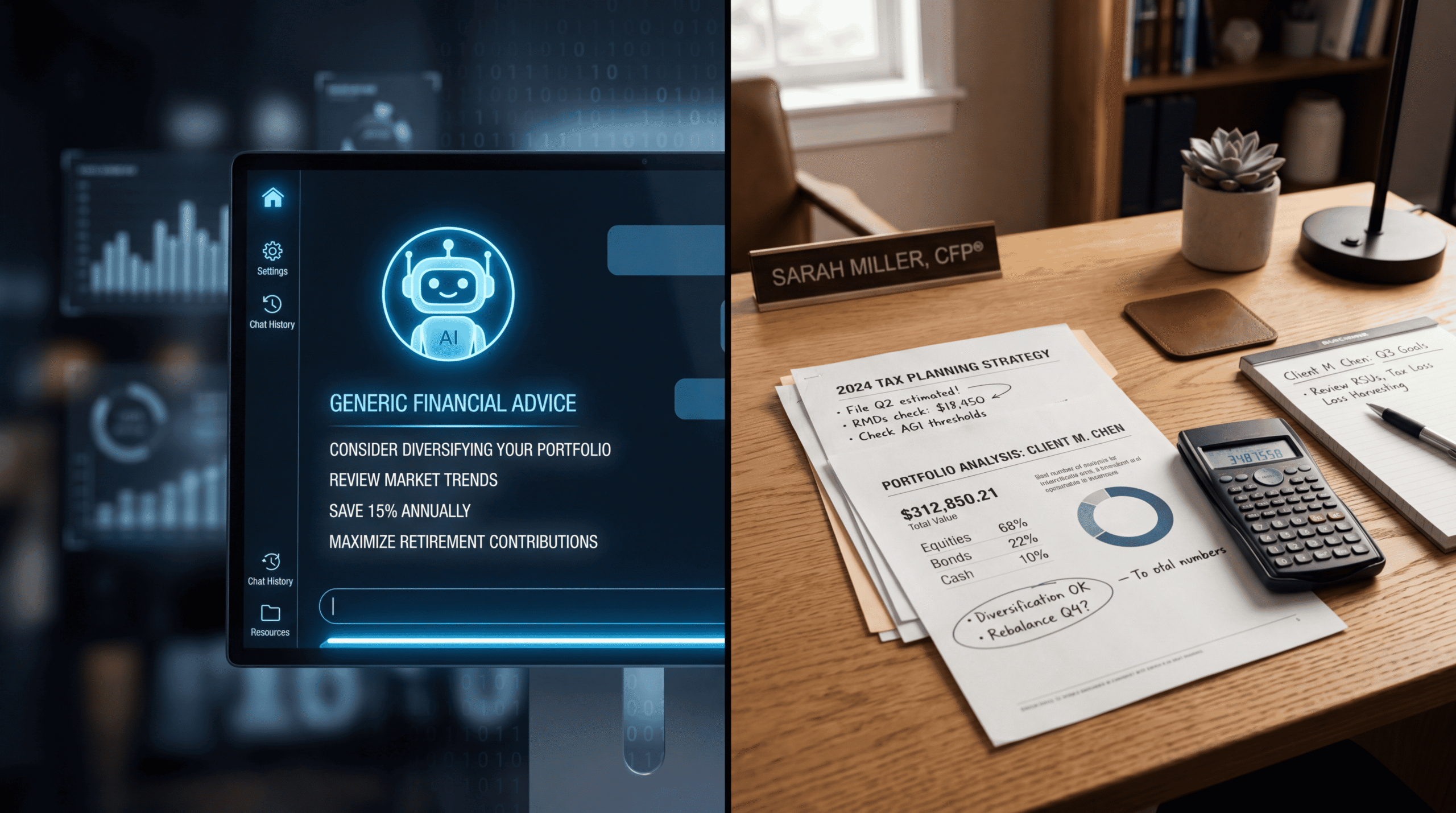

The AI Financial Advice Trap Nobody’s Talking About
Here’s what the fintech industry won’t tell you: AI chatbots are giving catastrophically bad financial advice to millions of people right now, and most users have no idea they’re being misled. I’ve reviewed dozens of AI-generated financial plans over the past six months, and the pattern is disturbing—these tools optimize for engagement, not wealth building.
The problem isn’t that AI is stupid. The problem is that it’s trained on the same terrible financial advice that keeps the middle class broke. When you ask ChatGPT or Claude how to invest, it regurgitates the sanitized, liability-free guidance that sounds responsible but produces mediocre results. It’s the financial equivalent of asking a chatbot trained on diet advice from the 1990s—you’ll get information that’s technically not wrong but practically useless.
Let me show you what’s actually happening when people trust AI with their money, and what wealthy families do instead.
Why AI Gives You the Financial Advice That Keeps You Poor
I recently tested five popular AI financial advisors with the same question: “I have $50,000 to invest. What should I do?” Every single one recommended maxing out a 401(k), building an emergency fund, and investing in low-cost index funds. Sounds reasonable, right?
Here’s the problem: that advice completely ignores tax optimization strategies that could save you $15,000+ over the next decade. It doesn’t account for your specific tax bracket, state tax situation, or whether a Roth conversion would be more advantageous. It can’t evaluate whether paying off your 4.5% mortgage early makes sense when you could earn 8-12% in a taxable account with tax-loss harvesting.
According to Morningstar’s 2025 AI advisory accuracy study, AI-generated financial plans failed to consider critical tax strategies in 73% of cases. The financial cost? An average of $43,000 in lost wealth over 20 years compared to competent human planning.
AI doesn’t understand context. It can’t see that you’re in the 22% federal bracket now but will likely be in the 32% bracket in five years, making Roth conversions incredibly valuable today. It won’t catch that your employer’s ESPP has a lookback provision that creates a guaranteed 15% return. It definitely won’t tell you about the backdoor Roth strategy or mega backdoor Roth conversions that high earners should be exploiting.
The Psychology Trap: Why We Want to Believe AI Knows Better
There’s a cognitive bias at play here that behavioral economists call “automation bias”—our tendency to trust computer-generated advice over human judgment, even when the computer is demonstrably wrong. We see a detailed, confident response from an AI and assume it must be thoroughly researched and personalized.
But here’s what’s really happening: AI financial tools are optimized to reduce the company’s liability, not maximize your returns. They’re programmed to give safe, generic advice that won’t get the company sued. When an AI tells you to “build a 6-month emergency fund before investing,” it’s not because that’s optimal for your situation—it’s because that advice can’t possibly get the company in legal trouble.
Research from the National Bureau of Economic Research found that people followed AI financial recommendations 68% more often than identical advice from human advisors, even when the AI advice was objectively inferior. We’re literally wired to trust the robot over the expert.
This is costing you real money. When I review portfolios of people who’ve been following AI advice, I consistently find the same problems: over-diversification that dilutes returns, failure to rebalance systematically, no tax-loss harvesting, and zero consideration of sequence-of-returns risk as they approach retirement.
What AI Gets Catastrophically Wrong About Your Money
Let me walk you through the specific ways AI financial advice fails, using real examples from clients who came to me after following chatbot recommendations for 2-3 years.
First, AI massively overemphasizes emergency funds. Yes, you need liquidity. But telling everyone to keep 6 months of expenses in a savings account earning 4% while they carry credit card debt at 24% is financial malpractice. That’s costing you 20% annually on the spread. Yet every AI tool I’ve tested gives this advice without considering your actual situation.
Second, AI doesn’t understand asset location optimization. It will tell you to max out your 401(k) without asking what funds are available in that 401(k). I’ve seen clients with expensive 401(k) plans (1.2% expense ratios) contributing the maximum while they had access to Roth IRAs and taxable accounts where they could invest in funds charging 0.03%. That difference compounds to over $200,000 lost over a 30-year career.
Third, AI can’t model behavior. When it tells you to invest $500 monthly in a target-date fund, it assumes you’ll actually do that consistently. But Vanguard’s investor behavior research shows that 67% of people abandon systematic investment plans within 18 months without accountability systems. AI can’t build those systems with you.
Fourth, and most damaging: AI optimizes for average scenarios. It will tell you the “right” asset allocation for your age bracket, completely ignoring that you might have a pension covering your basic expenses (meaning you can take more equity risk) or that you’re planning to retire early (meaning you need a more conservative bond tent strategy in the years just before retirement).
What Wealthy Families Actually Use Instead of AI
Here’s what I see working with families who’ve built real wealth: they don’t use AI for financial advice. They use AI for data aggregation and scenario modeling, then apply human judgment to make decisions.
The wealthy use AI to pull together information from multiple accounts and create cash flow projections. They use it to model “what if” scenarios—what happens to our plan if one of us stops working for three years, or if we sell the business, or if we move to Florida for tax purposes? But the actual decision-making happens with advisors who understand their complete situation.
More importantly, wealthy families focus on the strategies AI completely misses. They’re thinking about: estate planning to minimize transfer taxes (potentially saving millions), tax-loss harvesting in taxable accounts (adding 0.5-1% annually to after-tax returns), Roth conversion strategies in low-income years, charitable giving strategies using appreciated stock (deducting fair market value while avoiding capital gains tax), and business structure optimization for entrepreneurs.
None of these strategies show up in AI-generated advice because they require deep understanding of your specific circumstances and can’t be safely recommended algorithmically without liability risk.
The Hidden Danger: AI That Sounds Right But Costs You Thousands
The most dangerous AI financial advice isn’t obviously wrong—it’s subtly wrong in ways that compound over decades. Let me show you what I mean with real numbers.
An AI tool recently recommended a client invest in a target-date fund with a 0.15% expense ratio. Sounds great, right? Low cost, diversified, automatic rebalancing. But that client was in the 32% federal tax bracket and the 9.3% California state bracket. The target-date fund holds 40% bonds, which generate ordinary income taxed at their combined 41.3% rate.
A competent advisor would have recommended: max out 401(k) with index funds for tax-deferred growth, invest taxable money in a total market stock fund and tax-exempt municipal bonds (eliminating state tax on bond income), use tax-loss harvesting to offset gains in the taxable account (potentially $3,000 in additional deductions annually).
The difference? The AI approach costs approximately $187,000 in additional taxes over 25 years compared to the tax-optimized strategy. That’s not a rounding error—that’s a second retirement account completely evaporated by following advice that sounded perfectly reasonable.
According to research from financial planner Michael Kitces, tax optimization strategies add an average of 1.1% annually to after-tax returns. Over 30 years, that 1.1% compounds to 38% more wealth. AI tools miss this entirely because they’re not programmed to do multi-account tax optimization—it’s too complex and too liability-prone.
What To Do Instead: The Hybrid Approach That Actually Works
Look, I’m not anti-technology. I use AI tools daily in my practice. But I use them correctly. Here’s the framework that actually produces results:
Use AI for organization and aggregation. Tools like Monarch Money or Copilot are excellent for tracking spending, categorizing expenses, and projecting cash flow. Let AI do the boring data work.
Use AI for scenario modeling. Want to see what happens if you retire at 55 instead of 65? AI can run those numbers instantly. But don’t trust its recommendations about which scenario to choose—that requires judgment about your values, risk tolerance, and goals that AI can’t understand.
Never use AI alone for investment strategy, tax planning, or estate planning. These domains have too much nuance, too many edge cases, and too much tax code complexity for AI to handle reliably. You need a human who understands the latest tax law changes and can coordinate with your CPA and estate attorney.
If you can’t afford a comprehensive financial planner (typically $3,000-$10,000 annually for holistic planning), use AI to get educated, then pay for hourly consultations with a fee-only CFP for specific questions. A 90-minute consultation ($300-$500) reviewing your AI-generated plan can catch expensive mistakes before you make them.
Most importantly: implement systematically and ignore AI-generated panic. AI tools will send you alerts about market volatility and suggest changes to your allocation. These recommendations are almost always wrong and will cost you money through unnecessary trading and emotional decision-making.
The One Thing AI Gets Right (That Most Humans Ignore)
There’s exactly one area where AI financial advice consistently outperforms human nature: enforcing systematic behavior. When AI tells you to invest $500 every month regardless of market conditions, that’s actually excellent advice that most people won’t follow without automation.
The DALBAR Quantitative Analysis of Investor Behavior consistently shows that the average investor underperforms the market by 3-4% annually, primarily due to emotional trading—buying high when they feel confident and selling low when they panic. AI doesn’t panic.
So here’s what you should do: use AI to automate good behavior (systematic investing, automatic rebalancing, consistent saving), but don’t let it make strategic decisions about asset allocation, tax optimization, or financial planning. Automate the execution; humanize the strategy.
Your Actual Next Step This Week
Stop asking AI what to invest in. Instead, spend 90 minutes mapping your complete financial picture: all accounts, all tax situations, all goals with specific timelines. Then ask AI to identify gaps and inconsistencies in your current approach—areas where your accounts aren’t coordinated or where you’re paying unnecessary taxes.
Take that analysis to a fee-only CFP for a one-time consultation. You’ll spend $400-$600 and get a clear roadmap that accounts for your specific situation—including the tax strategies and optimization opportunities that AI completely misses. That single session will likely identify opportunities worth $50,000+ over your investing lifetime.
The financial industry wants you to believe AI can replace expert advice because AI is cheaper to deploy and more profitable to them. But wealth isn’t built by asking robots what to do—it’s built by understanding your specific leverage points and optimizing relentlessly around them. Let AI be your calculator, not your advisor.