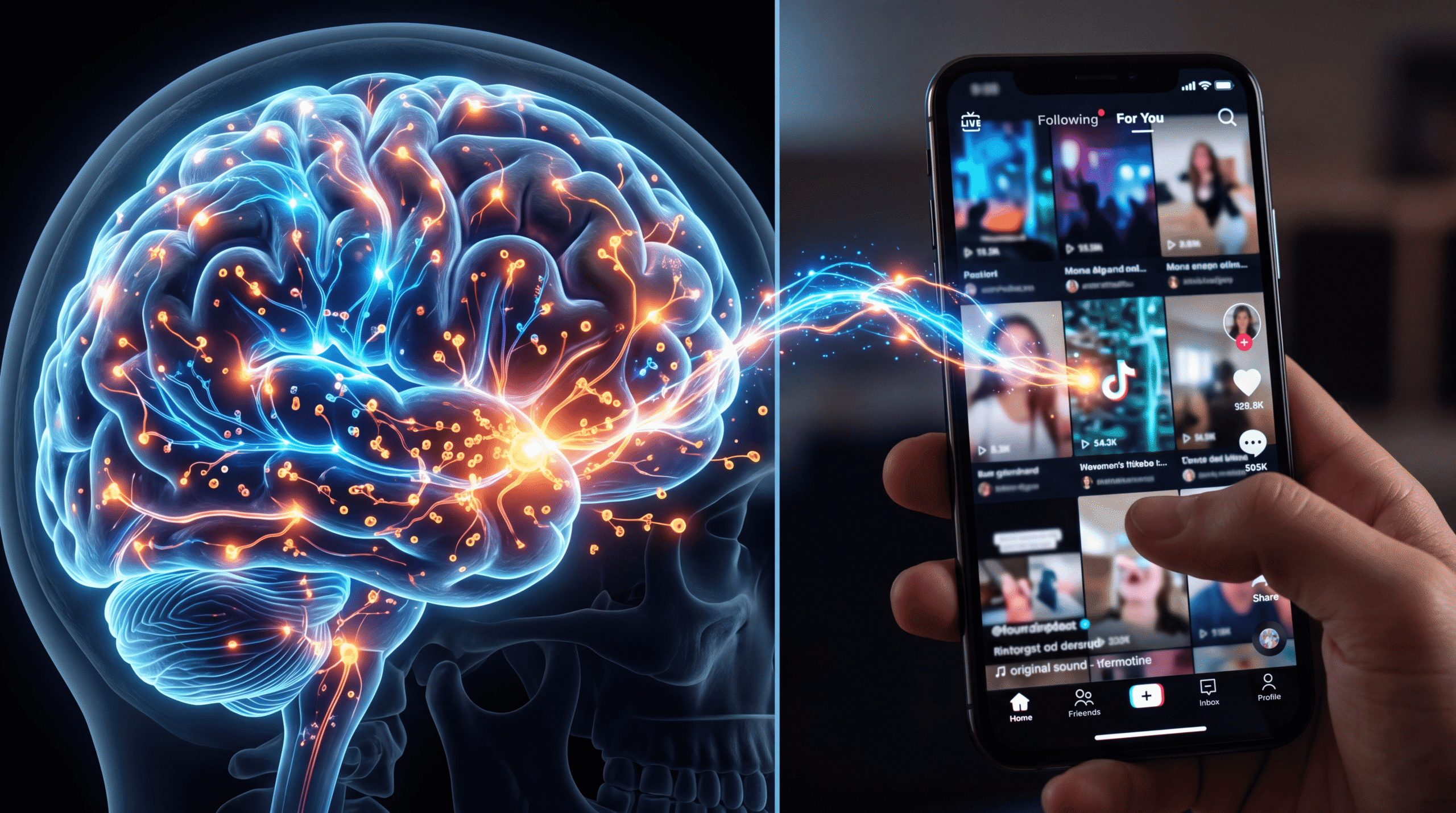

You tell yourself it’ll be five minutes. Two hours later, you’re still scrolling, your thumb moving on autopilot, your brain somehow both overstimulated and numb. You’re not weak-willed. You’re not lazy. You’re up against one of the most sophisticated behavioral manipulation systems ever created, and it’s winning because that’s exactly what it was designed to do.
Let me be clear: TikTok addiction isn’t about lacking discipline. It’s about how the platform exploits fundamental vulnerabilities in human neurology that took millions of years to evolve and mere seconds to hijack.
The Dopamine Slot Machine in Your Pocket
Here’s what’s actually happening in your brain when you scroll TikTok: Every swipe triggers what psychologists call a variable ratio reinforcement schedule—the same mechanism that makes slot machines so addictive. You never know if the next video will be boring or brilliant, and that uncertainty floods your brain with dopamine.
Unlike cocaine or alcohol, which create a predictable dopamine spike, TikTok’s algorithm ensures unpredictability. A 2023 study in Neuropsychopharmacology found that this unpredictable reward pattern creates stronger compulsive behaviors than consistent rewards. Your brain isn’t getting high—it’s gambling, and the house always wins.
The average TikTok video lasts 15-30 seconds. That means you’re getting 120-240 micro-doses of potential dopamine every hour. Traditional substance addictions can’t compete with that delivery rate.
Why Your Brain Treats TikTok Like a Survival Need
The deeper problem isn’t dopamine—it’s how TikTok hijacks your brain’s salience network, the system that determines what deserves your attention. This network evolved to notice threats (a rustling bush might be a predator) and opportunities (ripe fruit on a tree). It kept our ancestors alive.
TikTok exploits this by making every video feel urgent and novel. The infinite scroll means there’s always one more thing to check. Research published in JAMA Pediatrics in 2023 showed that adolescents checking social media more than three hours daily had double the risk of poor mental health outcomes, including anxiety and depression.
Your brain literally cannot distinguish between “I should check if that notification is important” and “I should check if that noise is a threat.” Both trigger the same neural alarm system. This is why you feel anxious when you don’t check your phone—your brain has been conditioned to treat TikTok like a survival tool.
The Mental Health Cascade You’re Not Noticing
Here’s what most people miss: TikTok addiction doesn’t just waste time—it systematically dismantles your brain’s ability to function normally. Every hour you spend scrolling creates three specific mental health impacts.
First, it destroys your attention residue. When you switch from TikTok to anything else—homework, conversation, work—part of your brain stays stuck thinking about videos. A study in the Journal of Personality and Social Psychology found that even brief social media use creates attention deficits that last up to 30 minutes after you stop. You’re not present in your actual life because you’re mentally still on the app.
Second, it triggers social comparison on steroids. Unlike Instagram’s curated photos, TikTok shows you thousands of people who are funnier, more attractive, more talented, or more successful than you—in rapid-fire succession. Your brain doesn’t have time to rationalize or contextualize. It just absorbs an endless stream of “you’re not enough.”
Third, and most insidiously, it creates learned helplessness with your own thoughts. When you’re alone with your mind—walking, waiting, trying to fall asleep—you reach for TikTok to escape boredom or discomfort. Over time, your brain loses its ability to self-soothe, to daydream, to simply be. You become dependent on external stimulation to regulate your internal state.
The Withdrawal You’re Already Experiencing
If you’re reading this and feeling defensive (“I’m not addicted, I can stop whenever I want”), that’s actually diagnostic. One of the clearest signs of behavioral addiction is denial about its impact.
Try this: Don’t open TikTok for 24 hours. Most people experience what researchers call digital withdrawal—restlessness, irritability, phantom vibrations, compulsive phone-checking. A 2021 systematic review in Frontiers in Psychiatry documented that social media withdrawal symptoms mirror substance withdrawal: anxiety, mood changes, and intense cravings.
Your brain has been rewired. When you’re not getting those dopamine hits, you feel the absence physically. You’re not imagining it—your neurochemistry has literally adapted to expect constant stimulation.
The Research Says: Your Brain Can Heal, But Not on Its Own
Here’s the good news buried in the neuroscience: neuroplasticity works both ways. Just as TikTok rewired your brain toward compulsive scrolling, you can rewire it back—but not through willpower alone.
A 2023 study in Scientific Reports tracked people reducing social media use over three months. Those who simply tried to “use it less” failed 87% of the time. Those who implemented specific environmental changes (we’ll get to this) succeeded 64% of the time. The difference wasn’t motivation—it was strategy.
The key insight from cognitive behavioral research: You cannot out-think a habit that operates below conscious awareness. You need to change your environment and create incompatible behaviors, not just promise yourself you’ll have more self-control tomorrow.
Why Everything You’ve Tried Has Failed
You’ve probably already tried the obvious solutions: deleting the app (you reinstall it), setting time limits (you ignore them), moving it to a folder (you still find it). These fail because they rely on what psychologists call hot cognition—decision-making in the moment of craving.
When you’re feeling the urge to scroll, your prefrontal cortex (rational brain) is offline. Your limbic system (emotional brain) is in control, and it wants that dopamine hit now. Any strategy that requires you to be reasonable when you’re craving is doomed.
Effective intervention requires what we call cold cognition—decisions made when you’re calm, implemented through systems that work even when you’re not thinking clearly. You need to build gates, not rely on willpower.
The One Change That Actually Works
The single most effective intervention I’ve seen in 15 years of practice is stupidly simple: Create a five-minute friction point. Before you can open TikTok, you must do one specific competing behavior that takes at least five minutes and uses your hands.
Not something you enjoy. Not something productive. Something neutral and mildly boring: fold five pieces of laundry, do 20 pushups, write three sentences in a physical journal, organize one drawer. The activity doesn’t matter—the delay does.
Why this works: The average urge to scroll lasts 3-7 minutes. Research on urge surfing published in Cognitive and Behavioral Practice shows that if you can occupy your attention for five minutes, the craving passes on its own. You’re not fighting the urge—you’re outlasting it.
The physical component is critical. TikTok is a thumb-and-eyeball activity. If your hands are busy and your eyes are focused elsewhere, you physically cannot scroll, even if part of your brain still wants to.
What Recovery Actually Looks Like
Real recovery from TikTok addiction doesn’t mean never using the app again (though that’s a valid choice). It means restoring your brain’s ability to function without constant external stimulation. You’ll know you’re healing when:
You can sit in a waiting room without immediately reaching for your phone. You can be alone with your thoughts without anxiety. You can watch a 20-minute show without checking your phone mid-episode. You can have a conversation without mentally composing a TikTok about it.
This takes time—typically 6-12 weeks before your brain’s reward system recalibrates. During that window, you’ll experience boredom more intensely than you have in years. That’s not a problem to fix. That’s your brain remembering what normal feels like.
The Deeper Question You’re Not Asking
Here’s what I want you to sit with: Why did TikTok become necessary in the first place? For most people, compulsive scrolling isn’t the disease—it’s the symptom. It’s emotional avoidance that happens to be incredibly effective.
What are you not feeling when you’re scrolling? Loneliness? Anxiety about the future? Grief? Shame? Behavioral addictions are always secondary to emotional pain that feels unmanageable without them. TikTok doesn’t create that pain—it just offers an instant, reliable escape from it.
If you only address the scrolling without addressing what it’s medicating, you’ll replace TikTok with something else—different app, same function. Real recovery means learning to be with discomfort without numbing it. That’s the hardest work, and it’s why most people never actually quit.
Try This Today
Right now, before you finish reading this article, do three things:
1. Enable Screen Time settings and check your actual daily TikTok usage. Not what you think it is—what it actually is. Write that number down physically on paper.
2. Choose your five-minute friction activity. Pick something specific, simple, and available anywhere. Write it down on a note you keep with your phone.
3. Tell one person what you’re doing and ask them to check in with you in three days. Not to shame you if you fail—just to break the isolation that keeps behavioral addictions thriving in secret.
Don’t commit to quitting forever. Commit to trying the five-minute rule before opening TikTok, just for today. Then do it again tomorrow. Then the day after. You’re not building willpower—you’re building a new neural pathway, one that proves you can feel an urge without immediately satisfying it.
The Truth You Knew Already
You picked up your phone to scroll right now, didn’t you? Maybe multiple times while reading this. That impulse—that’s not you being weak. That’s your brain doing exactly what it’s been trained to do. The question isn’t whether you’re addicted. The question is whether you’re ready to admit that the algorithm knows you better than you know yourself, and whether you’re willing to do the uncomfortable work of taking that knowledge back.
Your attention is the last thing you truly own. TikTok wants to rent it, one video at a time, until you forget you ever had it at all.