
MIT researchers just published something in Nature that should make every oncology startup nervous: a common amino acid you can buy at Whole Foods for $15 triggers a previously unknown immune pathway that repairs intestinal damage. Not a drug candidate. Not a gene therapy. An amino acid that’s been sitting in chicken breasts and Greek yogurt this entire time.
The gap between this discovery and what most health tech is building is massive. While everyone chases synthetic molecules and precision medicine, Omer Yilmaz’s lab at MIT found that cysteine directly activates CD8 T cells to produce IL-22—a regenerative signal that kicks intestinal stem cells into repair mode. This is the first time anyone has shown a single dietary nutrient can do this.
What The Press Got Wrong About This Discovery
Most coverage treats this like a diet story. It’s not. This is an immunology breakthrough that happens to use a dietary input.
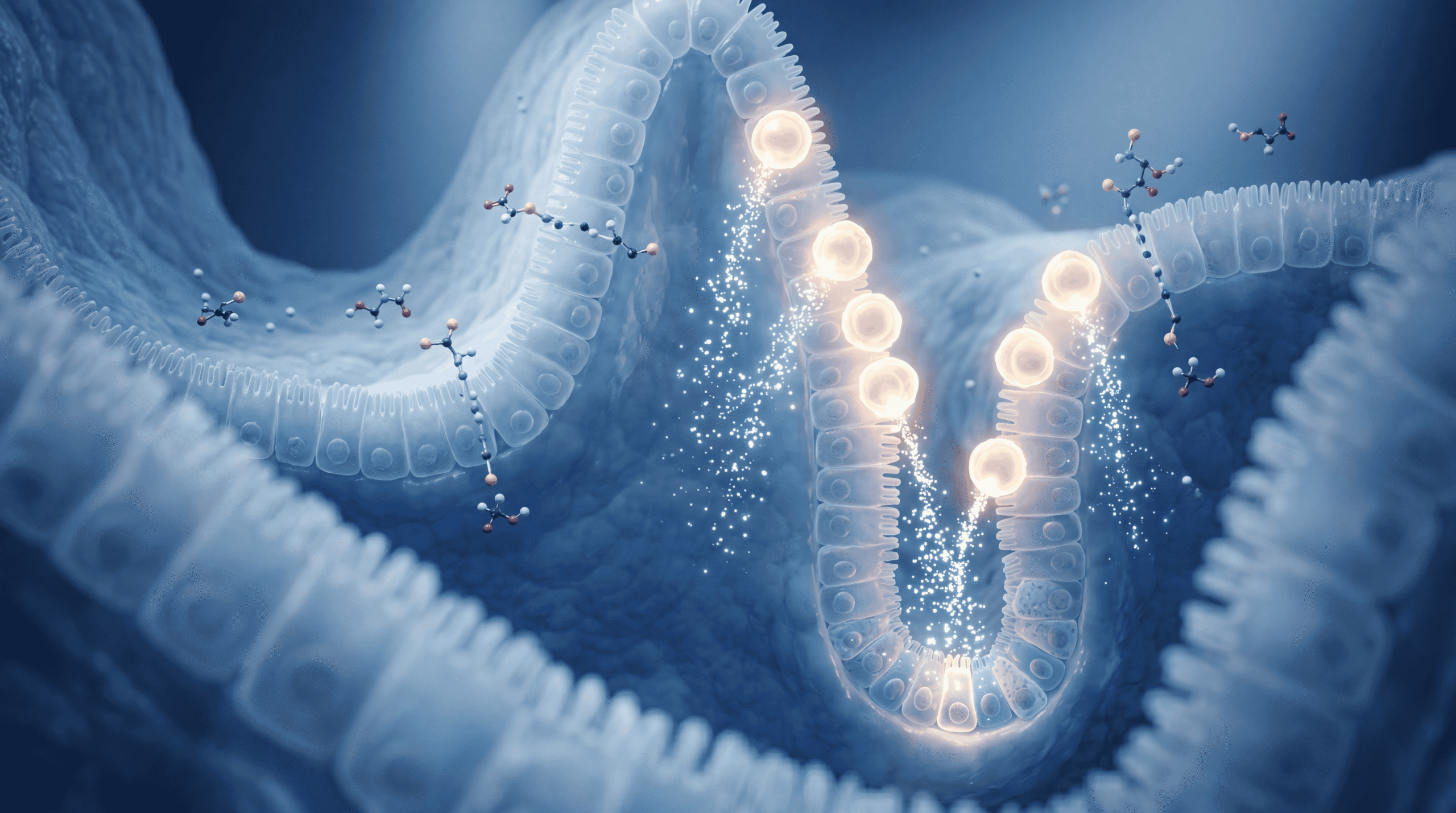
The mechanism is precise: When intestinal epithelial cells absorb cysteine, they convert it to Coenzyme A (CoA). That CoA gets released into the intestinal tissue where CD8 T cells—which nobody thought produced IL-22 in this context—absorb it and start multiplying. Those expanded T cells then pump out IL-22, which is the actual regenerative signal that intestinal stem cells respond to.
Here’s what matters: This isn’t about antioxidants or general nutrition. Cysteine has been known for its antioxidant properties for decades. What Yilmaz’s team discovered is an entirely separate mechanism—a specific immune activation pathway that positions CD8 T cells in the small intestine lining before damage even occurs.
The experimental design was methodical. They fed mice diets enriched with each of the 20 standard amino acids individually, then measured stem cell and progenitor cell activity in the gut. Only cysteine produced a strong regenerative effect. Then they traced the molecular pathway backward from the phenotype to the mechanism.
The Technical Detail Everyone Is Missing
The reason this works preferentially in the small intestine is not magical—it’s anatomical. The small intestine is where most dietary protein gets absorbed. When you eat a cysteine-rich meal, the gut sees a concentrated bolus of the amino acid before it gets distributed systemically.
Compare that to what happens when your liver converts methionine to cysteine (which your body does naturally). That cysteine gets released into circulation at steady-state levels. It never creates the local spike in the gut that triggers the CD8 T cell expansion.
This distinction is crucial for anyone thinking about translating this to humans. A cysteine supplement taken orally would hit the small intestine directly. An IV infusion would not produce the same effect. The delivery route matters as much as the molecule.
The IL-22 production is the other piece most coverage glosses over. IL-22 is a cytokine that’s well-studied in intestinal immunity, but it’s usually produced by innate lymphoid cells and Th17 cells—not CD8 T cells. The fact that dietary cysteine can expand a CD8 T cell population that produces IL-22 is genuinely novel. This suggests there’s an entire regulatory axis in gut immunity that we’ve been missing.
Why This Works When Other Approaches Don’t
Radiation and chemotherapy drugs like 5-fluorouracil don’t just kill cancer cells—they obliterate the rapidly dividing cells in your intestinal lining. The result is mucositis, diarrhea, malabsorption, and sometimes life-threatening complications that force oncologists to delay or reduce treatment doses.
Current supportive care is mostly reactive: fluid replacement, anti-nausea drugs, pain management. There’s no widely used intervention that actually speeds up intestinal regeneration. Some centers use growth factors like palifermin (Kepivance), but it’s expensive, requires IV administration, and only approved for specific contexts.
Cysteine’s mechanism is different because it’s prophylactic. In the mouse studies, they fed the cysteine-rich diet before radiation exposure. The CD8 T cells were already expanded and positioned in the tissue, ready to respond. When damage occurred, recovery was faster.
The unpublished 5-fluorouracil experiments Yilmaz mentions are critical. 5-FU is one of the most common chemotherapy agents for colorectal and pancreatic cancer, and gut toxicity is dose-limiting. If cysteine supplementation can reduce that toxicity in humans, it directly expands the therapeutic window for existing cancer treatments. That’s not a new drug—that’s making current drugs work better.
Who Actually Wins and Loses From This
Winners:
- Cancer patients on chemotherapy or radiation. If this translates to humans, it’s a low-cost intervention that could reduce treatment delays and improve quality of life during therapy.
- Generic supplement manufacturers. Cysteine (usually sold as N-acetylcysteine or NAC) is already widely available. If oncologists start recommending it based on this research, demand will spike.
- Academic research groups working on metabolic immunology. This finding validates the idea that nutrients aren’t just fuel—they’re signaling molecules that can reprogram immune responses.
Losers:
- Biotech companies developing expensive biologics for mucositis. Why invest in a $10,000-per-treatment growth factor when a $20 bottle of amino acids might work?
- Precision nutrition startups that can’t explain mechanism. If you’re selling personalized supplements based on vibes and microbiome correlations, this is the level of mechanistic rigor you’re competing against.
- Researchers who dismissed dietary interventions as unserious. Yilmaz’s team just published in Nature using an approach many would have considered too simple to bother with.
The Implementation Reality Nobody Is Talking About
Here’s the problem with translating this to the clinic: dosing. The mouse studies used “cysteine-rich diets,” but the paper doesn’t specify exact concentrations that would translate to human supplementation. Mice have different metabolic rates, different gut anatomy, and different baseline diets.
A typical human diet contains about 1-2 grams of cysteine per day from protein sources. NAC supplements usually come in 600mg or 1200mg doses. Is that enough to trigger the CD8 T cell expansion Yilmaz observed? We don’t know yet. Someone needs to run dose-response studies in humans and measure IL-22 levels in intestinal tissue.
The other complexity: individual variation in gut microbiome and baseline immune status. The mice in this study were laboratory animals with controlled genetics and sterile housing. Humans are messier. Some people might respond strongly to dietary cysteine. Others might not.
This is where a smart biotech would come in—not to replace cysteine with a synthetic molecule, but to figure out the optimal formulation, timing, and patient selection. Maybe it’s a specific cysteine prodrug that releases at a controlled rate in the small intestine. Maybe it’s a combination with other amino acids that showed weaker effects in the initial screen. Maybe it’s a diagnostic test to identify patients whose CD8 T cells are most responsive to this pathway.
What This Means for Other Regenerative Approaches
The broader implication is that we’ve been thinking about tissue regeneration wrong. Most strategies focus on directly stimulating stem cells—give them growth factors, remove inhibitory signals, transplant new ones. Yilmaz’s work shows there’s another lever: position immune cells in the tissue beforehand that will produce regenerative signals when needed.
The hair follicle research he mentions is worth watching. Hair follicles have their own stem cell populations that go through cycles of growth and rest. If dietary cysteine can pre-position immune cells that support hair follicle regeneration the same way it does in the gut, that’s a mechanistic link between two seemingly unrelated tissues.
The same logic could apply to other epithelial barriers—skin, lung, bladder—anywhere you have rapidly turning over tissue that’s vulnerable to damage. The question is whether those tissues have the same anatomical setup: local nutrient absorption that creates high concentrations, and resident T cell populations that respond to CoA by producing tissue-specific regenerative signals.
The Detail That Changes Everything
One sentence in the paper is easy to miss but changes how you should think about this: the effect is “largely limited to the small intestine because that is where most dietary protein is absorbed.”
That means this isn’t a systemic effect. It’s a local effect that depends on regional nutrient concentration. If you wanted to trigger the same regenerative response in the colon, you’d need to deliver cysteine in a form that survives transit through the small intestine—maybe a coated capsule that releases further downstream, or a rectal formulation for distal colon.
This is the kind of detail that separates real translation from hand-waving. The mechanism is elegant, but applying it to different clinical scenarios requires thinking through the pharmacokinetics and anatomy.
Why This Discovery Took So Long
Cysteine isn’t new. IL-22 isn’t new. CD8 T cells aren’t new. So why did it take until 2026 for someone to connect them in this specific context?
Partly it’s the reductionist way most nutrition research works. Studies either look at whole dietary patterns (Mediterranean diet, fasting, calorie restriction) or they look at isolated micronutrients in cell culture. Very few groups systematically screen individual amino acids in vivo while measuring both immune and stem cell responses in the same tissue.
Yilmaz’s lab had the advantage of expertise in both intestinal stem cell biology and immunology. They were set up to notice that the regenerative effect was immune-mediated, not a direct effect on stem cells. A pure stem cell lab might have missed the T cell angle. A pure immunology lab might not have focused on dietary inputs.
This is the argument for funding curiosity-driven research. Nobody would have prioritized “test all 20 amino acids to see if any affect gut stem cells” as a high-impact project. It sounds like a fishing expedition. But that fishing expedition just found something that could change supportive care for millions of cancer patients.
The Prediction Nobody Wants to Hear
Within three years, every major cancer center will have patients asking about cysteine supplementation during chemotherapy, but fewer than 10% of oncologists will have good data to guide their answer. The lag between a Nature paper and clinical implementation is always longer than patients want and shorter than institutions are prepared for.
We’ll see a flood of low-quality observational studies and supplement marketing that outpaces the actual science. The right move is for NCI or a major oncology consortium to fund a proper randomized trial in chemotherapy patients: cysteine supplementation vs. placebo, with intestinal toxicity as the primary endpoint and IL-22 levels as a mechanistic biomarker.
Until that data exists, we’re in the zone where the biology is compelling but the clinical recommendations are uncertain. That’s uncomfortable, but it’s where most breakthroughs live for longer than anyone likes to admit.