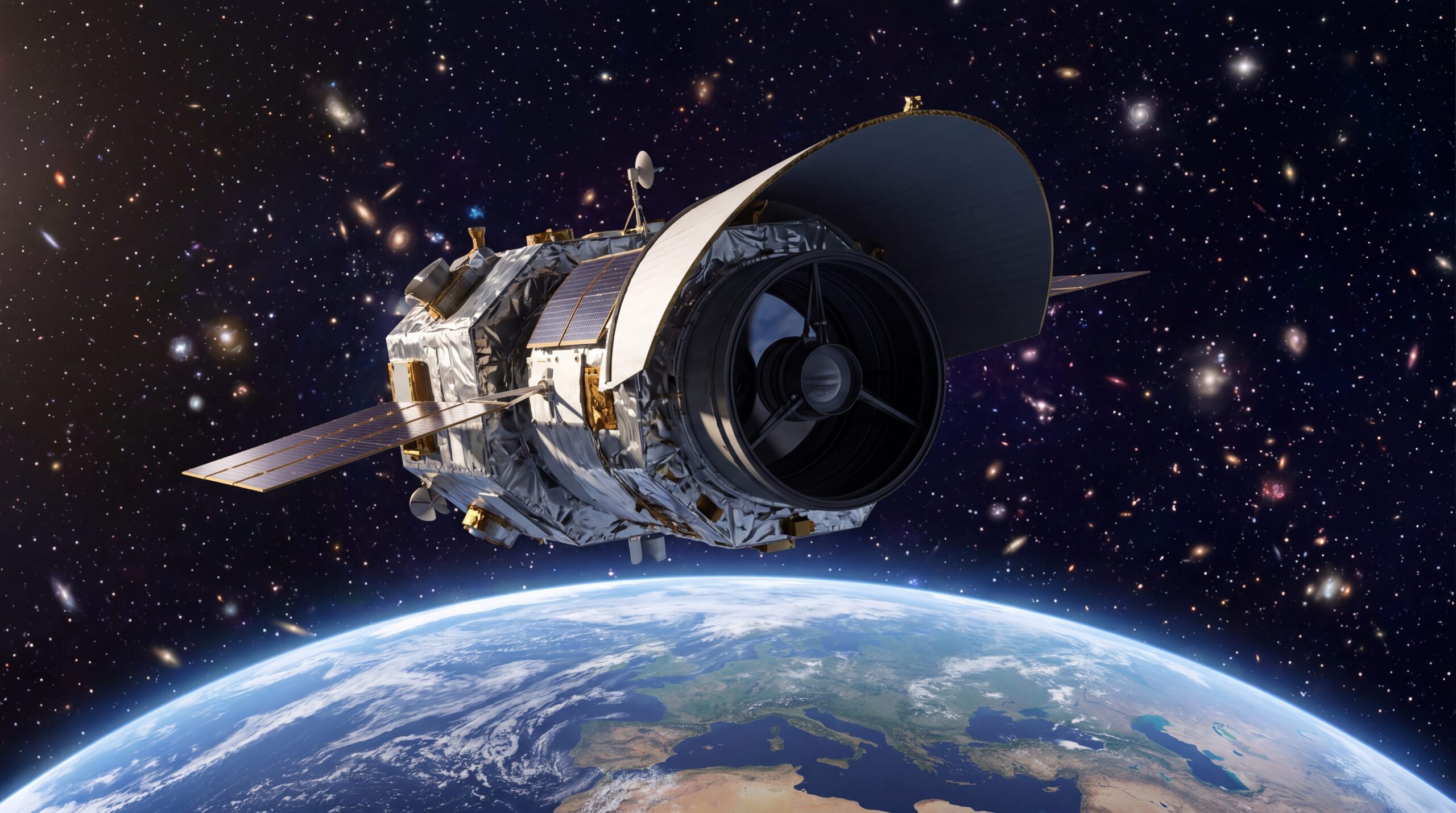

NASA is building a telescope that will do something James Webb physically cannot: survey enormous swaths of the universe at once. The Nancy Grace Roman Space Telescope, launching in 2027, has generated endless “Webb killer” headlines. That framing misses the point entirely.
Roman isn’t replacing Webb. It’s solving a different class of problems that Webb was never designed to handle. Webb stares at tiny patches of sky with extraordinary depth. Roman will map areas 100 times larger in a single shot. That’s not a spec difference — it’s a fundamentally different mission architecture.
The Technical Reality Behind The 100x Claim
Roman’s Wide Field Instrument covers 0.28 square degrees per exposure. Webb’s NIRCam covers 0.0031 square degrees. The math checks out: Roman really does capture roughly 100 times more sky in one image. But raw field of view only tells half the story.
Webb operates at cryogenic temperatures (around 50 Kelvin) to detect the faintest infrared signals from the early universe. Roman will also observe in infrared, but with a 2.4-meter mirror — the same size as Hubble’s, and significantly smaller than Webb’s 6.5-meter primary mirror. Roman trades raw sensitivity for survey speed.
The engineering choice reveals the priority: Roman is optimized for finding things, not studying individual objects in extreme detail. NASA’s Roman mission page positions it as a “wide-eyed” complement to Webb’s “sharp focus.” That positioning is correct, but it undersells what Roman will enable.
What The Press Got Wrong About Roman
Most coverage frames Roman as “Webb’s successor” or treats the two telescopes as competitors. This reflects a fundamental misunderstanding of how modern astronomy operates. No single instrument can do everything, and mission designers stopped trying decades ago.
Webb excels at spectroscopy — breaking light into its component wavelengths to reveal chemical compositions, temperatures, and distances. Roman will do some spectroscopy, but its real power is in quickly identifying targets across vast areas. Think of Webb as a microscope and Roman as a reconnaissance drone.
The “100 times faster survey” claim also needs context. Roman will complete certain wide-field surveys 100 times faster than Webb could. But Webb was never meant to do those surveys. Comparing them this way is like saying a cargo plane is “faster” than a fighter jet because it carries more payload. Different tools, different jobs.
Another misconception: Roman will “see farther” than Webb. Not really. Both observe in infrared, but Webb’s larger mirror and extreme cooling give it better sensitivity to faint, distant objects. Roman’s advantage is coverage, not depth. It will find more objects at intermediate distances rather than pushing the absolute edge of the observable universe.
The Coronagraph: Roman’s Real Differentiator
Beyond the Wide Field Instrument, Roman carries a technology demonstration that could reshape exoplanet science: a coronagraph capable of directly imaging planets around nearby stars. Webb has coronagraphs too, but Roman’s is designed to block starlight 100 million to 1 billion times brighter than the planets it’s trying to image.
This matters because most exoplanets we’ve discovered so far were found through indirect methods — watching stars wobble or dim as planets pass in front of them. Direct imaging lets you study the planet’s atmosphere, weather patterns, and potentially detect biosignatures. Roman won’t image Earth-like planets (its coronagraph targets larger, Jupiter-like worlds), but it’s a critical step toward future missions that will.
The coronagraph is officially listed as a technology demonstration, not a primary science instrument. That’s NASA hedging its bets. If it works as designed, it could produce some of the mission’s most valuable data. If it doesn’t, the Wide Field Instrument alone justifies the mission. Smart risk management.
Who Actually Wins And Loses
Winners:
Survey astronomers who need to map large areas win big. Roman will enable population studies of exoplanets, dark energy research through gravitational lensing surveys, and searches for rare astronomical events. Projects that require finding needles in haystacks — supernovae, microlensing events, rogue planets — become tractable.
The broader astronomy community wins because Roman’s data will be public immediately. Unlike some ground-based telescopes where observers get exclusive access to their data for a year, Roman will release everything to NASA’s archive as soon as it’s calibrated. This democratizes access to space telescope data in ways that weren’t possible with earlier missions.
Losers:
Ground-based survey projects lose some of their advantage. Roman operates above the atmosphere, eliminating the distortions and limited infrared transparency that plague ground telescopes. Projects like the Vera C. Rubin Observatory will still have their place (they observe in visible light and have even wider fields of view), but Roman nibbles at their territory in the infrared.
Astronomers who need the deepest possible observations of single objects don’t gain much. Roman can’t replace Webb for detailed studies of distant galaxies or precise atmospheric characterization of individual exoplanets. If your science requires staring at one object for hundreds of hours, you’re still booking time on Webb, not Roman.
The Development Reality Nobody Talks About
Roman’s 2.4-meter mirror wasn’t built for this mission. It came from a National Reconnaissance Office donation — a spare spy satellite mirror that NASA repurposed. This saved hundreds of millions in development costs but locked in certain design constraints. The mirror’s size is fixed, and the instrument suite had to work within the payload volume originally designed for Earth observation.
This inheritance shapes what Roman can and can’t do. The telescope is optimized for the infrared wavelengths useful for reconnaissance, which happens to align well with astronomical needs. But some design choices — like the mirror’s coating and the spacecraft’s thermal management — reflect its intelligence satellite heritage rather than pure astronomical requirements.
The launch date has slipped repeatedly, from an original target in the mid-2020s to the current 2027 estimate. Some delays came from budget pressures. Others reflected technical challenges in integrating instruments that were designed for different purposes. Recent reporting from Space.com confirms the 2027 timeline is holding, but that depends on no major setbacks in the next two years of integration and testing.
What Roman Means For The Next Decade
Roman’s real impact will come from what astronomers call “time-domain astronomy” — studying how the universe changes over time. By repeatedly surveying the same areas of sky, Roman will catch transient events: supernovae, tidal disruption events when stars get shredded by black holes, and gravitational microlensing events that reveal hidden exoplanets.
The mission is designed for a five-year primary lifetime, with enough fuel for another five years if extended. That’s long enough to detect patterns in how the universe evolves but short enough that data storage becomes manageable. Roman will generate about 11 petabytes of data during its primary mission — roughly 5% of what the Vera C. Rubin Observatory will produce, but from space.
Data volume shapes what’s scientifically possible. Roman will find thousands of supernovae, hundreds of thousands of galaxies at intermediate distances, and potentially thousands of exoplanets through microlensing. Those sample sizes enable statistical studies that single-object telescopes can’t support. You can ask questions like “what’s the average metallicity of galaxies at redshift 2?” instead of “what’s the metallicity of this one galaxy?”
The Uncomfortable Budget Context
Roman’s total lifecycle cost is projected around $4.4 billion through the first five years of operations. For comparison, Webb cost about $10 billion. Roman is cheaper partly because of that donated mirror, but also because NASA learned from Webb’s budget overruns. The mission has firm cost caps and a descope plan if development runs long.
That discipline came at a price. Some originally proposed instruments didn’t make the cut. The coronagraph nearly got canceled multiple times during development. NASA had to choose between a flagship mission that does everything versus a focused mission that solves specific problems well. They chose focus.
Budget pressure affects what comes after Roman too. NASA’s next space telescope, the Habitable Worlds Observatory, won’t launch until the late 2030s at the earliest. Roman needs to produce enough compelling science to justify that wait and maintain Congressional support for space astronomy. The pressure is on.
What To Actually Expect In 2027
When Roman launches, don’t expect immediate “first images” that blow your mind like Webb’s did. Roman’s science is statistical, not visual. The most important early results will be papers analyzing hundreds or thousands of objects, not stunning pictures of individual galaxies.
The coronagraph results will trickle out slowly. Direct imaging of exoplanets requires long exposures and careful data processing. If you see claims about Roman “photographing Earth-like planets” in the first year, someone is selling hype. The technology demonstration targets are Jupiter-sized worlds, and even those will take time to characterize.
The real Roman revolution will be subtle: astronomers will suddenly have enough examples of rare phenomena to test theories that were previously untestable. Population studies of exoplanets will shift from “here are the dozens we know about” to “here are the thousands we’ve characterized.” That’s powerful, but it doesn’t make for dramatic press releases.
The Platform Question Nobody Is Asking
Here’s what should worry the astronomy community: Roman is still a standalone mission. It will operate independently, without real-time coordination with Webb or ground-based telescopes. NASA talks about “complementary observations,” but that mostly means using Roman to find targets and then proposing Webb time to study them months later.
The universe doesn’t wait for proposal cycles. Transient events happen and fade before you can redirect another telescope. What astronomy needs is a coordinated network of space telescopes with automated handoffs — Roman finds something interesting, immediately triggers Webb or a ground telescope, and captures the full evolution of an event. That capability doesn’t exist yet and isn’t planned for Roman’s primary mission.
Future missions will need to solve this coordination problem, or we’ll keep finding phenomena we can’t fully characterize because our response time is measured in months rather than hours.
Roman Space Telescope will spend 2027-2032 answering questions we couldn’t even ask before Webb launched, while revealing dozens of new mysteries that neither telescope can solve alone.