



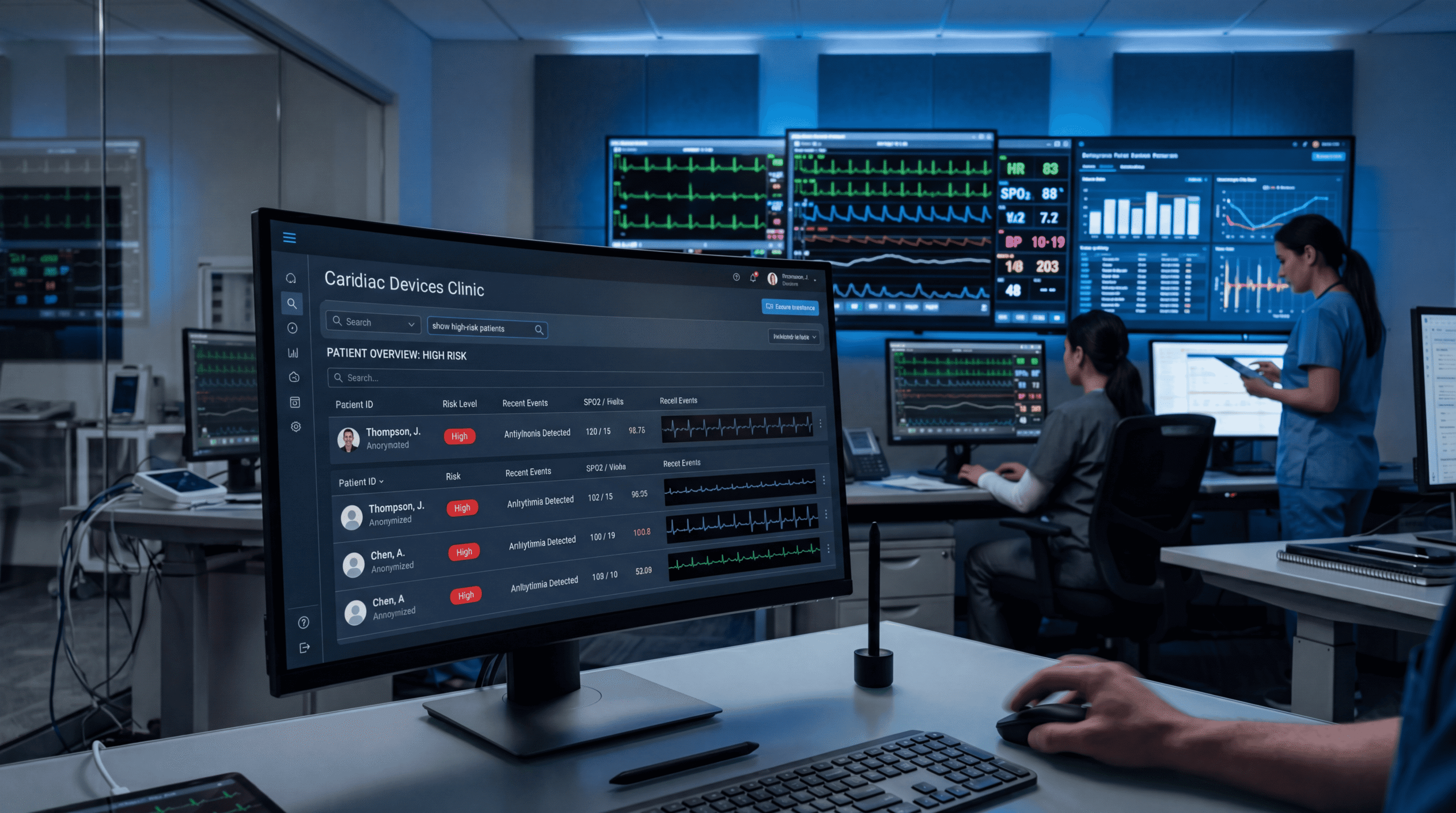

Octagos just launched Ask Atlas, marketed as the first AI tool that lets cardiac device clinics query their own data in plain English. The pitch sounds revolutionary: doctors type questions, get instant answers, skip the IT department. But here’s what the press release won’t tell you — this isn’t really about natural language processing. It’s about finally having a unified data layer that can actually answer questions at all.
I’ve watched healthcare tech companies promise conversational AI for a decade. The real innovation here isn’t the chatbot interface. It’s that someone finally built middleware that can normalize the absolute chaos that is medical device data across manufacturers.
What The Press Got Wrong About Ask Atlas
Every headline will focus on the ChatGPT-style interface. That’s the demo-friendly part. But talk to anyone managing a device clinic and they’ll tell you the actual problem: Medtronic data lives in one system, Abbott in another, Boston Scientific somewhere else, and trying to answer a simple question like “how many patients are overdue for follow-up” requires three different logins and a spreadsheet.
The valuable part of Ask Atlas isn’t that it understands natural language — OpenAI and Anthropic APIs already do that competently. The valuable part is the data integration layer underneath that can actually retrieve coherent answers from fragmented systems. According to a 2023 analysis in Cardiovascular Business, the average device clinic uses 4-6 separate software systems with zero interoperability.
Octagos presumably spent years building connectors to each manufacturer’s data format. That’s the hard part. Wrapping it in a conversational interface is the easy part that gets the press.
The Workflow Improvements That Actually Matter
Strip away the AI hype and Ask Atlas is solving three real operational problems in device clinics. First, it’s eliminating the “data analyst as bottleneck” problem. Right now, if a clinic director wants to know which patients are at high risk for hospitalization, they email someone in IT who writes a SQL query who sends back a CSV file three days later. By then, the clinical decision window has closed.
Second, it’s enabling ad-hoc analysis without technical skills. Device clinic staff are nurses and techs, not data scientists. But they’re the ones who know which questions matter. Ask Atlas lets them iterate on queries themselves instead of playing telephone with the analytics team. This is the same workflow improvement that made Stripe’s Dashboard valuable — put the data in the hands of people who can act on it.
Third, and this is the part that will actually drive adoption, it’s creating an audit trail. Healthcare is ruthlessly regulated. Every clinical decision needs documentation. A conversational AI that logs every query and response automatically creates compliance documentation. That’s not sexy, but it’s the feature that makes CFOs sign contracts.
The Healthcare Information and Management Systems Society estimates that clinicians spend 28% of their time on documentation and data retrieval. Ask Atlas isn’t going to cut that in half, but reducing it by even 10% would be massive for clinic economics.
Why This Timing Makes Sense
Octagos launched this now because three technical prerequisites finally aligned. First, large language models got good enough and cheap enough that the conversational interface actually works. GPT-4 level models can handle medical terminology and context without extensive fine-tuning. Two years ago, you’d need a specialized medical NLP model that cost millions to develop.
Second, healthcare data standards are slowly, painfully converging. FHIR (Fast Healthcare Interoperability Resources) is gaining real adoption. Device manufacturers are under regulatory pressure to make data accessible. The integration problem is still hard, but it’s no longer impossible.
Third, remote patient monitoring exploded during COVID and never contracted. Device clinics went from managing hundreds of patients to thousands. The old workflow of manually checking each manufacturer’s portal broke completely. Clinics are desperate for tools that work across their entire patient population. According to MedTech Dive, the remote cardiac monitoring market grew 47% from 2020 to 2023.
These three factors created a window where a product like Ask Atlas becomes feasible to build and desperate to buy. That’s the real market signal, not the AI branding.
The Technical Architecture They’re Not Talking About
Here’s what Ask Atlas almost certainly looks like under the hood. There’s a data warehouse that pulls from each manufacturer’s API every night (or in real-time if they paid for premium integrations). That data gets normalized into a common schema — probably FHIR-based — with patient identifiers properly mapped across systems.
On top of that sits a semantic layer that translates clinical concepts into database queries. When someone asks “show me patients with declining ejection fraction,” the system needs to know that means comparing sequential echocardiogram results and that different manufacturers report this metric in different fields.
Then there’s the LLM layer that interprets natural language and decides which queries to run. This is probably a fine-tuned model specifically trained on medical device terminology, not just raw GPT-4. Finally, there’s a RAG (Retrieval Augmented Generation) system that fetches the actual data and formats it into a readable response.
The entire architecture is probably HIPAA-compliant infrastructure running on AWS or Azure with end-to-end encryption. The conversational interface is the tiny visible tip of a massive data engineering iceberg. This is a healthcare data integration problem disguised as an AI product.
Who Actually Wins and Loses
Winners: Mid-size device clinics managing 500-2000 patients. They’re big enough that manual processes are breaking but too small to hire dedicated data analysts. Ask Atlas could cut their administrative overhead by 20-30%. That directly improves clinic economics without requiring behavior change from clinical staff.
Winners: Device clinic software vendors like Octagos who can now offer a genuinely differentiated product. Every EMR vendor has been promising “AI features” for three years. Most of it is vaporware. A working natural language query system is actual functionality that clinics will pay premiums for.
Losers: Healthcare IT consulting firms that charge $200/hour to build custom reports. If clinic staff can answer their own questions, that entire business model evaporates. Expect these firms to spread FUD about AI accuracy and push hard on the “you still need human analysts” narrative.
Losers: Device manufacturers who’ve used proprietary data formats as competitive moats. If Octagos successfully abstracts away manufacturer differences, it commoditizes the data layer. Clinics will make device decisions based on clinical outcomes, not which vendor has the best dashboard. Medtronic and Abbott should be watching this closely.
Losers: Traditional medical device clinic software that never invested in modern data infrastructure. If natural language queries become table stakes, every legacy vendor is suddenly on a 24-month clock to rebuild their entire data layer or lose customers to Octagos.
The Process Improvements That Will Define Success
The real test for Ask Atlas isn’t whether it can answer questions — it’s whether it can change clinical workflows. Here are the three processes where this could have outsized impact.
First, risk stratification becomes continuous instead of periodic. Right now, most clinics review high-risk patients monthly or quarterly. With instant queries, they could flag declining patients daily. This shifts device clinics from reactive to proactive care management. That’s a fundamental operational change that could reduce hospitalizations and improve outcomes.
Second, resource allocation gets data-driven. Clinic managers can instantly see which patients require the most clinical time, which are stable enough for automated follow-up, and where to deploy limited nursing staff. This is basic operations research, but healthcare has been running on gut feel because getting the data was too hard.
Third, quality reporting becomes automatic. Medicare and insurance companies require mountains of quality metrics. Clinics currently employ people whose entire job is extracting this data and filling out forms. If Ask Atlas can auto-generate quality reports, that’s an immediate ROI that pays for the software.
The process improvements compound over time. Once clinic staff trust the system, they’ll start asking more sophisticated questions. The queries themselves become a dataset that reveals what clinics actually care about versus what vendors think they care about.
What This Means For The Future
If Ask Atlas succeeds, it proves that conversational interfaces can work for specialized professional tools, not just consumer apps. That’s significant. The enterprise software world has been skeptical that LLMs are accurate enough for high-stakes decisions. Healthcare is the ultimate high-stakes environment. If doctors and nurses trust AI-generated answers enough to make clinical decisions, that’s a validation that will ripple across every other industry.
The bigger implication is that data integration becomes the new competitive battleground in healthcare IT. For twenty years, healthcare software companies competed on features and user interface. The next decade will be about data gravity — whoever has the most complete, queryable dataset wins. Ask Atlas is Octagos’s play to become the system of record for device clinic data.
This also accelerates the trend toward AI-native healthcare workflows. Once clinics get comfortable with conversational queries, they’ll expect it everywhere. EMRs, lab systems, pharmacy management — every healthcare IT vendor is now on notice that natural language interfaces are no longer optional. The question is whether incumbents like Epic and Cerner can retrofit this onto legacy architectures or if startups like Octagos leapfrog them.
The technical architecture that Octagos is building here — unified data layer plus conversational interface — becomes the template for vertical AI applications. You’ll see the same pattern in legal tech (query case law), financial services (query transaction data), and logistics (query supply chain data). Healthcare is proving the model because the pain of fragmented data is most acute here.
The Real Risk Everyone’s Ignoring
The elephant in the room is hallucinations. Large language models are statistically likely to confidently state things that are wrong. In most applications, that’s annoying. In healthcare, it’s malpractice. Octagos needs to have built extensive guardrails that ensure every response is directly traceable to source data with zero synthesis or inference.
If Ask Atlas ever generates a plausible-sounding answer that doesn’t match the actual patient data, and a clinician acts on it, Octagos faces liability that could sink the company. This is why the system architecture probably includes extensive logging, confidence scoring, and human-in-the-loop verification. The AI is the interface, but there better be deterministic database queries underneath.
The second risk is vendor lock-in. Once a clinic has two years of query history in Ask Atlas, switching costs become enormous. Octagos controls not just the software but the institutional knowledge of what questions matter and how to answer them. Expect aggressive pricing increases once they hit critical mass in the market. Smart clinic IT leaders should be negotiating data portability guarantees into their contracts now.
The AI gold rush of 2023-2024 is littered with products that are impressive demos but don’t actually improve workflows. Most conversational AI in healthcare will fail because it solves the wrong problem or introduces more friction than it removes. Ask Atlas has a real shot because it’s targeting a genuine operational pain point that clinics will pay to fix.
Healthcare moves slowly, but when it moves, it moves completely. If Ask Atlas proves that conversational AI can handle clinical decision support, every healthcare IT vendor will be forced to follow. We’re watching the beginning of a platform shift disguised as a product launch.