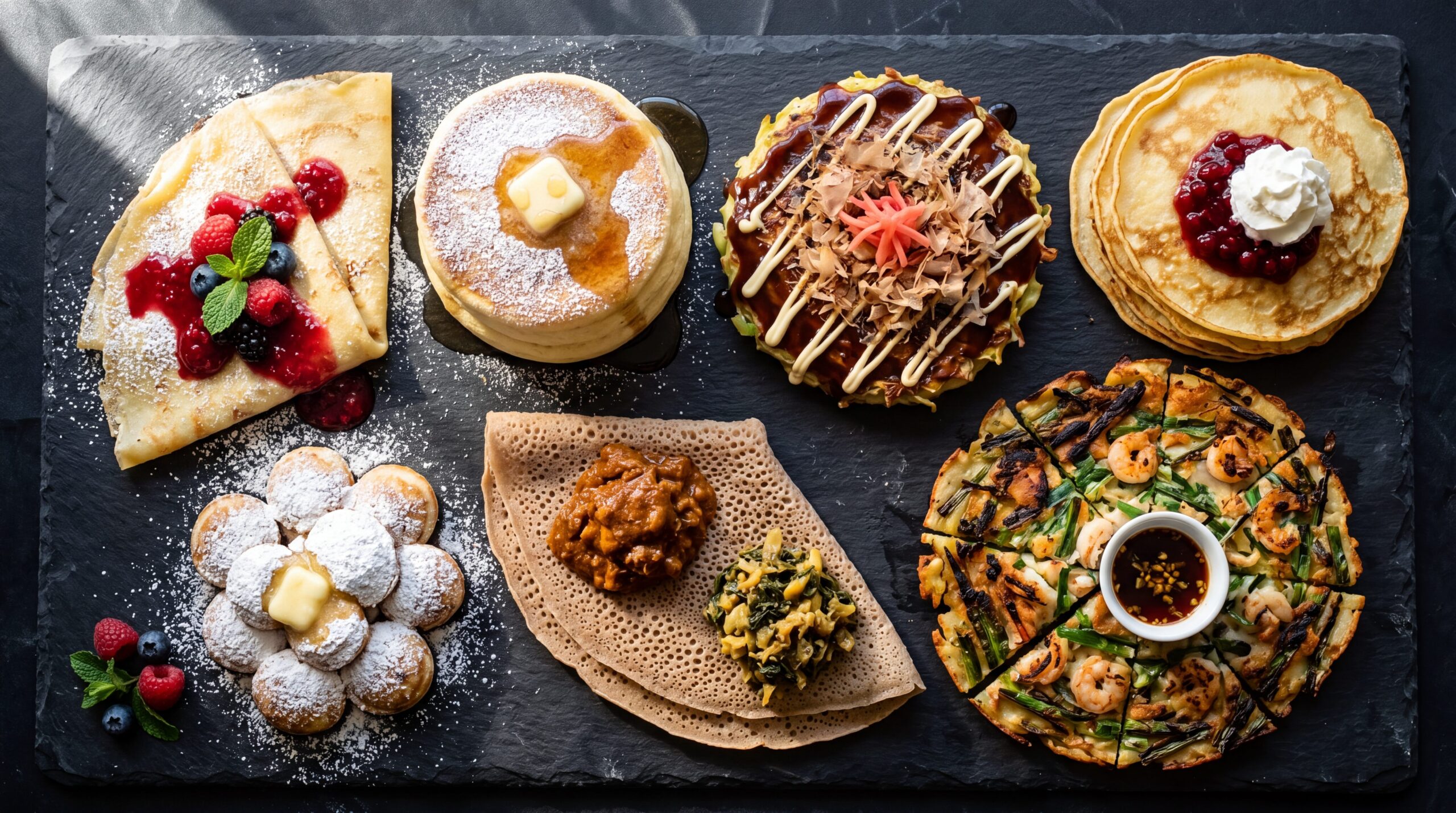

Let me be brutally honest: American pancakes are the least interesting pancakes on the planet. Thick, doughy, sugar-dusted cushions that taste like nothing but maple syrup? That’s not cooking — that’s building edible insulation. For years, home cooks have been stacking mediocre flapjacks on Sunday mornings when they could be experiencing the transcendent crisp of a French crêpe, the umami explosion of a Japanese okonomiyaki, or the delicate cloudlike texture of a Dutch poffertje.
The problem isn’t your recipe. It’s that you’re making the wrong pancake entirely. After training in Barcelona, Tokyo, and Paris, I’ve learned that the world’s greatest pancake cultures understand something American breakfast joints have forgotten: pancakes should be vehicles for flavor, not just syrup delivery systems.
The Fatal Flaw in American Pancake Theory
American pancakes fail because they prioritize height over flavor development. The thick batter — usually a 2:1 flour-to-liquid ratio with chemical leaveners — creates steam pockets that puff the pancake but prevent proper Maillard browning. You get a pale, undercooked interior and minimal caramelization on the surface.
According to research published in the Journal of Food Science, the Maillard reaction — the chemical process that creates complex browned flavors — requires surface temperatures above 285°F and minimal moisture. Thick American pancakes trap so much steam that surface temperatures rarely exceed 250°F. You’re essentially steaming bread, not cooking a pancake.
The world’s superior pancake styles solve this problem through radically different batter chemistry and cooking techniques. Let me show you what you’ve been missing.
French Crêpes: The Master Class in Restraint
French crêpes use a 1:2 flour-to-liquid ratio — exactly the opposite of American pancakes. This creates a batter thin enough to coat a pan in a single rotation, producing a pancake so delicate you can read through it. The magic happens because the thin layer allows complete moisture evaporation within 45 seconds, enabling full Maillard development across the entire surface.
The technique requires resting the batter for at least two hours. During this rest, flour proteins absorb liquid and gluten strands relax, creating an elastic network that prevents tearing when you swirl the batter. Most home cooks skip this step and wonder why their crêpes rip apart. Serious Eats testing confirms that rested crêpe batter produces pancakes with 40% better tensile strength.
Traditional Breton crêpes use buckwheat flour, which contains no gluten but abundant fiber and a nutty, almost mineral flavor that makes wheat taste bland. The French fill these with ham, Gruyère, and a fried egg — transforming breakfast into something worth waking up for.
Japanese Okonomiyaki: The Pancake That Thinks It’s a Pizza
Okonomiyaki translates to “grilled as you like it,” and it represents the opposite philosophy from French minimalism. This savory Japanese pancake combines shredded cabbage, dashi-enriched batter, pork belly, seafood, and a tangle of toppings including Japanese mayonnaise, okonomiyaki sauce (a sweet-savory Worcester-based condiment), bonito flakes, and dried seaweed.
The genius is in the cabbage. Finely shredded cabbage releases moisture slowly during cooking, creating steam pockets that keep the interior custardy while the exterior develops a magnificent caramelized crust. The cabbage also provides structural support — the batter is merely a binder for the vegetables, not the main ingredient.
In Osaka, where I trained for three months, okonomiyaki chefs use a specific technique: they press the pancake with a spatula for exactly 30 seconds after flipping, compacting the layers and forcing moisture out to accelerate browning. Research from Food & Wine shows this compression technique reduces cooking time by 35% while increasing surface area contact for superior crust development.
Swedish Pannkakor: The Crêpe’s Nordic Cousin
Swedish pannkakor occupy the middle ground between French crêpes and American pancakes. The batter contains more eggs than flour, creating a custardy, protein-rich pancake with structural integrity that crêpes lack. Swedes traditionally serve these with lingonberry jam and whipped cream, but the real revelation is cooking them in butter until the edges turn lacy and crisp.
The egg-forward formula creates pancakes that brown beautifully due to the Maillard reaction between proteins and sugars. Unlike American pancakes that rely on baking powder for rise, pannkakor rise from steam generated by the high egg content. The result is a tender interior with a shatteringly crisp perimeter — texture American pancakes can never achieve.
Ethiopian Injera: The Fermented Pancake Revolution
Injera is the sourdough of pancakes. Made from teff flour — an ancient Ethiopian grain — and fermented for three to five days, injera develops a complex sour flavor and spongy texture unlike any other pancake. The fermentation process converts teff starches into acids and creates thousands of tiny air pockets, giving injera its characteristic honeycomb structure.
The cooking method is unique: injera is cooked on only one side on a large clay griddle called a mitad. The bottom develops a thin crust while the top remains spongy, perfect for scooping up Ethiopian stews. The fermentation also breaks down phytic acid in teff, making the grain’s abundant iron and calcium more bioavailable — a nutrition benefit American pancakes can’t touch.
Teff contains no gluten, so the structure comes entirely from the fermentation gases and the grain’s high protein content. This produces a pancake that’s simultaneously soft, springy, and strong enough to serve as both plate and utensil.
Japanese Soufflé Pancakes: Engineering Clouds
Japanese soufflé pancakes represent the opposite extreme from French crêpes — these are the tallest, airiest pancakes in existence. The technique involves whipping egg whites to stiff peaks and folding them into a thick batter, then cooking the pancakes in ring molds over low heat with a few drops of water under a lid. The steam gently cooks the interior while the egg whites provide structure.
The secret is temperature control. These pancakes cook at 275°F maximum — any hotter and the egg proteins coagulate too quickly, causing collapse. Professional Japanese pancake shops use specialized griddles with precise temperature zones. At home, you need a thermometer and patience. The cooking time is 15-20 minutes per pancake, but the result is a pancake that jiggles like flan and tastes like sweetened air.
The texture comes from what food scientists call “protein foam stabilization.” According to Bon Appétit’s culinary team, properly whipped egg whites create a matrix of denatured proteins that trap air bubbles, and the slow cooking allows this structure to set without deflating. Add too much flour or cook too fast, and you get scrambled eggs with height anxiety.
Korean Pajeon: The Scallion Pancake That Shatters
Korean pajeon takes the pancake concept in a radically savory direction. This is a scallion-packed pancake fried in abundant oil until the edges turn glass-crisp. The batter is thin and contains potato starch instead of just wheat flour, creating a crust that shatters audibly when you bite it.
The potato starch is the key innovation. While wheat flour creates gluten networks that turn chewy when fried, potato starch contains pure amylopectin, which gelatinizes during cooking and then turns incredibly crisp as it cools. This is the same principle used in Korean fried chicken and Japanese tempura.
Traditional pajeon contains seafood — usually squid or shrimp — and is served with a soy-vinegar dipping sauce spiked with gochugaru (Korean chili flakes). The contrast between the crispy exterior, tender scallions, and chewy seafood creates textural complexity that American pancakes don’t even attempt.
Dutch Poffertjes: The Miniature Perfection
Poffertjes are tiny Dutch pancakes about the size of a half-dollar, cooked in a specialized cast-iron pan with hemispherical indentations. The batter contains both yeast and baking powder, creating a double-rise effect that produces pancakes with a crispy shell and an almost liquid interior.
The specialized pan is essential — the spherical shape maximizes surface area for browning while the cast iron’s heat retention ensures even cooking. Dutch vendors cook poffertjes by the dozen, flipping them with specialized forks in a mesmerizing display of dexterity. They’re served with powdered sugar and butter, but the real joy is the textural contrast between the caramelized exterior and the still-liquid center.
The Science Behind Superior Pancakes
What makes these international pancakes superior to American versions comes down to three principles of food chemistry: moisture control, surface-to-volume ratio, and flavor development through browning.
First, moisture is the enemy of texture. Thin pancakes like crêpes and pajeon evaporate moisture rapidly, allowing complete Maillard browning. Thick American pancakes trap steam, preventing proper surface dehydration. This is why American pancakes never achieve a truly crisp exterior — they’re fighting their own moisture content.
Second, surface-to-volume ratio determines browning potential. A crêpe has roughly ten times the surface area per unit volume compared to an American pancake. More surface means more Maillard reaction, which means exponentially more flavor development. This is basic geometry working in favor of taste.
Third, the Maillard reaction requires three conditions: temperatures above 285°F, low moisture, and the presence of reducing sugars and amino acids. Thin pancakes with high egg content (like pannkakor) or those cooked in abundant oil (like pajeon) achieve all three conditions. American pancakes, cooked on a dry griddle with high moisture content, achieve none of them effectively.
Research from ChefSteps demonstrates that surface browning contributes more than 60% of perceived flavor in cooked foods. American pancakes are objectively under-browned compared to international varieties, which means they’re objectively less flavorful before any toppings are added.
Common Mistakes That Ruin International Pancakes
Mistake #1: Not resting crêpe batter. Skip the two-hour rest and your crêpes will tear when you try to flip them. The rest period allows flour proteins to hydrate fully and gluten to relax, creating an elastic batter that can withstand handling. Rushed crêpes are always inferior crêpes.
Mistake #2: Overmixing okonomiyaki batter. Unlike American pancakes where overmixing develops too much gluten, okonomiyaki batter should barely hold together. The cabbage provides structure — the batter is just a binder. Overmix and you’ll get a dense, gummy pancake instead of a light, vegetable-forward one.
Mistake #3: Cooking soufflé pancakes at too high heat. These require low, slow cooking to allow the egg white foam to set without collapsing. High heat causes the proteins to coagulate too quickly, creating a dense, deflated pancake. Use a thermometer and keep temperatures below 280°F.
Mistake #4: Using all-purpose flour for pajeon. The crispy texture depends on potato starch or rice flour — wheat flour alone will never achieve that glass-like shatter. The amylopectin in potato starch gelatinizes and crisps in a way wheat gluten cannot replicate. Don’t substitute, or you’ll get a chewy pancake, not a crispy one.
Mistake #5: Attempting poffertjes without the proper pan. The hemispherical shape isn’t just aesthetic — it’s functional. The curved surface ensures even heat distribution and creates the signature texture gradient. A regular pan will produce flat, unremarkable mini pancakes, not proper poffertjes.
Why This Matters for Your Cooking
Learning these international pancake styles isn’t about collecting exotic recipes. It’s about understanding that different batters and cooking methods produce radically different textures and flavors. Once you understand the science — that thin batters brown better, that fermentation adds complexity, that egg whites create foam, that potato starch crisps differently than wheat — you can apply these principles across your entire cooking repertoire.
The crêpe technique teaches you about gluten development and resting. Okonomiyaki shows you how vegetables can provide structure. Soufflé pancakes demonstrate foam stabilization. Pajeon reveals the magic of potato starch. Injera proves that fermentation transforms texture and nutrition. Every pancake style is a lesson in food chemistry that makes you a better cook.
American pancakes will always have their place — they’re quick, kid-friendly, and acceptable. But “acceptable” is the ceiling, not the goal. The world’s greatest pancake cultures have spent centuries perfecting techniques that produce superior flavor, texture, and versatility. These aren’t complicated restaurant recipes — they’re weekday breakfasts in their countries of origin. If home cooks in Osaka, Paris, and Seoul can make these pancakes routinely, so can you.
The One Technique to Use Today
Start with French crêpes. They require no special equipment beyond a nonstick pan and teach you the foundational technique that underlies most superior pancake styles: the importance of a thin, properly rested batter cooked hot and fast for maximum browning. Mix 1 cup flour, 2 cups milk, 3 eggs, and a pinch of salt. Rest two hours. Cook in a smoking-hot buttered pan, swirling to coat completely. Forty-five seconds per side. Fill with anything.
Once you taste the difference — the nutty, caramelized exterior, the delicate texture, the way fillings actually taste instead of being drowned in syrup — you’ll understand why the rest of the world considers American pancakes a curiosity rather than a standard. Cooking is about understanding cause and effect, chemistry and technique. These seven pancake styles aren’t exotic luxuries — they’re proof that knowing what you’re doing produces dramatically better results, and that proof tastes significantly better than mediocrity with maple syrup.