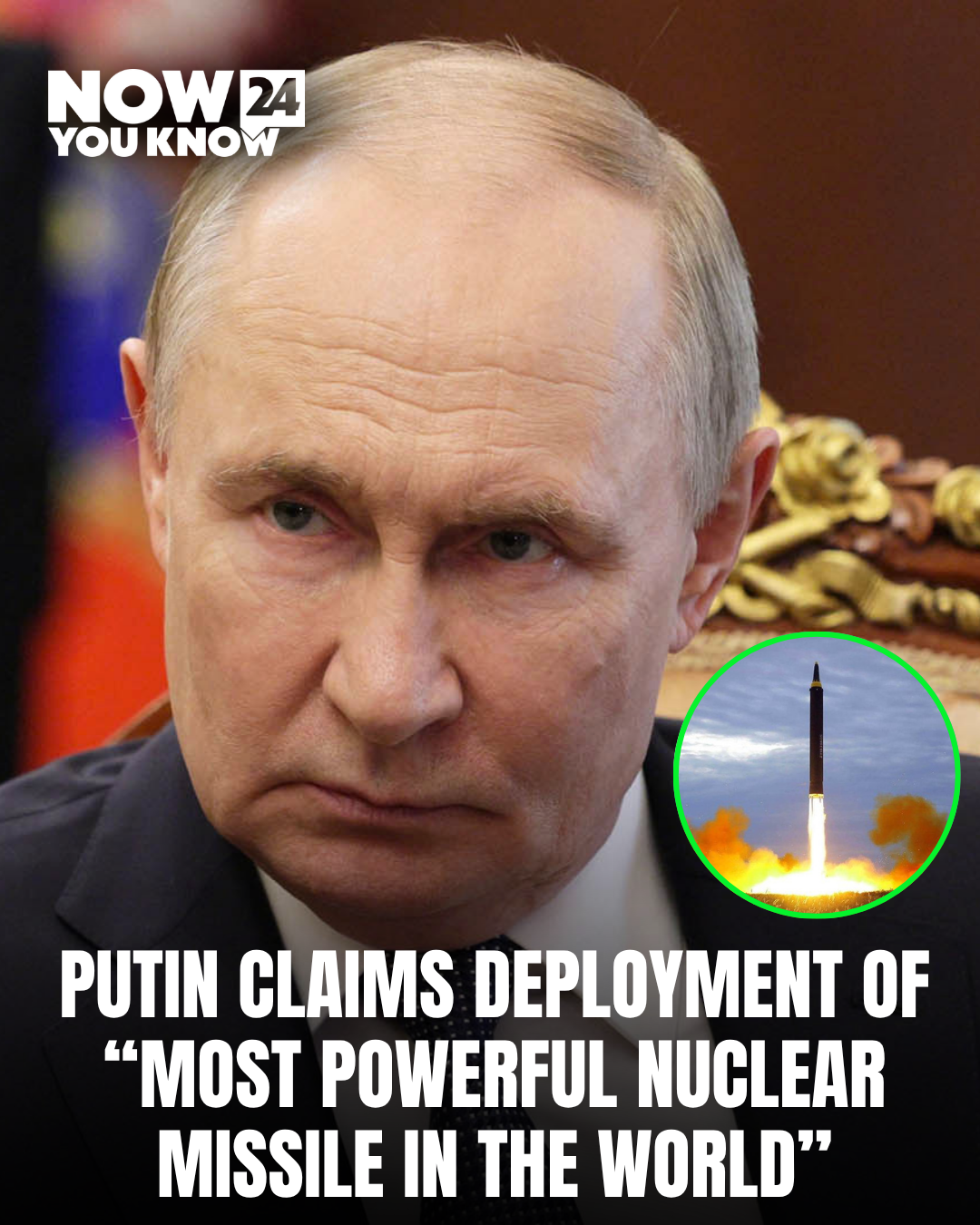

Putin Announces New Sarmat Missile Deployment
Russia has announced plans to deploy what it describes as the “most powerful nuclear missile in the world” later this year, according to statements attributed to President Vladimir Putin and reported in Russian state media.
The missile, known as the RS-28 Sarmat, is presented by Russian officials as a next-generation intercontinental ballistic missile designed to strengthen the country’s strategic nuclear forces.
Capabilities Claimed by Russian Officials
Russian military leadership claims the Sarmat system is capable of carrying multiple warheads and reaching targets across vast distances, including parts of Europe and the United States.
Officials have also stated that the missile can bypass existing and future missile defence systems, though these claims have not been independently verified.
The system is reportedly part of Russia’s broader effort to modernise its nuclear arsenal.
Technical Claims and Strategic Messaging
According to statements cited in media reports, the missile is said to weigh over 200 tonnes and is designed for long-range strategic deployment.
Russian officials have suggested that its range could exceed 10,000 kilometres, allowing it to reach intercontinental targets. Some claims have gone further, though such figures vary depending on the source.
Military analysts note that many of these specifications are difficult to independently confirm and often come from official statements rather than transparent testing data.
Broader Nuclear Arsenal Context
Russia is widely reported to possess the largest nuclear arsenal in the world, with thousands of deployed and stored warheads. The United States follows closely in second place, according to estimates from independent arms control organisations.
Both countries maintain large strategic deterrent forces under the doctrine of mutually assured destruction, which has historically limited direct conflict between nuclear powers.
Political Messaging and International Reactions
Russian officials have repeatedly referenced nuclear capability in public messaging since the start of the Ukraine conflict in 2022. These statements are often viewed by Western analysts as strategic signalling rather than immediate operational intent.
Some Russian political figures have also made provocative public remarks regarding nuclear escalation, further heightening international concern.
Western governments, however, have consistently rejected accusations of nuclear escalation planning and continue to call for restraint.
The Role of Deterrence Strategy
Experts emphasise that nuclear weapons are primarily designed for deterrence rather than active battlefield use. The concept is based on preventing large-scale war through the threat of overwhelming retaliation.
This framework, known as mutually assured destruction, remains a central factor in global nuclear stability despite ongoing geopolitical tensions.
Ongoing Global Concerns
While statements about new weapons systems often generate international alarm, defence analysts caution that rhetoric does not always translate into immediate deployment or operational readiness.
Nevertheless, continued development and testing of advanced missile systems contribute to ongoing tensions between nuclear-armed states.