



The world didn’t end over the weekend. That’s precisely why you should be worried.
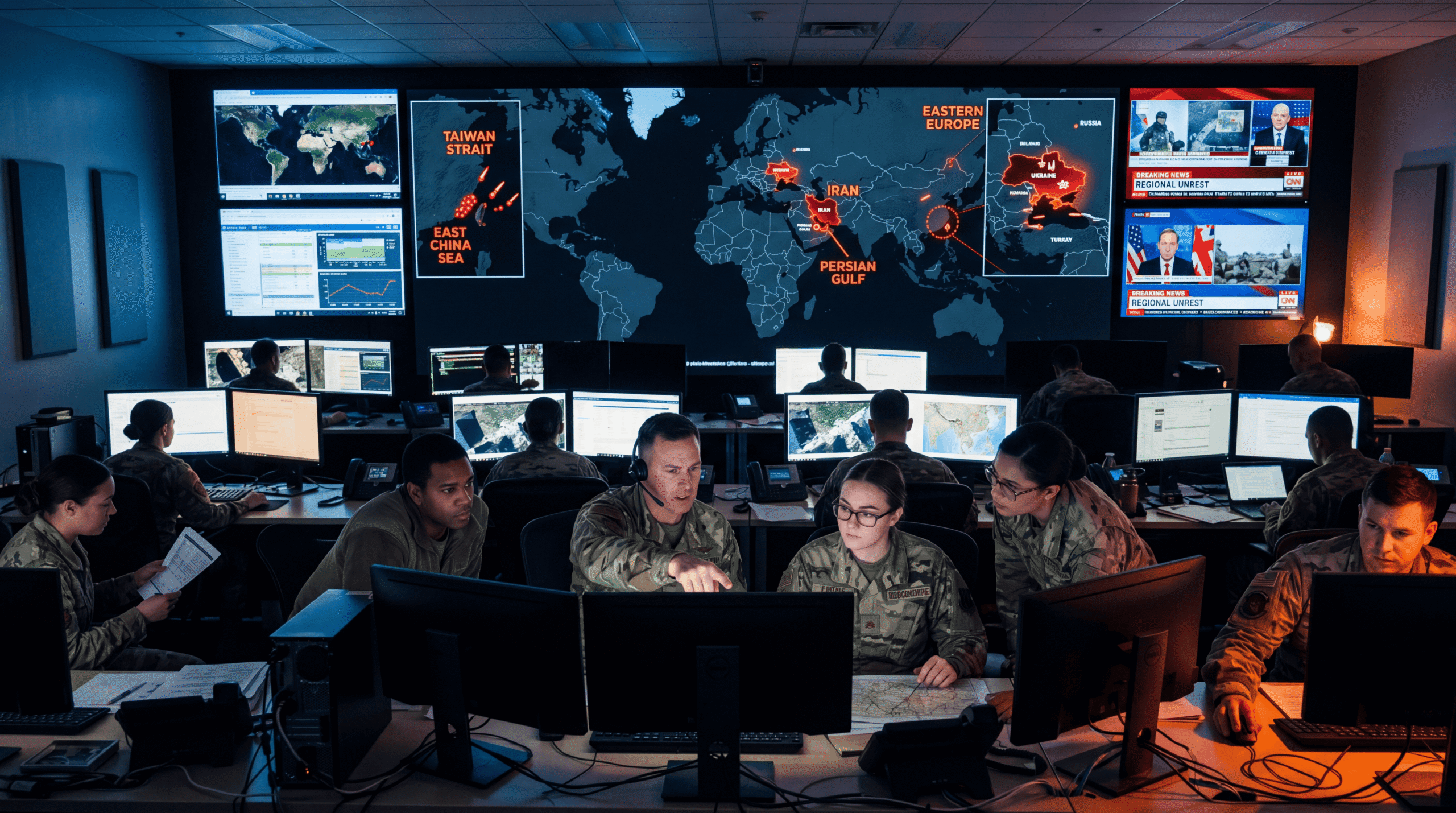
While markets opened Monday with the usual pretense of stability, three pressure points in the global system have reached critical mass. As a geopolitical analyst who has spent nearly two decades tracking how small triggers create catastrophic failures, I can tell you this: the most dangerous moments aren’t marked by dramatic headlines. They’re marked by silence while systems strain.
What happened over a seemingly quiet 48 hours reveals more about the trajectory of global conflict than most politicians want to acknowledge. Let me walk you through what your government isn’t saying in its morning briefings.
The Taiwan Strait: Normalization as Weapon
Chinese military aircraft conducted their seventeenth consecutive day of incursions into Taiwan’s Air Defense Identification Zone this weekend. Seventeen. Most news organizations stopped counting after day three.
This is textbook escalation through normalization — a technique Beijing perfected by studying how Russia slowly militarized Crimea before 2014. When extraordinary military posturing becomes ordinary background noise, you’ve already lost the information war. By the time Western capitals treat this as urgent, the window for non-military responses will have closed.
Taiwan’s defense ministry reported 47 People’s Liberation Army aircraft on Saturday alone, including nuclear-capable H-6 bombers. But here’s what matters more than the number: the flight patterns now routinely simulate strike packages targeting Taiwan’s eastern ports. They’re not just probing defenses anymore. They’re rehearsing.
The United States responded with its standard formula — a State Department statement expressing “concern” and a freedom of navigation operation that changed precisely nothing. This is diplomatic theater designed to satisfy domestic audiences while signaling to Beijing that Washington has no appetite for actual confrontation.
Historical parallel: In the six months before Germany remilitarized the Rhineland in 1936, Hitler ordered 22 separate “training exercises” that violated Versailles Treaty restrictions. Britain and France issued statements. By the time tanks rolled across the Rhine bridges, the international community had been conditioned to accept German military assertiveness as the new normal.
Middle East Powder Keg: The Iran Nuclear Timeline
Iran announced over the weekend that it had successfully tested advanced centrifuge cascades at its Fordow facility — buried deep under a mountain, designed specifically to withstand airstrikes. The International Atomic Energy Agency confirmed Tehran now possesses enough 60% enriched uranium to produce four nuclear weapons within 12 weeks if it chooses to weaponize.
Twelve weeks. That’s the distance between decision and detonation.
What makes this development particularly dangerous isn’t just the technical capability. It’s the regional response architecture that’s already in motion. Israel conducted previously unacknowledged air force exercises over the Mediterranean this weekend, practicing long-range strike missions with aerial refueling. Saudi Arabia quietly moved Patriot missile batteries to defensive positions around its oil infrastructure in the Eastern Province.
According to sources at the Brookings Institution who track Middle Eastern military deployments, both actions indicate operational timelines measured in weeks, not months. The military infrastructure for major regional conflict is being positioned while diplomatic channels exchange pleasantries about “dialogue.”
The Biden administration’s strategy — maximum pressure through sanctions combined with minimal diplomatic engagement — has produced exactly what critics predicted: an Iranian regime with nothing to lose. When you back a regional power into a corner with no off-ramp, you don’t get capitulation. You get desperation, which is far more dangerous.
Eastern Europe: The Forgotten Flashpoint
While global attention fixates on Asia and the Middle East, Belarus held “surprise” military exercises along its border with Poland this weekend. These weren’t announced to NATO under the Vienna Document protocols, which require notification of major military movements.
President Lukashenko’s regime — now essentially a satellite administration for Moscow — deployed an estimated 15,000 troops with heavy armor to staging areas within 30 kilometers of the Polish frontier. This mirrors exactly the “training exercise” posture Russia adopted before launching its 2022 invasion of Ukraine.
Poland responded by activating reserve brigades and requesting emergency consultations under NATO Article 4, which addresses threats to member states’ territorial integrity. This is the most serious invocation of Article 4 since the 2023 Turkish-Syrian border crisis.
The Council on Foreign Relations published analysis this weekend noting that NATO now faces a two-front challenge: deterring Russian aggression in Eastern Europe while maintaining credible defense commitments in the Indo-Pacific. The alliance was never designed for simultaneous major theater operations across continents. The military logistics alone create impossible choices about where to concentrate limited assets.
What decision-makers know but won’t say publicly: NATO’s current force posture cannot credibly defend the Baltics, Poland, and Taiwan simultaneously. Any major conflict in one theater would create irresistible opportunities for adversaries in the other. This is the strategic nightmare that keeps Pentagon planners awake at 3 AM.
The Energy Weapon: Europe’s Vulnerability Persists
Quietly, almost unreported over the weekend, Russia announced “technical difficulties” at the Yamal-Europe pipeline that reduced natural gas flows to Germany by 40%. This is the fourth “technical problem” in six weeks, each coincidentally timed to moments of diplomatic tension.
European natural gas prices spiked 18% on Monday morning before most Americans had their coffee. This is the economic coercion playbook Putin has perfected: never explicitly weaponize energy, just create enough “technical issues” to remind Europe who controls the tap.
Germany’s strategic gas reserves stand at 62% capacity heading into what meteorologists predict could be a colder-than-average autumn. That’s better than the crisis levels of 2022, but still dangerously inadequate if Russia decides to shut off flows entirely. The German economy — Europe’s engine — remains vulnerable to energy blackmail despite three years of supposed diversification efforts.
The uncomfortable truth that European leaders avoid discussing: the continent’s transition away from Russian energy has been more rhetorical than real. Alternative suppliers cannot fill the gap at prices European industries can afford while remaining competitive. This gives Moscow continuing leverage over European foreign policy toward Ukraine, Taiwan, and every other flashpoint where Western and Russian interests collide.
What This Means For You
If you’re reading this briefing from anywhere in the developed world, these geopolitical tensions will impact your life within 90 days, regardless of whether they escalate to armed conflict.
Economic impact: Global insurance companies have already begun pricing elevated geopolitical risk into premiums for shipping, supply chains, and business continuity policies. That cost gets passed to consumers. Expect inflation pressures to intensify, particularly for manufactured goods dependent on Asian supply chains and energy-intensive European production.
Energy prices: Even without direct conflict, the risk premium on oil and natural gas will remain elevated throughout 2025. The International Energy Agency projects $95-115 per barrel oil prices if current tensions persist without resolution. That translates to $4-4.50 per gallon gasoline in the United States and continued pressure on European industrial competitiveness.
Military mobilization: Multiple NATO countries — Poland, Finland, Sweden, Estonia, Latvia, Lithuania — have either reinstated or expanded conscription programs. If you’re a dual citizen or have family connections to these nations, prepare for potential call-ups affecting young adults.
Financial markets: Portfolio managers are quietly increasing allocations to defense contractors, cybersecurity firms, and commodities while reducing exposure to globalized supply chain companies. If you haven’t reviewed your retirement accounts recently, this is the moment to consider whether your risk profile matches the global security environment.
What Happens Next: Three Scenarios
Scenario One: Managed Escalation (40% probability)
All three flashpoints remain active but below the threshold of direct military confrontation between major powers. China continues pressure on Taiwan without invasion. Iran remains weeks away from weaponization without crossing the threshold. Belarus conducts military exercises without border incursions. This is essentially the current trajectory extended forward — dangerous, expensive, but not catastrophic.
In this scenario, expect: continued elevated defense spending, persistent inflation from risk premiums, and gradual erosion of international institutions as major powers compete through proxies rather than direct confrontation. The new normal becomes permanent crisis without resolution.
Scenario Two: Sequential Crisis (35% probability)
One flashpoint ignites — most likely Taiwan or Iran — forcing the United States and its allies to concentrate resources on a single theater. Adversaries in other regions exploit this distraction to advance their own objectives. Russia might move on the Baltics while America is focused on Taiwan. Iran might accelerate weaponization while the U.S. Navy is committed to the Taiwan Strait.
This scenario is particularly dangerous because it reveals the fundamental limitation of American power in a multipolar world: the inability to enforce global security architecture simultaneously across continents. Expect: major regional conflicts that don’t escalate to world war but permanently redraw geopolitical boundaries and spheres of influence.
Scenario Three: Diplomatic Off-Ramp (25% probability)
Through backchannel negotiations currently invisible to public view, major powers reach tacit understandings that reduce immediate tensions. China might scale back military pressure on Taiwan in exchange for reduced U.S. arms sales. Iran might accept enhanced monitoring in exchange for sanctions relief. Russia might de-escalate in Eastern Europe in exchange for Western acknowledgment of its sphere of influence in former Soviet states.
This requires all parties to accept outcomes they publicly reject, which is why it’s the least likely scenario. But it’s not impossible — Cold War history is filled with secret agreements that prevented conflicts neither side actually wanted. The question is whether current leadership possesses the strategic imagination to prioritize survival over victory.
The Intelligence Gap: What We Don’t Know
Every analysis like this has blind spots — factors that seem obvious in retrospect but invisible in real-time. Based on my experience covering conflicts from the Balkans to Syria, here are the potential game-changers we might be missing:
Internal instability: China’s economic slowdown is more severe than official statistics admit, potentially constraining Beijing’s appetite for external conflict. Russia’s military is more degraded by Ukraine attrition than Moscow acknowledges. Iran’s domestic opposition is more organized than regime propaganda suggests. Any of these internal vulnerabilities could dramatically alter external behavior.
Technology wildcards: Artificial intelligence is changing military planning cycles in ways that reduce warning time. Cyber capabilities create first-strike advantages that upset traditional deterrence calculations. Space-based weapons systems remain classified but potentially decisive. The next conflict might be shaped by technologies whose existence we can barely confirm.
Unexpected alliances: The geopolitical alignment that seems fixed today could shift within weeks. Turkey and Iran have competing interests in Syria but converging interests regarding Kurdish autonomy. India and China are border rivals but economic partners. Saudi Arabia and Israel share threat perceptions about Iran but cannot publicly cooperate. Unexpected partnerships could emerge when crisis forces hard choices.
The Brookings Perspective: System Failure, Not Isolated Incidents
What connects these three flashpoints isn’t geography or ideology. It’s the fundamental breakdown of the post-1945 international order that prevented great power conflict for nearly eight decades.
That order rested on three pillars: American military dominance that deterred challenges, international institutions that provided forums for dispute resolution, and economic interdependence that made conflict costlier than cooperation. All three pillars are now compromised.
American military dominance has given way to multipolar competition. International institutions like the United Nations have been paralyzed by great power vetoes and rival coalitions. Economic interdependence has been weaponized rather than serving as a brake on conflict — as Russia demonstrated by cutting off European gas and China has shown through export controls on rare earth materials.
We’re not witnessing isolated crises. We’re watching the simultaneous failure of multiple systems designed to prevent exactly this cascade of instabilities. That’s why small triggers — a flight pattern over Taiwan, a centrifuge test in Iran, a military exercise in Belarus — carry outsized significance. In a robust system, these would be absorbed. In a failing system, any of them could be the spark.
What Leaders Should Do (But Probably Won’t)
If I were briefing a head of state this morning — and the content of this analysis will reach several foreign ministries by tomorrow — here’s what I’d recommend:
Immediate term: Establish direct military-to-military communication channels with potential adversaries to prevent accidental escalation. The U.S.-Soviet hotline prevented several near-misses during the Cold War. We need equivalent mechanisms with China, Russia, and Iran.
Medium term: Rebuild strategic reserves — energy, critical minerals, medical supplies, food — that provide resilience against supply chain weaponization. Globalization created efficiency at the cost of security. That trade-off no longer serves national interests.
Long term: Accept that the unipolar moment is over and design security architecture for a multipolar world. This doesn’t mean capitulation to authoritarian powers. It means recognizing that no single nation can enforce global order unilaterally, and burden-sharing with allies isn’t optional — it’s essential for survival.
None of these recommendations are politically convenient, which is why they’re unlikely to be implemented before crisis forces action. Leaders optimize for re-election cycles, not generational security challenges. This is the fundamental tragedy of democratic foreign policy: voters punish leaders who spend money preventing wars that never happen, but they also punish leaders who stumble into wars through neglect.
The Verdict History Will Render
When historians assess this period fifty years from now — assuming we avoid the conflicts that would make such historical assessments impossible — they’ll ask one question: Why did leaders who had access to all this information choose inaction?
The warning signs are everywhere. The intelligence is clear. The trajectory is obvious to anyone willing to look beyond the next election cycle. Yet the international community continues to treat symptomatic crises while ignoring the systemic disease.
This weekend wasn’t remarkable because something dramatic happened. It was remarkable because nothing dramatic happened while three separate fuses burned steadily shorter. The absence of crisis doesn’t mean the absence of danger. Sometimes it means we’ve simply stopped paying attention to the timer.
The question isn’t whether these tensions will escalate. The question is whether they’ll escalate simultaneously, and whether the international system has any mechanism left to prevent that cascading failure. Based on everything I’ve observed over eighteen years covering conflicts that leaders insisted were unthinkable right up until they became inevitable, I have to tell you: the answer to that question should terrify you far more than anything that happened over the weekend.