
The war may be ending, but the world it created is permanent. President Trump announced this week that the U.S.-Iran conflict is “very close to over,” predicting markets will “boom” once a deal is signed. But this reads like a fundamentally naïve assessment from someone who measures geopolitical outcomes in stock tickers rather than power shifts. What Trump calls a successful negotiation, historians will recognize as the moment Iran achieved what decades of nuclear brinkmanship never delivered: regional legitimacy as a conventional military power that fought the United States to a negotiated settlement.
The optics matter less than the precedent. For the first time since 1979, Tehran will emerge from direct confrontation with Washington not as a pariah to be isolated, but as a counterparty to be accommodated.
The Conflict That Broke the Old Rules
This wasn’t a proxy war conducted through Hezbollah cutouts or Houthi middlemen—this was Iowa-class American firepower meeting Iranian cruise missiles over the Strait of Hormuz. According to recent Brookings analysis, the 47-day exchange represented the first sustained conventional military engagement between the two nations since the Islamic Revolution. U.S. forces conducted over 200 airstrikes on Iranian infrastructure; Iran responded with coordinated missile and drone attacks on American positions across three countries.
The damage assessment tells the strategic story. Iran lost an estimated 40% of its refining capacity and key command nodes. The U.S. lost seven aircraft, two naval vessels, and 89 service members—the highest American combat casualties in a single month since the Kabul withdrawal. Both sides bled enough to want terms, but not enough to accept surrender.
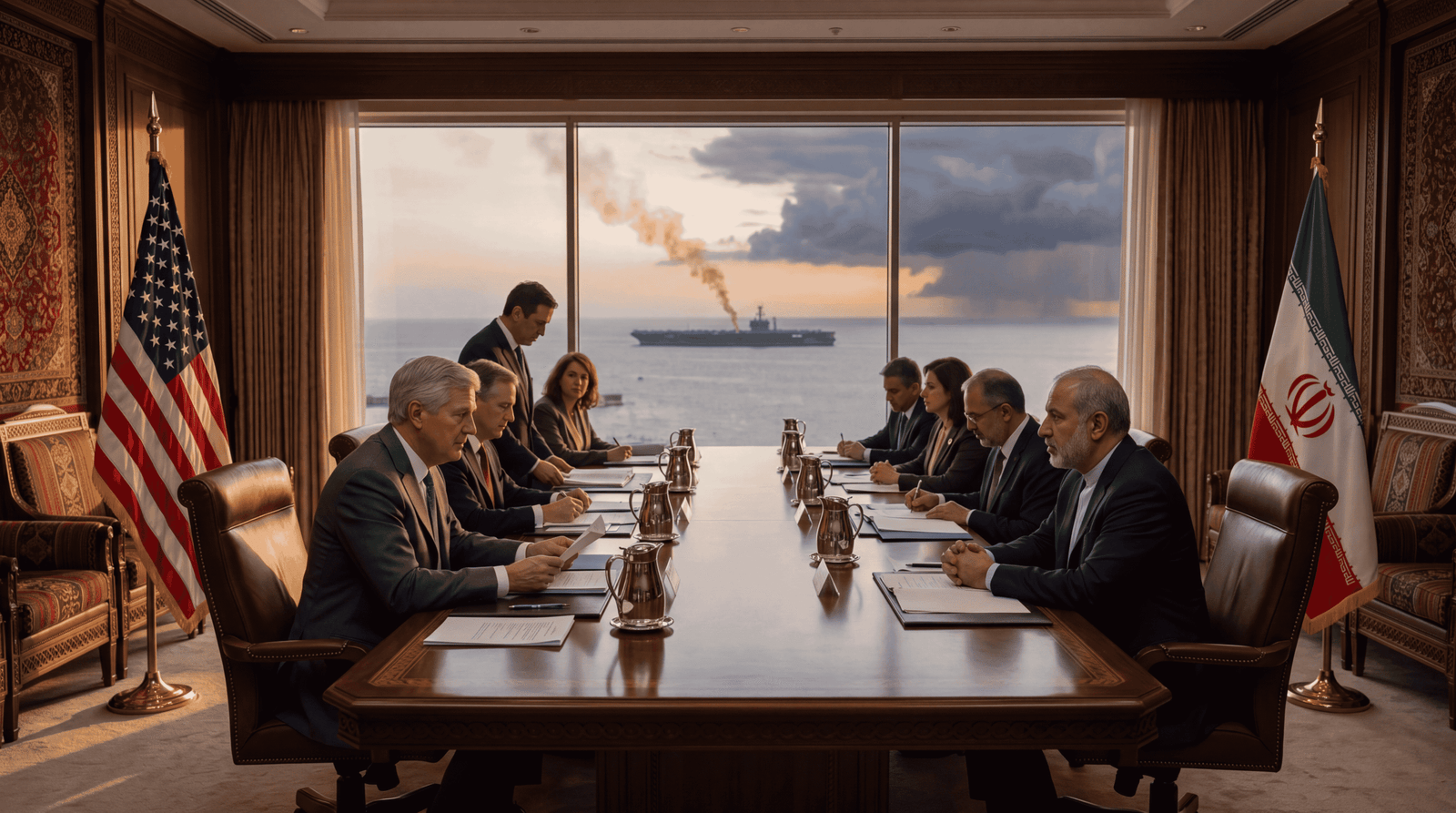
The ceasefire negotiations currently underway in Oman represent something neither government will publicly admit: mutual exhaustion masquerading as mutual respect. Trump frames this as “peace through strength.” Tehran’s Supreme Leader calls it “resistance achieving its goals.” Both narratives are self-serving. The truth is simpler and more destabilizing—they fought to a draw, and the regional order that assumed American military supremacy just died in the Arabian Sea.
What the Maps Now Show
Look at the Middle East power geometry before and after this conflict. Prior to the war, Iran operated through proxies—Hezbollah, PMF militias, the Houthis—always maintaining plausible deniability. That model worked when Tehran wanted to avoid direct U.S. retaliation. But this war forced Iran to reveal capabilities it previously kept ambiguous: sophisticated air defenses, anti-ship missile technology that could credibly threaten U.S. carrier groups, and cyber capabilities that temporarily disrupted CENTCOM communications.
Israel, which historically could assume American intervention would contain any Iranian threat, now faces a different calculation. Writing in Foreign Affairs, former Mossad deputy director Ram Ben-Barak warns that Israel can no longer operate under the assumption that U.S. forces will automatically engage Iranian assets in a regional crisis. The unspoken reality: Washington just demonstrated it will negotiate with Tehran when the costs of escalation become politically untenable at home.
Saudi Arabia and the UAE have already drawn their conclusions. Both increased diplomatic outreach to Tehran during the final weeks of fighting—not because they suddenly trust Iran, but because they no longer fully trust American staying power. This is the real victory Iran achieves through any negotiated settlement: not territorial gains or sanctions relief, but the psychological shift across Arab capitals from “Iran must be contained” to “Iran must be accommodated.”
The Economic Mirage Trump Is Selling
Trump’s prediction of a market boom rests on a shallow reading of how geopolitical risk actually prices into global markets. Yes, Brent crude fell 12% on news of potential ceasefire talks, and yes, defense sector stocks that surged during the conflict are now correcting. But these are short-term volatility plays, not structural shifts.
The deeper economic reality: this conflict permanently raised the risk premium on all Gulf energy infrastructure. Insurance rates for tankers transiting Hormuz have tripled and will not return to pre-war levels regardless of any diplomatic agreement. Iran demonstrated it can strike Saudi oil facilities and Emirati ports with precision-guided munitions—that capability doesn’t disappear when diplomats sign documents in Muscat.
Global energy markets now operate with the knowledge that the next U.S.-Iran crisis could shut 20% of the world’s oil supply overnight. That’s not a scenario that produces a sustained market “boom”—it’s a scenario that produces persistent inflation hedging and supply chain diversification away from a region that just proved catastrophically unstable. The Financial Times projects an accelerated $340 billion shift in energy investment toward non-Gulf sources over the next five years as a direct consequence of this conflict.
What This Means For You
If you’re an American taxpayer, understand what this “near-end” to the war actually costs: $89 billion in emergency military appropriations, long-term care for thousands of wounded veterans, and the strategic credibility loss that will require decades of alliance management to repair. Your gas prices may temporarily stabilize, but your government just wrote a geopolitical check that your children will still be paying.
If you work in energy, shipping, or any supply chain dependent on Gulf stability, the old risk models are obsolete. The world just saw that U.S. military dominance in the Middle East is no longer automatic or cost-free. Every business continuity plan that assumed stable Gulf access needs revision. The insurance and hedging costs of doing business in this region just permanently increased.
If you’re watching from Europe or Asia, you witnessed the limits of American security guarantees in real time. Washington will fight to protect its interests—but it will also negotiate away from commitments when domestic political costs spike. That’s not a moral judgment; it’s a strategic observation every ally and adversary just internalized.
The Nuclear Question That Won’t Go Away
Nowhere in Trump’s optimistic assessment does he address the central issue that triggered this crisis: Iran’s nuclear program. Current intelligence estimates, per Reuters reporting, place Tehran approximately 14 days from weapons-grade uranium enrichment if they chose to break out. That timeline hasn’t changed because of this war—if anything, the conflict provided cover for Iran to advance centrifuge deployment at fortified facilities beyond easy military reach.
Any peace deal that doesn’t permanently resolve Iran’s nuclear trajectory isn’t a peace deal—it’s an intermission. Trump is reportedly offering significant sanctions relief in exchange for renewed IAEA inspections and enrichment caps. But we tried that exact framework in 2015. It collapsed because the fundamental disagreement wasn’t about inspection protocols—it was about whether Iran has an inherent right to maintain an industrial-scale enrichment program that puts it perpetually within weeks of a bomb.
Tehran will pocket sanctions relief, pocket international recognition as a legitimate military power, and maintain exactly the nuclear infrastructure that triggered this entire crisis. That’s not peace—that’s a subscribed subscription to the next crisis, pre-paid.
What Happens Next: Three Scenarios
Scenario One: The False Dawn (40% probability)
A deal is announced within 30 days. Markets rally for 6-8 weeks. Then the compliance disputes begin—arguments over inspection access, debates about missile technology restrictions, accusations of sanctions violations. By late 2026, we’re back in a slow-motion escalation cycle, only now Iran has normalized its military confrontation with the U.S. and regional states have diversified their security relationships. The war didn’t solve anything; it just redistributed leverage.
Scenario Two: The Israeli Wildcard (30% probability)
Israel, watching the U.S. negotiate away its leverage, conducts a unilateral strike on Iranian nuclear facilities before any deal is finalized. This forces Washington into an impossible choice: support an ally who just sabotaged American diplomacy, or condemn an action designed to address the exact threat the U.S. claimed justified this war in the first place. Regional chaos follows, the deal collapses, and we’re back in kinetic conflict by summer—only now with U.S.-Israel relations in crisis.
Scenario Three: The Cold Peace (30% probability)
A deal holds for 18-24 months because both sides are genuinely exhausted. Iran uses the breathing room to rebuild and modernize its military with lessons learned from U.S. tactics. America refocuses on China competition. Regional states hedge by pursuing their own nuclear programs (Saudi Arabia) or deepening ties with Russia and China (UAE). The Middle East doesn’t explode—it just becomes a more multipolar, more heavily armed, and more unpredictable region where American influence is one voice among several, not the deciding voice.
The Verdict History Will Render
Trump will claim this as a diplomatic victory—”peace in our time” without the messy occupation that followed Iraq. His supporters will point to falling oil prices and the absence of mushroom clouds as evidence of successful dealmaking. But geopolitics isn’t judged by what didn’t happen; it’s judged by what power structure emerges from crisis.
What emerges here is a Middle East where Iran fought the United States to a negotiated settlement, where American allies can no longer assume automatic military backing, and where the nuclear question that started this entire crisis remains unresolved. That’s not a victory—that’s a strategic timeout before the next round.
Every “very close to over” war in modern history—Korea in 1953, Vietnam in 1973, Afghanistan in 2021—taught the same lesson: how you exit a conflict matters more than how you fight it. Trump is exiting this one by declaring success loud enough to drown out the fact that none of the underlying issues are resolved. The stock market may boom for a quarter or two, but the geopolitical bill is already being written, and someone else will have to pay it.
The real end of this war won’t be announced at a press conference in Oman—it will be discovered in five years when the next Middle East crisis erupts and American credibility is needed, only to find that this conflict spent it all.