


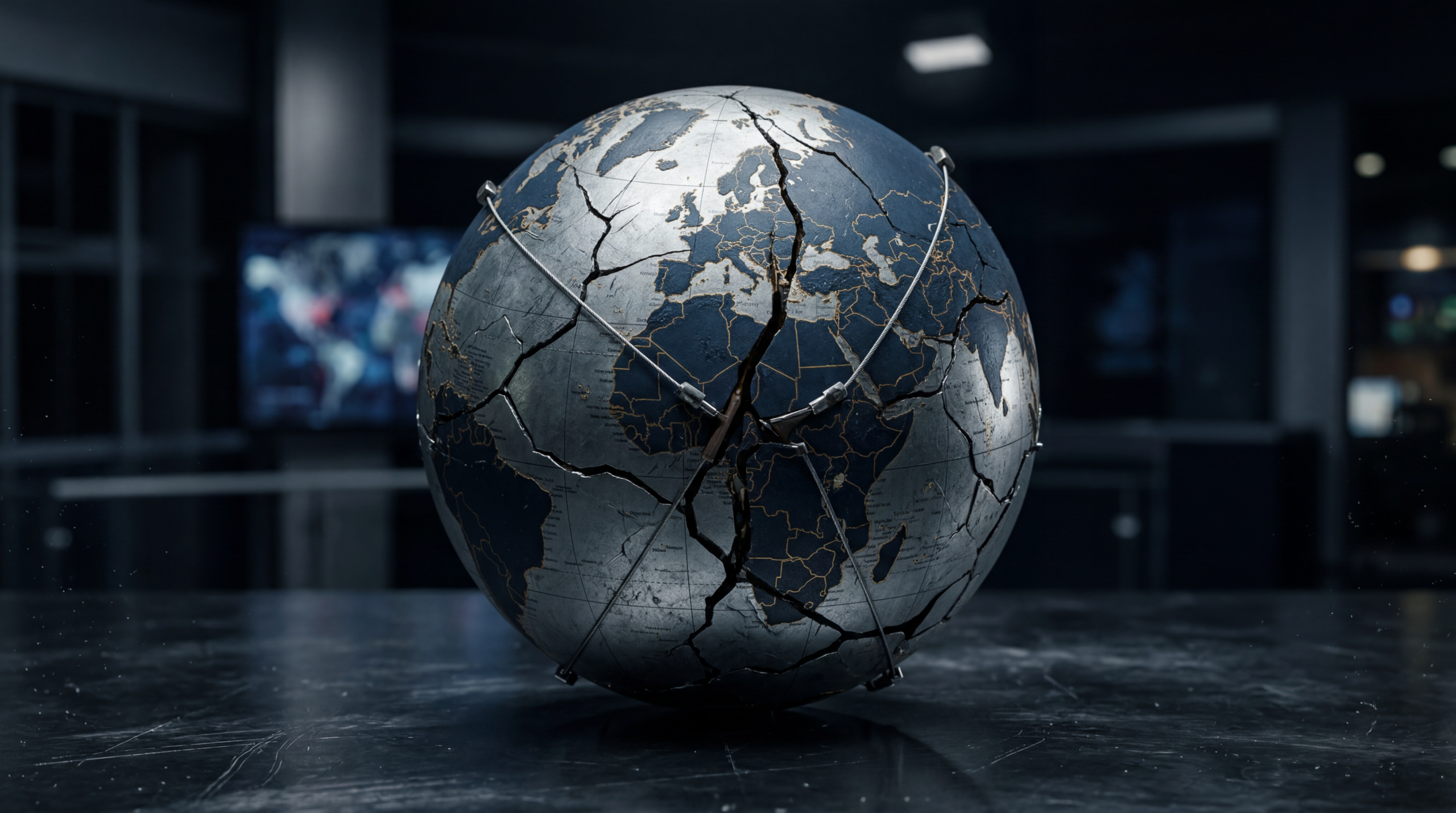

The international system isn’t fraying at the edges anymore—it’s combusting from the core. What we’re witnessing in 2026 isn’t another “crisis of multilateralism” or “challenge to the rules-based order.” Those euphemisms died somewhere between the collapse of arms control treaties, the weaponization of economic interdependence, and the open militarization of space. We are living through the first genuine systemic breakdown since 1945, and most policymakers are still operating with frameworks designed for a world that no longer exists.
After 18 years analyzing conflict zones from Donbas to the Taiwan Strait, I can tell you this: the institutions built to manage great power competition have become the venues where it intensifies. The UN Security Council hasn’t passed a meaningful resolution on a major crisis in four years. The World Trade Organization is a zombie institution. NATO and the Shanghai Cooperation Organization are no longer talking past each other—they’re preparing for scenarios where they don’t talk at all.
The Three Simultaneous Fractures No One Saw Coming
Every previous challenge to international order came sequentially. The Congress of Vienna, then World War I. Versailles, then World War II. The Cold War, then the unipolar moment. Each system had time to adapt, to reform, to at least pretend it was learning. Not this time.
The first fracture is technological supremacy as existential contest. Artificial intelligence, quantum computing, and hypersonic weapons aren’t being developed within an international framework—they’re being developed to shatter any framework that might constrain them. When China announced its “New Generation Artificial Intelligence Development Plan” in 2017, it wasn’t an economic policy. It was a declaration that the next world order would be written in code, not treaties. The United States responded not by proposing new institutions, but by weaponizing semiconductor supply chains. According to Brookings analysis on the AI arms race, we’re now in a permanent state of tech warfare where cooperation is seen as strategic suicide.
The second fracture is the return of territorial revisionism at scale. Russia didn’t just invade Ukraine—it announced that the borders of Europe were negotiable through force. China didn’t just increase pressure on Taiwan—it demonstrated that economic coercion can be coupled with military intimidation on a timeline measured in years, not decades. The Council on Foreign Relations’ Global Conflict Tracker now lists 27 active territorial disputes involving major powers, up from 12 in 2020. The post-Cold War assumption that borders were settled is dead.
The Institutional Collapse You’re Not Reading About
Here’s what separates 2026 from previous moments of international tension: the referees have left the field. Not because they were pushed out, but because the game changed and they became irrelevant.
The International Atomic Energy Agency can’t verify Iran’s nuclear program because Iran won’t let them. The International Criminal Court issues arrest warrants that no major power recognizes. The World Health Organization’s pandemic response framework was ignored by the countries that wrote it. These aren’t signs of institutional weakness—they’re symptoms of institutional death.
The third fracture is economic interdependence weaponized beyond recognition. The assumption that tied the global economy together—that mutual dependence creates mutual restraint—has been inverted. Now, dependence is leverage. Supply chains are strategic vulnerabilities to be exploited. The European Union’s dependence on Russian gas wasn’t a peace dividend; it was a kill switch. China’s dominance in rare earth minerals isn’t a market advantage; it’s a veto over Western defense production.
When Germany discovered in 2022 that it had built its industrial base on energy from a revanchist power, that wasn’t a policy mistake—it was the revelation that the entire post-Cold War economic model was built on a geopolitical fantasy. According to recent Chatham House research on economic security, 74% of critical supply chains are now concentrated in geopolitically contested regions. The global economy isn’t integrated—it’s held hostage.
The Historical Parallel Everyone Is Missing
The closest historical parallel isn’t 1939 or 1914—it’s 1815, but in reverse. After Napoleon, the Concert of Europe created a system where great powers managed competition through consultation. It wasn’t perfect, but it worked because everyone agreed the alternative was worse. They had just seen what total war looked like.
We’re living through the opposite moment. The generation that remembered the devastation of world war is gone. The leaders making decisions today came of age during the unipolar moment, when American power was so dominant that the very concept of great power war seemed archaic. Now, Russia, China, and the United States are all led by figures who believe their geopolitical window is closing and that decisive action now is better than managed decline later.
That’s why the current moment is so dangerous. The Concert of Europe worked because everyone feared war. Our current non-system is failing because key actors believe they can win one, or at least avoid losing one badly enough to justify the attempt.
What This Means For You
If you’re reading this from North America or Europe, the practical implications are already hitting your life, even if you haven’t connected the dots. Energy prices aren’t volatile because of “market forces”—they’re volatile because energy is now a weapon. Supply chain disruptions aren’t inefficiency—they’re the visible manifestation of economic warfare.
The inflation you’ve experienced since 2021 isn’t primarily monetary policy failure. It’s the cost of deglobalization happening in real time. When the United States bans semiconductor exports to China, when Europe stops buying Russian gas, when China restricts rare earth exports—those aren’t isolated trade disputes. They’re the great powers decoupling their economies at a pace and scale that makes the 1930s look gradual.
For those in smaller states caught between great powers—Southeast Asia, Eastern Europe, the Middle East, Latin America—the message is starker: there is no neutral ground anymore. The era when you could do business with everyone and align with no one is over. Every country is being forced to choose, and those choices are increasingly binary and permanent.
What Happens Next: Three Scenarios
Scenario One: Managed Fragmentation (30% probability). The major powers recognize they’re on a path to systemic conflict and pull back from the brink. Not through grand institutional reform—those days are done—but through pragmatic sphere-of-influence arrangements. Think Cold War 2.0, but with economic zones instead of military blocs. The United States and China divide technology standards. Russia gets Eastern Europe as a buffer zone in exchange for not going further. India becomes the swing power everyone courts. Uncomfortable, unstable, but survivable.
The problem with this scenario: it requires all parties to accept their limitations at the exact moment when domestic politics in each capital demands the appearance of strength. As Foreign Affairs recently argued, we’re in an “Age of Revisionism” where accepting the status quo is political suicide.
Scenario Two: Controlled Escalation (50% probability). This is where we’re heading now. Not world war, but not peace either. A permanent state of gray-zone conflict, economic warfare, and limited military confrontations. Taiwan isn’t invaded, but it’s blockaded. Ukraine becomes a frozen conflict. The South China Sea sees monthly incidents that don’t quite cross the threshold to trigger treaty obligations. Supply chains are permanently fractured into competing blocs.
This scenario is the most likely because it’s the path of least resistance. No leader has to make the career-ending decision to back down, but no one is reckless enough to go for total war. The cost is a generation of lower growth, higher defense spending, and permanent crisis management. The global middle class stagnates while defense contractors and cybersecurity firms boom.
Scenario Three: Systemic War (20% probability). Someone miscalculates. A Taiwan blockade leads to a naval confrontation. A cyber attack on critical infrastructure crosses a red line no one knew existed. An incident in space—where there are no rules at all—spirals because there’s no framework to de-escalate. The difference from previous world wars: this one wouldn’t require armies massing at borders. It would start with financial system attacks, infrastructure sabotage, and disruptions of food and energy supplies before a shot is fired.
This scenario’s probability is lower not because leaders are wiser, but because the weapons are terrifying enough to give pause. Nuclear weapons kept the Cold War cold. The question for 2026: are cyber weapons, economic interdependence weapons, and AI-enabled military systems similarly stabilizing, or do they lower the threshold to conflict by making “limited war” seem achievable?
Why Traditional Diplomacy Can’t Save This
The instinctive response from the foreign policy establishment is always “more dialogue, more institutions, more multilateralism.” That’s not cynicism—it’s exhaustion. We’ve tried that. The G20 accomplished nothing. Climate negotiations produced toothless agreements. Nuclear arms control talks ended in treaty withdrawals.
The reason isn’t lack of will—it’s structural obsolescence. The institutions we have were designed for a world where major powers shared a baseline commitment to the system. The UN Security Council only works if the permanent members want it to work. The WTO only functions if members believe trade rules should constrain national security decisions. Those assumptions are dead.
What we need isn’t institutional reform—it’s acceptance that we’re in an interregnum between orders. The old system is gone. The new one hasn’t emerged. The question isn’t how to save the rules-based international order. It’s what comes after it, and whether that transition happens through negotiation or catastrophe.
The Decision Point Arriving Faster Than Anyone Admits
Here’s the timeline most analysts won’t tell you: we have about 18 months before the current trajectory becomes locked in. That’s how long before economic decoupling reaches irreversibility, before military buildups create use-it-or-lose-it dynamics, before domestic politics in major capitals makes any compromise politically impossible.
The decisions being made right now—in Washington about semiconductor export controls, in Beijing about Taiwan’s timeline, in Brussels about strategic autonomy, in Moscow about how far to push in Eastern Europe—aren’t policy adjustments. They’re civilizational choices whose consequences will define the next 50 years.
The tragedy is that no single actor wants total conflict, but the system’s internal logic is pushing everyone toward it. Each side’s reasonable defensive moves look like offensive preparations to the other side. Each economic protection measure forces further decoupling. Each military modernization program triggers countermeasures. We’re trapped in a security dilemma at global scale with no circuit breaker.
What Power Actually Looks Like Now
The final thing to understand: power in 2026 doesn’t look like it did in 1945, or 1991, or even 2016. It’s not about aircraft carriers or GDP. It’s about control of dependencies. Who controls the semiconductor supply chain controls the future of artificial intelligence, and therefore military power, and therefore everything. Who controls critical minerals controls the energy transition and thus the 21st century economy. Who controls data flows controls information, and therefore domestic stability.
This is why the current disorder is so profound. The sources of power have shifted faster than institutions, alliances, or strategic thinking. We’re flying blind into a world where the weapons are economic, the battlefield is everywhere, and the referees have all gone home.
The international order didn’t collapse because it was attacked—it collapsed because it was built for a world where great powers shared interests, and that world no longer exists.