
McDonald’s just announced a massive push into “connected operations,” AI voice ordering, and kitchen automation. The press release talks about innovation and customer experience. Here’s what they’re not saying: this is a desperate play to reduce labor costs while delivery apps eat their lunch.
I’ve watched enough restaurant tech rollouts to know the pattern. When a legacy chain suddenly discovers AI, it’s because their unit economics are broken and franchisees are screaming about margins.
What McDonald’s Is Actually Building
The core of McDonald’s strategy involves three interconnected systems that sound impressive but reveal fundamental operational problems. First, AI-powered voice ordering at drive-thrus — technology they already tried and abandoned with IBM in 2021. Second, “connected kitchen” automation that coordinates fryers, grills, and assembly. Third, a centralized operations platform that McDonald’s claims will optimize everything from inventory to staffing.
Let me translate: they want to replace order-takers with speech recognition, reduce cook variance with machines, and run skeleton crews by predicting demand down to 15-minute windows. The technical approach is solid. The business reason is pure cost-cutting dressed up as innovation.
McDonald’s operates over 40,000 locations globally, with roughly 95% franchise-owned. Franchisees pay for these upgrades. When corporate pushes expensive tech, it’s because the alternative — higher wages, more staff, better training — costs more and doesn’t generate licensing revenue for corporate.
The AI Voice Ordering Problem Nobody Mentions
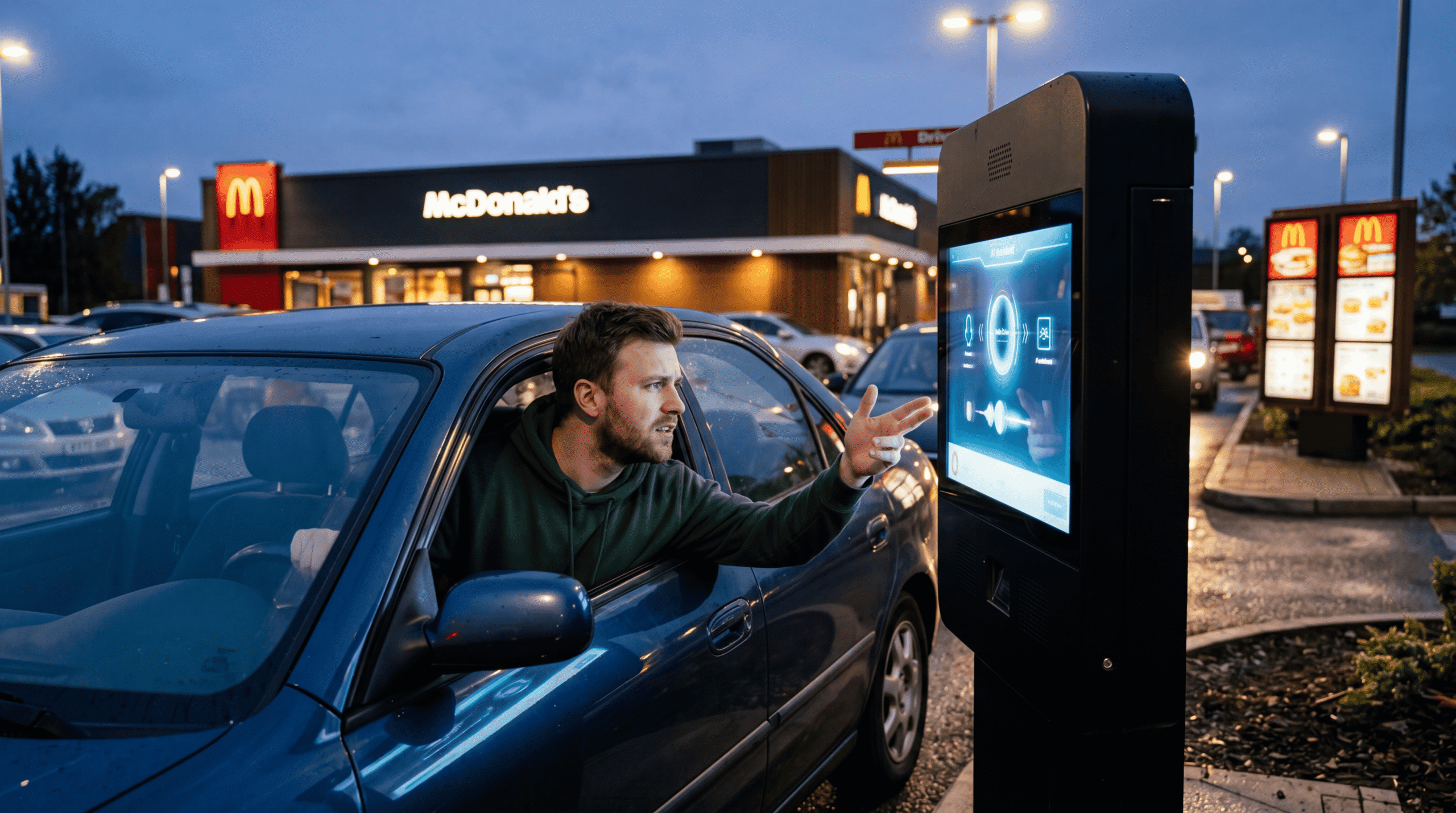
McDonald’s tried AI drive-thru ordering with IBM Watson from 2019 to 2021. They killed the partnership after test locations showed the system couldn’t handle accents, background noise, or complex orders. Now they’re trying again with different vendors, claiming the technology has improved.
It hasn’t improved enough. Current speech recognition hits about 85-90% accuracy in controlled environments. Drive-thrus are not controlled environments. You’ve got engine noise, multiple passengers talking, regional accents, menu items that sound similar, and customers who change their minds mid-order. Every error creates a queue backup that cascades through the entire location’s throughput.
The real accuracy target isn’t 90% — it’s 99.5%, because anything less creates more work for the human who has to fix the errors. McDonald’s isn’t there yet, and neither is anyone else. But they’re deploying it anyway because even imperfect AI is cheaper than $15/hour workers, and franchisees are calculating breakeven on 18-24 month timelines.
Here’s the technical debt nobody discusses: these systems require constant retraining on local menu variations, seasonal items, and promotional offers. Every market has different regulations about what can be called a “burger” or what qualifies as “cheese.” The maintenance cost of keeping these models current across 40,000+ locations will be enormous, but it’s opex, not capex, so it gets buried in corporate overhead.
Connected Kitchens: Real Innovation Hiding a Labor Play
The kitchen automation piece is actually interesting from an engineering perspective. McDonald’s wants networked equipment that talks to their order management system, automatically adjusts cook times based on queue depth, and coordinates multiple stations to minimize ticket times. This is legitimately hard distributed systems work.
The best technical breakdown I found comes from Food Logistics’ analysis of connected restaurant tech, which notes that McDonald’s is essentially building an industrial IoT platform for fast food. Every fryer, grill, and beverage dispenser becomes a networked device with sensors, actuators, and API endpoints.
The engineering is impressive. The business model is transparent: reduce the skill level required to work a McDonald’s kitchen to zero. Right now, making 200 Big Macs per hour requires experienced cooks who know how to manage multiple timers, coordinate between stations, and adjust on the fly. With full automation, it requires someone who can press “start” when a screen lights up.
This isn’t about making food faster or more consistent — McDonald’s already nails consistency through extensive training and process documentation. This is about being able to hire literally anyone, pay them minimum wage, and have the machines prevent mistakes that training used to prevent.
What The Press Got Wrong
Most coverage of McDonald’s AI push focuses on the customer experience narrative: faster service, personalized recommendations, seamless ordering. This misses the actual story completely. McDonald’s isn’t optimizing for customers — they’re optimizing for labor arbitrage while delivery apps destroy their traditional advantage.
The real competitive threat to McDonald’s isn’t Burger King or Wendy’s. It’s DoorDash, Uber Eats, and the ghost kitchen model. These platforms own the customer relationship, charge 20-30% commission, and have zero brand loyalty. A customer opening DoorDash doesn’t think “I want McDonald’s” — they think “I want a burger” and choose based on delivery time and price.
McDonald’s response isn’t to build a better app or delivery experience — it’s to cut costs so they can still make margin after paying platform fees. AI voice ordering, automated kitchens, and predictive scheduling are all about running locations with 30% less labor so they can afford to be on third-party delivery platforms.
According to Restaurant Business Online’s financial analysis, McDonald’s franchisee profit margins have dropped from roughly 15% to under 10% in the past five years, driven primarily by labor cost increases and delivery platform fees. This AI push is an existential response to broken unit economics, not a customer-driven innovation.
Who Actually Wins and Loses
Winners: McDonald’s corporate, which collects licensing fees on technology platforms and increases franchisee dependency. Equipment vendors like Middleby Corporation and Welbilt, who will sell hundreds of millions in connected kitchen hardware. AI voice platform providers, who get massive scale to improve their models at McDonald’s expense.
Losers: McDonald’s franchisees, who will spend $100,000+ per location on upgrades that may or may not improve margins. Workers, obviously — this is explicitly designed to reduce headcount and skill requirements. Customers, who will deal with glitchy voice ordering and less human judgment when their order inevitably needs customization.
The biggest loser might be McDonald’s brand positioning. They’ve built 70 years of equity on consistency, speed, and value. AI voice ordering that fails 10% of the time destroys consistency. Automated kitchens that can’t handle substitutions destroy flexibility. And all the labor savings get eaten by delivery platform fees anyway, so the value proposition erodes.
The Technical Debt Timeline
Here’s what’s going to happen over the next 24 months: McDonald’s will roll out AI ordering to 1,000+ locations, claim success based on carefully selected metrics, and push franchisees to adopt. The systems will work well enough in ideal conditions but fail badly in edge cases. Franchisees will hire staff to monitor and fix AI errors, negating much of the labor savings.
Kitchen automation will deploy slower because it requires physical equipment replacement, not just software updates. Early adopters will see genuine efficiency gains. Late adopters will inherit first-generation hardware that doesn’t integrate well with second-generation AI systems. By 2027, McDonald’s will be managing technical debt across three generations of incompatible systems.
The connected operations platform will become a political nightmare as franchisees realize it gives corporate unprecedented visibility into their operations — and leverage to impose more standardization. Some franchisees will resist adoption, creating a two-tier system where corporate-owned locations have better technology than franchise locations.
What This Means For Restaurant Tech Broadly
McDonald’s going all-in on AI and automation is a signal that labor costs have reached a breaking point for the entire quick-service restaurant industry. Expect every major chain to announce similar initiatives in the next 18 months. Burger King, Wendy’s, Taco Bell, and Chick-fil-A are all testing versions of these technologies.
The real innovation opportunity isn’t in replacing human workers — it’s in building technology that makes human workers more productive. Chains like Chick-fil-A have better unit economics than McDonald’s not because they have more automation, but because they have better training, higher pay, and lower turnover. Technology should amplify good operations, not replace them.
Investors should watch what happens to McDonald’s same-store sales over the next two years. If AI ordering and kitchen automation genuinely improve customer experience, sales should grow. If this is purely a cost-cutting play disguised as innovation, sales will stagnate or decline as customers get frustrated with worse service.
The Overlooked Technical Implication
Here’s what no analyst is discussing: McDonald’s is building a closed ecosystem that locks franchisees into corporate-approved vendors for every piece of connected equipment. This isn’t an open platform — it’s a proprietary stack that generates recurring revenue through licensing and maintenance contracts.
Ten years from now, McDonald’s corporate revenue will come less from real estate and royalties, and more from technology licensing. They’re following the Apple playbook: own the platform, control the ecosystem, extract value at every layer. Franchisees will pay corporate for the right to operate McDonald’s-branded AI systems, even though they’re paying vendors for the actual equipment.
This is brilliant from a corporate strategy perspective and terrible for franchisees. It’s also probably inevitable — once one major chain goes this direction, competitive pressure forces everyone else to follow. The entire quick-service restaurant industry is about to get vertically integrated around proprietary technology platforms.
My Prediction
McDonald’s AI and automation push will reduce labor costs by 15-20% at locations that fully adopt the technology, but customer satisfaction scores will drop as voice ordering creates friction and automated kitchens reduce flexibility. By 2027, McDonald’s will quietly re-hire human order-takers at their highest-volume locations after discovering that AI can’t handle the complexity of peak hours. The real winner will be McDonald’s corporate, which will have transformed itself from a real estate company into a restaurant technology platform that extracts rent from franchisees at every layer of the stack.