


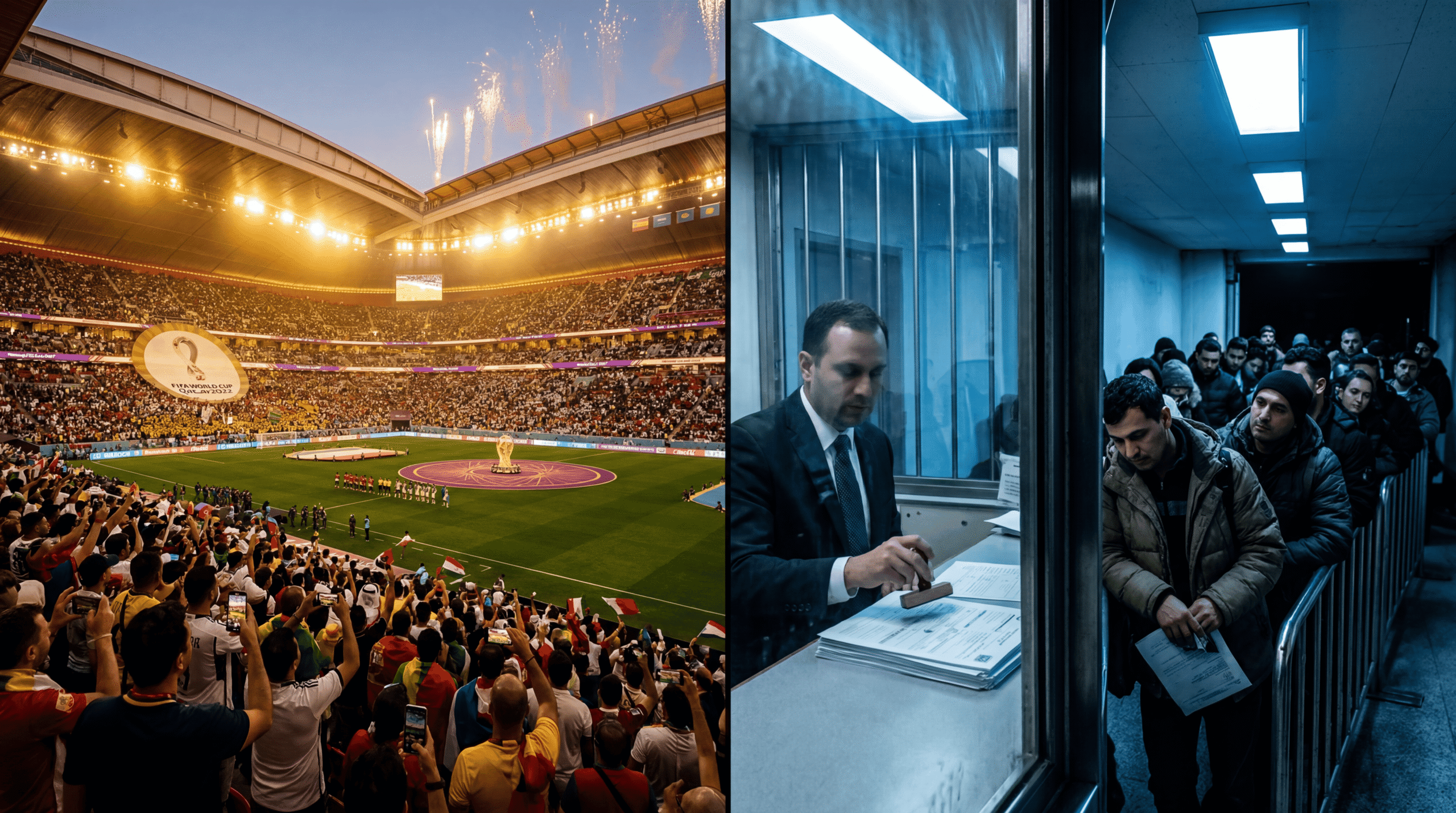

The United States will host the world’s most watched sporting event in 2026. But it has already decided that citizens from at least 38 countries — representing 2.8 billion people — will face near-insurmountable barriers to attend. This is not an administrative quirk. It is a deliberate exercise of sovereign leverage masquerading as immigration policy.
The World Cup as Geopolitical Theater
FIFA sold the 2026 World Cup to North America on a promise of inclusivity: 48 teams, 16 host cities, the biggest tournament in history. But the U.S. State Department never signed that memo. U.S. visa policy remains one of the most restrictive among wealthy democracies, with rejection rates for B-2 tourist visas exceeding 50% for citizens of countries like Nigeria, Pakistan, and Afghanistan.
The irony is precise: FIFA’s governing council includes representatives from nations whose citizens will be systematically denied entry to watch their own teams play. Morocco, Iran, Senegal — all have qualified for recent World Cups. All have visa rejection rates above 40%. This isn’t hypothetical. When the U.S. hosted the 1994 World Cup, thousands of fans were turned away at consulates, unable to prove “sufficient ties” to their home countries.
Why Visa Policy Is Foreign Policy
Visa issuance is not a bureaucratic courtesy. It is a tool of statecraft. Every consular officer operates under a legal presumption: every applicant intends to immigrate until proven otherwise. This “guilty until proven innocent” framework disproportionately punishes citizens from the Global South, where employment records, property ownership, and bank balances rarely meet U.S. thresholds.
Consider the calculus facing a Moroccan engineer hoping to watch his national team in Boston. He must demonstrate stable employment, liquid assets, return travel, family obligations — and still face a 35% chance of rejection based on aggregate country risk scores he cannot see or contest. Meanwhile, a German fan with identical credentials is waved through under the Visa Waiver Program.
This disparity is not accidental. It reflects a geopolitical hierarchy embedded in post-9/11 security architecture: Western allies enjoy frictionless mobility; everyone else navigates a gauntlet of suspicion. The World Cup simply makes this hierarchy visible on a global stage.
The Historical Parallel: 1980 Moscow
The last time a major power weaponized sports through access restrictions was the 1980 Moscow Olympics, when the U.S. led a 65-nation boycott over the Soviet invasion of Afghanistan. That was overt political theater. The 2026 visa crisis is more insidious — it achieves the same exclusionary effect while hiding behind “neutral” administrative rules.
The Soviet Union at least announced its politics. The United States insists its visa system is apolitical, even as rejection rates map perfectly onto geopolitical fault lines. Countries with U.S. military partnerships enjoy approval rates above 85%. Countries in the “Axis of Evil” or on terrorism watch lists see rates below 30%. Soccer fandom is irrelevant; allegiance is everything.
What This Means For You
If you hold a passport from the G7, Australia, or the Gulf monarchies, the 2026 World Cup will feel like a festival of global unity. If you hold a passport from Pakistan, Bangladesh, or much of Africa, it will feel like a reminder of your second-class status in the international order.
For ordinary citizens in visa-restricted countries, this creates a bitter calculus: miss a once-in-a-lifetime event, or spend thousands of dollars on application fees, travel to distant consulates, and invasive financial disclosures — only to likely be rejected anyway. The emotional toll is real. The diplomatic message is clear: your money is welcome, your presence is not.
Even successful applicants will face heightened scrutiny at entry. Customs and Border Protection has discretionary authority to deny entry at the border, and “secondary inspection” rates for travelers from Muslim-majority nations remain three times the global average. Attending a soccer match should not require a legal defense strategy.
FIFA’s Complicity and Silence
FIFA knew this was coming. When Gianni Infantino championed the North American bid in 2018, his staff had access to State Department visa statistics. They understood the access problem and chose the revenue anyway. The 2026 tournament is projected to generate $14 billion — more than double the 2022 Qatar World Cup.
FIFA has made vague gestures toward “visa facilitation,” including a proposed Fan ID system modeled on Russia 2018. But that program has no legal force in U.S. immigration law. Only Congress can waive visa requirements, and there is zero appetite on Capitol Hill to do so. Republicans view any visa expansion as a security risk; Democrats lack the votes to overcome that framing.
The result is a tournament that will look diverse on television but remain accessible only to the global elite. FIFA gets its spectacle. The U.S. gets to control who enters. Fans from the Global South get nothing but a clearer view of how power actually works.
The Broader Pattern: Sport as Sovereignty Test
This is not unique to soccer. The U.S. has used visa policy to shape international events for decades. When New York hosted the UN General Assembly, diplomats from adversarial states routinely faced delays and restrictions. When Miami hosts Formula 1, Cuban fans 90 miles away cannot attend. Every global event becomes an opportunity to remind the world who sets the rules.
Other host nations play this game too. Qatar’s 2022 World Cup imposed restrictive entry rules on Israeli passport holders and LGBTQ+ visitors. Russia 2018 used the Fan ID system to collect biometric data on foreign nationals. But the U.S. case is distinct in scale: no other democracy systematically excludes such a large share of humanity from such a supposedly universal event.
The North American bid included Canada and Mexico as co-hosts, theoretically offering alternative entry routes. But FIFA’s match allocation gives the U.S. 60 of 80 games, including all knockout rounds from the quarterfinals onward. Attending the tournament’s climax requires entering the U.S. There is no workaround.
What Happens Next: Three Scenarios
Scenario 1: Status Quo (70% probability). Congress does nothing. The State Department processes visas under existing rules. Rejection rates remain high. The tournament proceeds with a conspicuously Western-heavy crowd. FIFA issues a bland statement about “working with host nations.” Fans from restricted countries watch from home, and the geopolitical hierarchy is reinforced without consequence.
Scenario 2: Limited Diplomatic Accommodation (25% probability). Under pressure from FIFA and corporate sponsors, the State Department quietly increases visa appointments and expedites “low-risk” applications. Rejection rates drop modestly — from 40% to 30% for some countries. This provides political cover without fundamentally changing access. A few thousand more fans attend, but millions remain excluded. The U.S. claims a win for diplomacy while preserving border control.
Scenario 3: Congressional Intervention (5% probability). Facing international backlash, Congress passes a temporary visa waiver for World Cup ticket holders from non-VWP countries, modeled on the Olympics visa framework. This would require bipartisan support, which is nearly impossible in the current climate. If it happens, it signals a rare prioritization of soft power over security theater — but don’t count on it.
The Verdict: Sovereignty Wins, Sport Loses
The 2026 World Cup will be a spectacular success by every metric FIFA cares about: television ratings, ticket revenue, sponsor activation. It will also be a quiet catastrophe for the idea that sport transcends politics. The U.S. has chosen to assert control over who enters its territory, even at the cost of the tournament’s legitimacy as a global event.
This is not a failure of diplomacy. It is diplomacy working exactly as designed. Visa policy is foreign policy. Access is leverage. And when the world’s most powerful nation hosts the world’s most popular event, it gets to decide who belongs in the stadium and who watches from the outside.
The real lesson of 2026 is not about soccer — it’s about who gets to move freely in a world that pretends borders don’t matter, right up until they do.