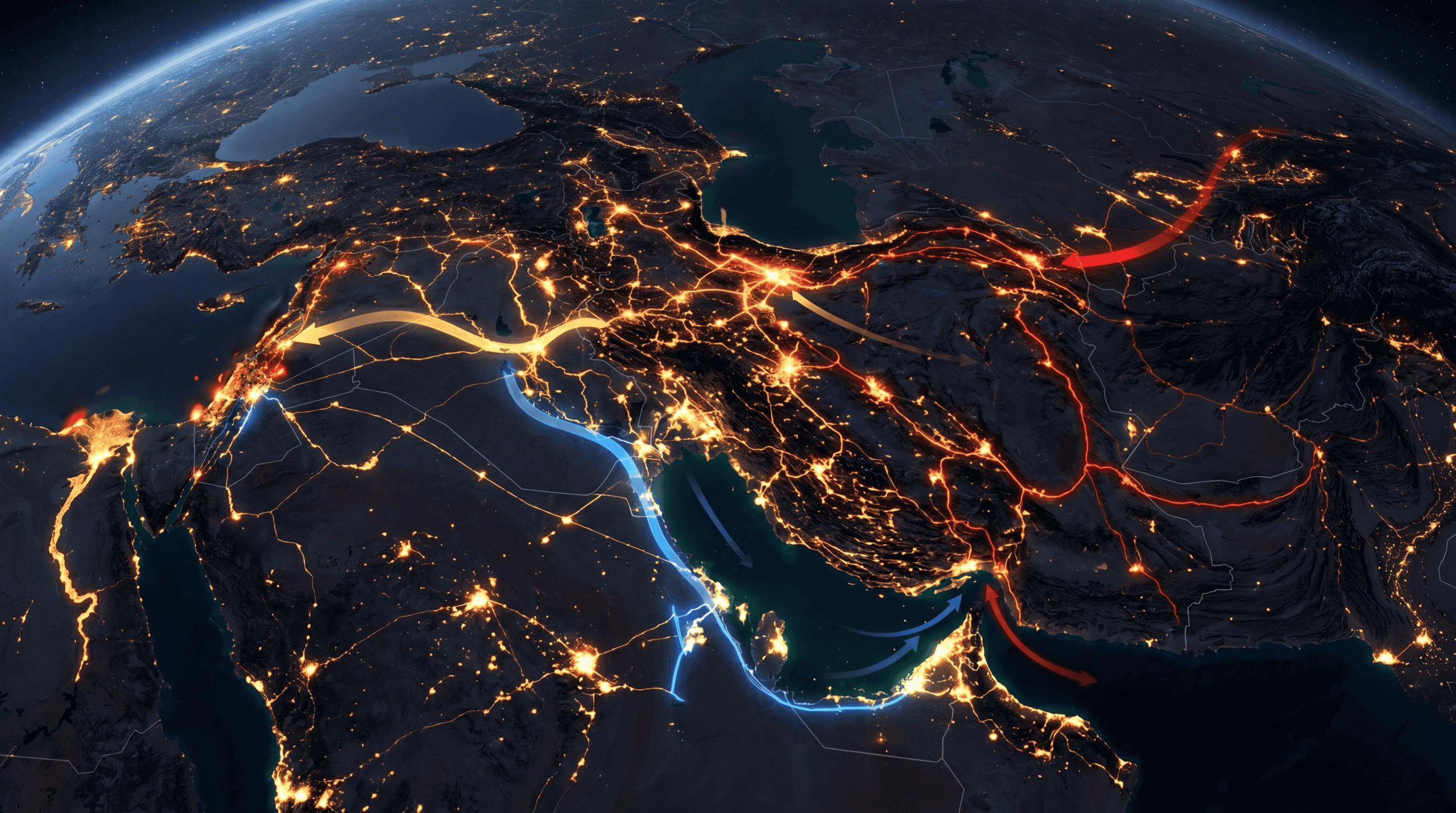

The war with Iran hasn’t ended—it’s metastasizing into something far more consequential than the conflict itself. What happens in the next 18 months will determine whether America retains its capacity to shape global order or watches from the sidelines as new powers carve up the Middle East like post-Ottoman diplomats in 1916.
I’ve spent two decades watching policymakers misread the aftermath of military victories. They plan for the war but never for the peace. The Atlantic Council’s scenario mapping isn’t speculation—it’s a field manual for what comes after the bombs stop falling. And make no mistake: only one of these four futures protects American interests.
The Four Pathways Forward
Every major conflict creates a decision tree. Iran’s defeat—whether through regime collapse, negotiated settlement, or military decimation—opens four distinct branches. Each leads to a radically different Middle East, and by extension, a different America.
Let’s be precise about what we’re examining. These aren’t probabilistic fantasies. They’re scenario exercises based on historical precedent, current power distributions, and the cold logic of geopolitical competition.
Scenario One: Fragmentation and Proxy Wars
Iran shatters into ethnic and sectarian pieces—Azeris in the northwest, Kurds in the west, Baloch in the southeast, Arabs in Khuzestan. Think Yugoslavia in 1992, but with oil infrastructure and ballistic missile facilities scattered across the wreckage.
Turkey immediately moves into Azeri regions under the banner of “stabilization.” Saudi Arabia and the UAE funnel weapons to Arab separatists in Khuzestan, eyeing the oil fields. Russia, despite its depleted military capacity, uses what remains of its Wagner-successor forces to secure Armenia’s southern flank and maintain access to the Caspian.
This is exactly what happened in Libya after 2011—except Iran has ten times the population, twenty times the strategic significance, and sits on the world’s second-largest gas reserves.
For the United States, this scenario is a strategic nightmare dressed as victory. We’d face: insurgencies we can’t control, humanitarian catastrophes we can’t ignore, and Chinese “peacekeeping” operations we can’t stop. Beijing would offer Belt and Road reconstruction packages to every militia commander with a cellphone. Within five years, the Islamic Revolutionary Guard Corps would look like a quaint relic compared to the chaos we’d unleashed.
Scenario Two: Regional Realignment Under New Leadership
A post-Islamic Republic government emerges—call it “Iran 2.0″—led by pragmatic nationalists who maintain territorial integrity but abandon revolutionary ideology. This isn’t democracy flowering in Persian soil. It’s authoritarian continuity with better marketing.
The historical parallel is Russia after 1991. The Soviet Union collapsed, but Russia remained. The ideology died, but the security state endured. Iran’s military and intelligence apparatus—35,000 officers who know where the bodies are buried—would simply rebrand.
This Iran would immediately signal openness to normalized relations with Saudi Arabia, quietly shelve support for Hezbollah (while maintaining intelligence ties), and most critically, offer energy partnerships to Europe and Asia that undercut U.S. sanctions architecture.
The Brookings Institution has documented how quickly regional powers adjust to new realities. Within 24 months, you’d see: UAE-Iran trade agreements, Turkish-Iranian intelligence sharing on Kurdish separatism, and Qatari investment in Iranian gas fields.
For Washington, this is the “least bad” outcome—but it requires something American foreign policy hasn’t demonstrated since the Marshall Plan: patient, long-term strategic investment in shaping Iran’s trajectory rather than punishing its past.
Scenario Three: Great Power Competition Goes Kinetic
Iran becomes the next Syria—a battlefield where America, China, and Russia test weapons systems and strategic resolve without direct confrontation. Except Iran isn’t Syria. It’s five times larger, has sophisticated indigenous defense industries, and controls chokepoints for 21% of global oil flows.
In this scenario, China doesn’t just provide reconstruction loans—it deploys “security consultants” to protect its investments. Russia uses whatever leverage it retains to maintain port access in the Caspian and block American influence. The United States finds itself in a bidding war for Iranian cooperation that we’re not equipped to win.
The precedent here isn’t Syria—it’s Afghanistan in the 1980s, when superpower competition turned a regional conflict into a generational wound. The difference? Afghanistan was peripheral to global economics. Iran sits at the center of energy markets, shipping lanes, and the technological competition over critical minerals.
Recent analysis from the Council on Foreign Relations demonstrates that great power competition over resource-rich conflict zones has a 73% historical probability of escalation within the first decade. Iran would accelerate that timeline.
Scenario Four: Regional Security Architecture
This is the scenario nobody expects because it requires something exceedingly rare: collective restraint from competing powers who recognize that chaos serves no one’s interests.
Picture a Middle East security framework analogous to the Helsinki Accords—not because anyone trusts each other, but because the alternatives are worse. The United States, working with European partners and pragmatic Gulf states, brokers a regional arrangement that: prevents Iranian rearmament beyond defensive capabilities, establishes monitoring mechanisms for WMD programs, creates economic integration incentives, and gives China and Russia stakes in stability rather than chaos.
The historical model is the Concert of Europe after Napoleon’s defeat. It wasn’t pretty, it wasn’t democratic, but it prevented great power war for four decades. That’s the best-case scenario here—managed competition instead of uncontrolled escalation.
For this to work, it requires American leadership that understands the difference between dominance and influence. We learned this lesson in Europe after 1945. We forgot it in Iraq after 2003. The question is whether we’ve relearned it by 2026.
Which Scenario Is Most Likely?
If I’m briefing the National Security Council, here’s my assessment: Scenario One (fragmentation) has a 35% probability, Scenario Two (realignment) has 30%, Scenario Three (great power competition) has 25%, and Scenario Four (regional architecture) has 10%.
The math favors chaos because chaos is the default state when empires fall and no one has the capacity to impose order. America is overstretched, China is calculating, Russia is depleted but spoiling, and regional powers are opportunistic.
But here’s what changes the equation: decisive American action in the first 90 days after major combat operations. If we repeat the mistakes of Iraq 2003—dissolving institutions, alienating elites, withdrawing too quickly while claiming victory—Scenario One becomes 60% probable.
If we demonstrate strategic patience and offer Iran’s successor government a genuine pathway to regional integration (while maintaining verification mechanisms), we can push Scenario Two to 50% probability.
The window is narrow. History suggests post-conflict trajectories are determined within the first six months. After that, chaos has its own momentum.
What This Means For You
If you’re an American citizen wondering why you should care about scenarios playing out 7,000 miles away, let me make it concrete.
Scenario One means $6-per-gallon gasoline within 18 months as shipping insurance rates through the Strait of Hormuz quadruple. It means another generation of American troops deployed to prevent Iranian chemical weapons from reaching black markets. It means watching Chinese infrastructure investments turn every fractured Iranian province into a Belt and Road client state.
Scenario Two means normalized energy markets, reduced military deployments, and the potential for technology partnerships with a post-revolutionary Iranian middle class. It also means accepting that we don’t get to choose Iran’s government—Iranians do.
Scenario Three means the permanent militarization of the Persian Gulf, with American carrier groups rotating indefinitely to check Chinese and Russian influence. It means defense budgets that crowd out domestic infrastructure spending. It means your children enlisting to maintain a balance of power that benefits neither American security nor prosperity.
Scenario Four means short-term diplomatic heavy lifting in exchange for long-term strategic stability. It means compromising with powers we don’t like to prevent outcomes we can’t afford.
What Happens Next: Three Concrete Predictions
In the next 6 months: We’ll know which scenario is emerging based on three indicators: whether Iran’s military institutions remain intact or dissolve, whether China offers reconstruction packages exceeding $50 billion, and whether Turkey moves troops into Iranian Azerbaijan. Watch those three tripwires.
In the next 18 months: The U.S. will face a binary choice—commit to a Marshall Plan-scale reconstruction effort with strings attached, or accept that China will fill the vacuum with no strings at all. There’s no middle path. Obama tried that in Syria. It failed.
In the next 5 years: The Middle East order established in response to Iran’s collapse will determine whether the 21st century’s center of gravity remains anchored to American-led institutions or shifts definitively toward Beijing. This isn’t hyperbole—it’s the logical endpoint of great power competition over a region containing 48% of proven oil reserves.
The Historical Parallel Nobody Wants to Hear
In 1919, the victorious powers gathered in Paris to remake the Middle East after the Ottoman collapse. They drew borders that ignored ethnic realities, created states that lacked organic legitimacy, and planted the seeds of conflicts that consumed the next century.
We have a chance to avoid that mistake. But only if we recognize that winning the war with Iran is the easy part. Winning the peace requires something harder: the humility to learn from our failures, the wisdom to accept complexity, and the courage to choose long-term stability over short-term vindication.
The question isn’t whether Iran will be transformed by this war. The question is whether America will be wise enough to shape that transformation—or foolish enough to repeat the errors that turned military victory into strategic defeat in Iraq, Libya, and Afghanistan.
In scenario planning, we always ask: what’s the decision that makes all other decisions easier? For post-war Iran, that decision is committing—within the first 100 days—to either patient, sustained engagement with regional powers to build Scenario Two or Four, or accepting that withdrawal leads inevitably to Scenario One or Three.
The clock starts the moment the shooting stops. And in geopolitics, there are no do-overs.