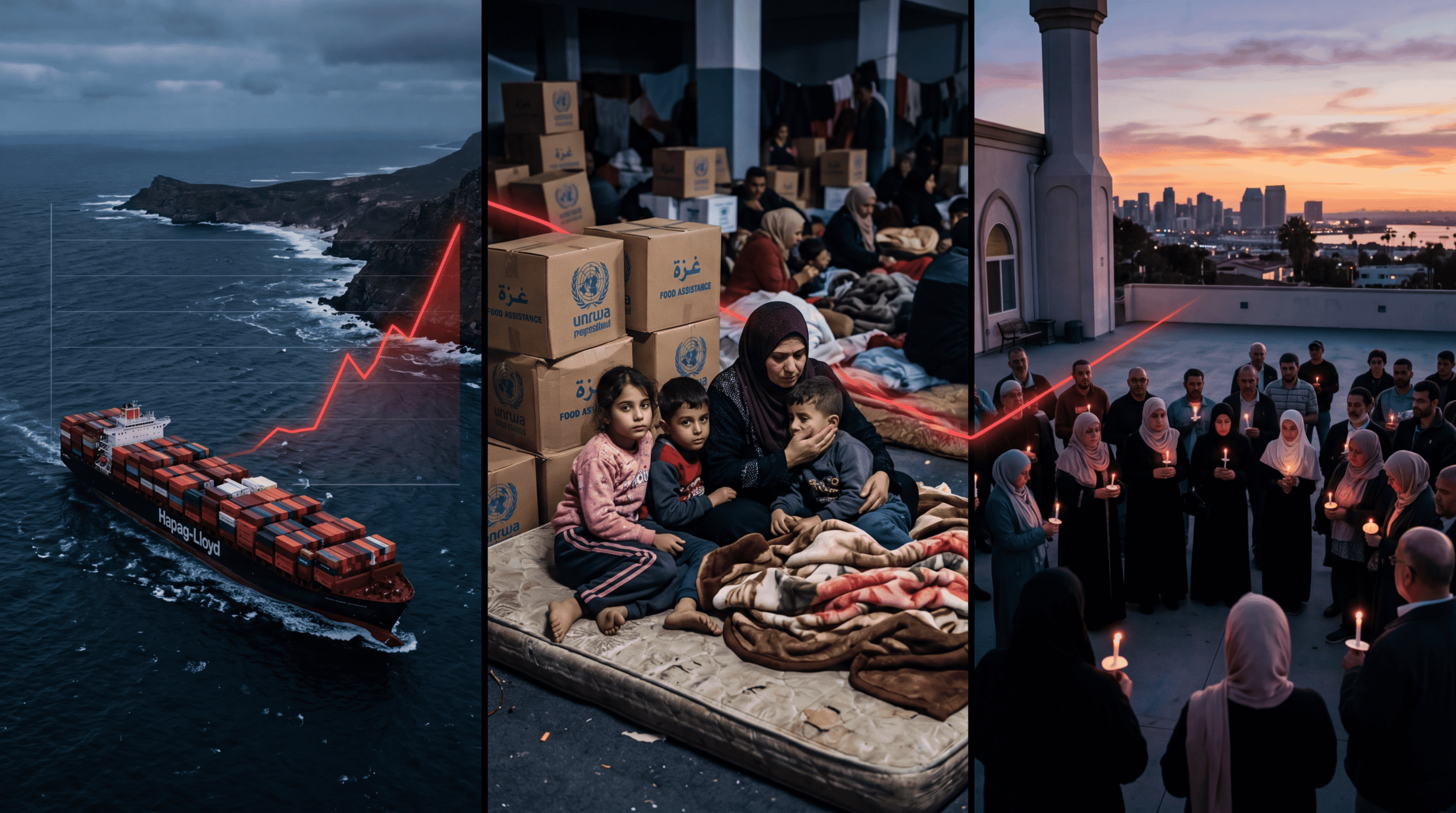

The global economy isn’t collapsing from tariffs anymore—it’s hemorrhaging from geopolitical fractures that began in Gaza and now stretch from Red Sea shipping lanes to the Islamic Center of San Diego. This isn’t about percentage points on growth charts. It’s about how regional wars metastasize into systemic shocks that starve Palestinian families, spike your grocery bills, and embolden extremists nine time zones away.
A new UNCTAD report confirms what foreign ministries have quietly feared since January: 2026 marks the year geopolitical risk formally replaced trade policy as the primary threat to economic stability. Global growth is projected to decelerate from 2.9% to 2.6%, but that sterile figure conceals a brutal reality—developing nations face simultaneous fuel, food, and currency crises while Gaza’s humanitarian catastrophe intensifies and sectarian violence reaches American suburbs.
How Middle East Conflicts Became Everyone’s Economic Problem
The UN Conference on Trade and Development analysis identifies three transmission mechanisms turning regional violence into global economic contagion. First, energy market disruption: Attacks on shipping in the Red Sea and threats to Strait of Hormuz traffic have created persistent oil price volatility, with Brent crude averaging $89/barrel—up 23% from 2025’s average.
Second, the insurance and logistics cascade. Container shipping costs from Asia to Europe have tripled as vessels reroute around Africa, adding 12-15 days to delivery times. This isn’t abstrast—it means higher prices for electronics, clothing, and automotive parts across developed economies, with inflation running 1.8 percentage points higher than it would be absent Middle East tensions.
Third, and least discussed: the AI investment paradox. The report reveals that world merchandise trade growth is collapsing from 4.7% to potentially 1.5% in 2026, yet semiconductor and data-processing equipment trade remains robust. We’re witnessing a dangerous bifurcation—wealthy nations pour capital into artificial intelligence infrastructure while basic commodity flows that feed and fuel developing nations contract sharply.
Gaza’s Starvation Crisis: When Funding Shortfalls Become Death Sentences
The 2026 Flash Appeal for Gaza and the West Bank sought $4.3 billion. It has received $490 million—12% funded. Those aren’t just disappointing numbers from a donor conference. They represent the precise mathematical calculation of how many Palestinian families will eat today versus tomorrow.
According to OCHA’s operational data, UN-supported community kitchens now serve 1 million meals daily in Gaza—down from 1.8 million in February. The delta isn’t people who found alternative food sources. One in five families now eats once per day, with mothers systematically skipping meals so children can eat.
This funding collapse reflects three calculated political choices by donor governments. First, Gaza fatigue—the conflict has persisted long enough that it no longer commands urgent cabinet-level attention in capitals from Brussels to Ottawa. Second, competing crises: Ukraine reconstruction, Sudan’s displacement emergency, and climate disasters in Southeast Asia create a brutal zero-sum competition for finite humanitarian budgets.
Third, and most cynically: some donor nations are deliberately withholding funds to pressure Palestinian authorities and maintain leverage in stalled ceasefire negotiations. This transforms humanitarian aid into a geopolitical bargaining chip, with civilian hunger as the enforcement mechanism.
The Logistics of Slow-Motion Catastrophe
Even when funding exists, Gaza’s humanitarian infrastructure is being methodically dismantled by military operations and administrative restrictions. Aid agencies report that critical equipment—generators, water purification systems, medical supplies—sits in Egyptian warehouses because Israeli authorities block entry of “dual-use” components that theoretically have military applications.
This weekend’s displacement of 150 families from eastern Khan Younis and Gaza City represents the 47th major population movement since January. Gaza’s 2.1 million residents aren’t just displaced—they’re experiencing perpetual displacement, a cycle where families move every 4-6 weeks as combat zones shift. This makes sustained humanitarian programming impossible. You cannot run vaccination campaigns, repair water systems, or establish food distribution networks when your beneficiary population relocates biweekly.
The fuel shortage compounds everything. Hospitals run generators 6 hours daily instead of 24. Water desalination plants operate at 40% capacity. Sewage treatment facilities have essentially ceased functioning, creating public health hazards that will persist long after any ceasefire.
South Sudan’s Forgotten War: Jonglei State and the Peacekeeping Paradox
While Gaza dominates headlines, 304,000 people have fled violence in South Sudan’s Jonglei state since January—a displacement crisis nearly invisible to Western media. The conflict in Uror, Nyirol, Ayod, Duk, and Akobo counties represents the familiar pattern of sub-Saharan resource wars: cattle raiding that escalates into ethnic militia combat, complicated by proliferating small arms and collapsing state authority.
UNMISS’s decision to retain peacekeepers in Akobo despite planned drawdowns reveals the impossible calculus facing UN missions globally. The organization lacks resources for robust deployments but faces moral and political catastrophe if it withdraws and atrocities follow. Anita Kiki Gbeho, the mission’s new head, inherited a mandate that demands she protect civilians with insufficient troops, mediate between armed groups with no enforcement authority, and support a peace agreement that parties routinely violate.
The 79,000 returnees—44,000 from Ethiopia’s Gambella region—create their own crisis. These populations return to areas with destroyed infrastructure, no functioning services, and active land disputes. Return isn’t resolution; it’s often the prelude to renewed violence when communities clash over diminished resources.
San Diego’s Mosque Attack: When Geopolitical Toxicity Goes Local
Three dead at the Islamic Center of San Diego. Two teenage suspects found dead nearby. A security guard’s rapid response preventing additional casualties. Secretary-General Guterres condemning attacks on places of worship. These details construct a narrative Americans have seen repeatedly, but the context demands we see it differently in May 2026.
The attack on the San Diego mosque cannot be separated from the geopolitical environment that spawned it. When Middle East conflicts dominate news cycles for 18 consecutive months, when political rhetoric frames complex regional disputes as civilizational conflicts, when social media algorithms amplify dehumanizing content about Muslim populations, violence becomes statistically predictable.
This isn’t about direct causation—the shooters’ motivations remain under investigation. It’s about atmospheric toxicity. Hate crimes against religious minorities surge during periods of sustained international conflict involving those communities. The FBI’s hate crime statistics for 2025 showed a 34% increase in anti-Muslim incidents compared to 2024, correlating directly with escalation timelines in Gaza and Lebanon.
The California attack also exposes the globalization of sectarian hatred. Extremist ideologies that might have remained regional phenomena in previous decades now circulate instantly through digital networks, radicalizing vulnerable individuals far from conflict zones. A teenager in San Diego can consume the same dehumanizing propaganda about Muslims that circulates in Tel Aviv, Warsaw, or Sydney—and act on it locally.
What This Means For You
If you’re not a foreign policy professional, these interconnected crises might seem distant. They’re not. The economic dimension is already in your wallet: higher prices for imported goods due to shipping disruptions, elevated fuel costs from Middle East energy market volatility, and inflation that persists despite central banks’ best efforts because geopolitical risk premiums are now baked into commodity prices.
If you’re Muslim in a Western nation, the security calculus changed again this week. Places of worship require enhanced security protocols. Community leaders must balance openness with protection. Parents must explain to children why their religious identity makes them potential targets.
If you’re invested in equity markets, understand that geopolitical risk is replacing interest rate policy as the primary driver of volatility. The AI investment boom UNCTAD identified creates a deceptive sense of resilience in tech-heavy indices while broader economic activity weakens.
If you’re a humanitarian professional or donor, recognize that the funding model for protracted crises has collapsed. The international community can no longer sustain multi-billion dollar appeals for Gaza, Ukraine, Sudan, and climate disasters simultaneously. We’re entering an era of triage, where some emergencies receive inadequate response by design, not accident.
What Happens Next: Three Scenarios
Scenario One: Muddling Through (60% probability). The current pattern persists—Gaza remains in humanitarian crisis with periodic escalations, global growth stays weak but doesn’t collapse, hate crimes continue at elevated levels. Donor fatigue deepens, forcing UN agencies to make impossible choices about who receives assistance. No major breakthroughs, but no catastrophic breakdowns. This is the most likely outcome and the most depressing: normalized crisis as the new baseline.
Scenario Two: Cascading Breakdown (25% probability). A major escalation in the Middle East—Iranian involvement in Red Sea attacks, Israel-Hezbollah war reignition, or Saudi infrastructure strikes—triggers severe energy market disruption. Oil reaches $120/barrel, pushing vulnerable economies into currency crises and debt defaults. Gaza’s humanitarian situation deteriorates into famine conditions, generating mass casualty events. Domestic extremism intensifies globally, with additional mass casualty attacks. This scenario isn’t alarmist speculation—it’s what happens when early warning indicators are ignored.
Scenario Three: Diplomatic Reset (15% probability). A comprehensive Middle East ceasefire framework emerges, possibly facilitated by major power engagement or regional exhaustion. Donor nations recommit to humanitarian funding with multi-year pledges. Shipping routes normalize, easing inflationary pressure. Governments implement serious counter-extremism programs addressing online radicalization. This is the least likely scenario because it requires coordinated action by actors with divergent interests, but it remains possible if economic costs become unsustainable for all parties.
The Power Dynamic Everyone Misses
Here’s what conventional analysis obscures: we’re witnessing the deliberate weaponization of humanitarian suffering by multiple actors simultaneously. Gaza’s funding shortfall isn’t accidental—it’s the result of calculated decisions by donor governments to maintain pressure on Palestinian authorities. The shipping disruptions in the Red Sea aren’t unfortunate side effects—they’re intended to raise costs for nations supporting Israel. The surge in anti-Muslim violence isn’t random—it’s cultivated by political movements that benefit from sustained intergroup tension.
Each actor claims to be responding to others’ provocations, creating a system where everyone is simultaneously victim and perpetrator, where humanitarian principles become tactical assets, where civilian populations are leverage rather than constituencies deserving protection.
The UNCTAD report, the OCHA funding appeal, the UNMISS deployment decisions, and the Secretary-General’s condemnation of the mosque attack are all diplomatic languages for a single reality: the international system designed to prevent and mitigate such crises is failing under the weight of deliberately imposed stress.
What makes 2026 different from previous crisis years isn’t the severity of individual emergencies—we’ve seen worse famines, larger displacements, deadlier attacks. What’s different is the simultaneity and interconnection, the way each crisis amplifies others through economic, social, and political transmission mechanisms that our institutions weren’t designed to address.
The question isn’t whether you should care about Gaza’s starving families, South Sudan’s displaced communities, or a mosque attack in California—the question is whether you understand they’re all symptoms of the same systemic breakdown, and that breakdown is already reshaping the world you’ll wake up in tomorrow.