




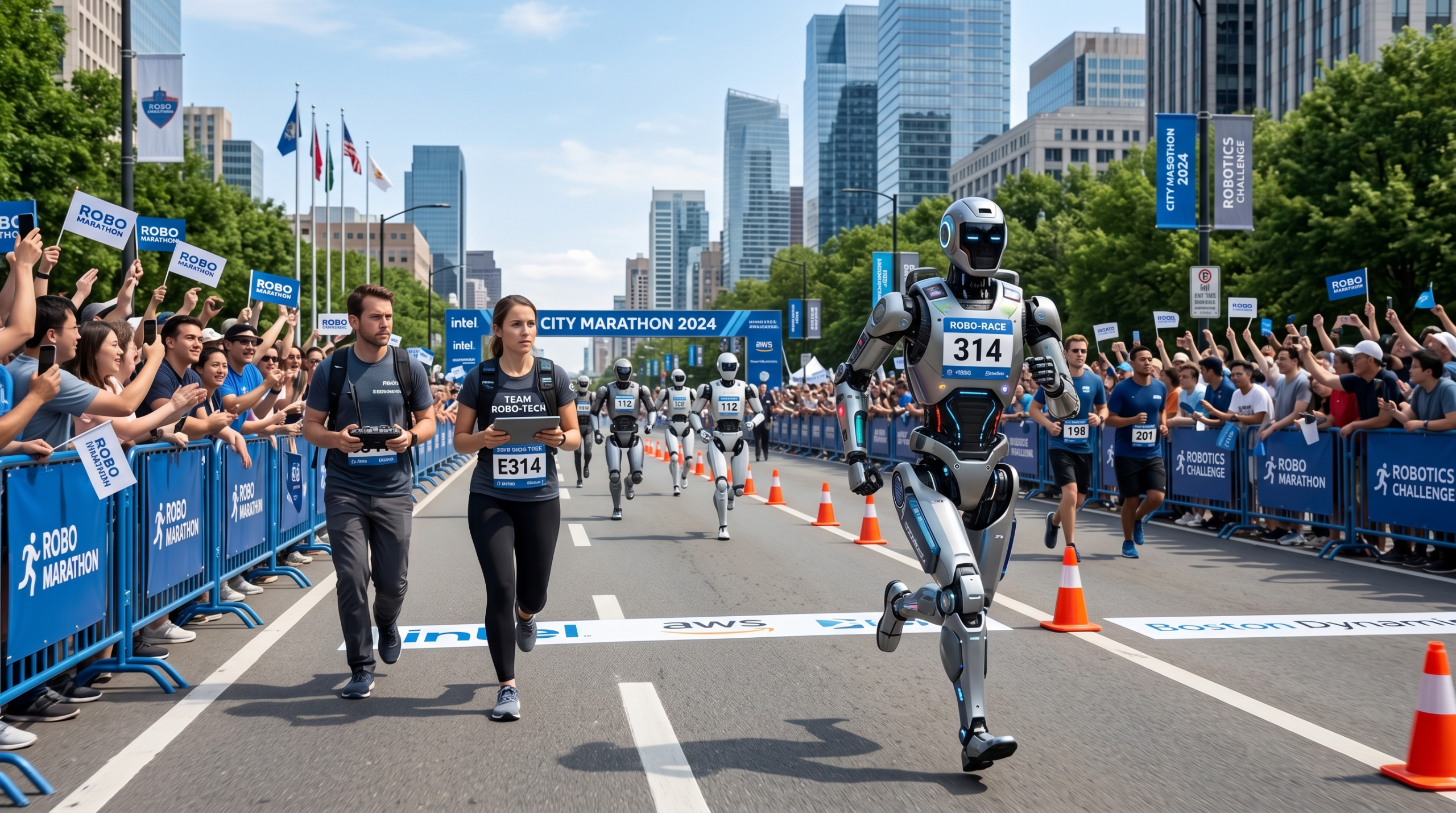

China recently hosted a humanoid robot half-marathon in Beijing, where a significant record was set despite numerous technical mishaps throughout the event. The race took place on Sunday and featured robots developed by various companies, with participation rising substantially from around 20 teams last year to over 100 this year.
The fastest robot, created by Chinese smartphone and gadget manufacturer Honor, completed the half-marathon in 50 minutes and 26 seconds. This timing surpasses the current human world record for the half-marathon, which was set by Uganda’s Jacob Kiplimo at 57 minutes and 20 seconds just last month. The improvement from the previous robot half-marathon, where the best time was two hours, 40 minutes, and 42 seconds, marks a considerable advancement in robotics.
Despite this achievement in speed and endurance, the event also provided many moments of technical difficulty and humor. Videos shared on social media show robots stumbling, falling, and even breaking apart during the race. In one notable instance, a robot fell face-first at the starting line, scattering its limbs across the track. Event staff responded by carrying the damaged robot off on a stretcher. In another clip, the Honor robot briefly veered into a barricade but managed to recover and finish the race while engineers jogged behind, controlling the machine remotely.
These incidents generated viral content online, where compilations of robots crashing or malfunctioning received significant attention. The challenges faced by the competitors highlight ongoing difficulties in the development and deployment of humanoid robots, despite advancements in their design and function.
China’s push to advance humanoid robotics includes integrating artificial intelligence systems, such as OpenClaw, within these machines. Industry leaders have acknowledged China as a significant competitor in this technology arena; for instance, Tesla CEO Elon Musk noted that China likely holds the strongest competition for Tesla’s own humanoid robot, Optimus.
However, the struggles of Chinese humanoid robots in public settings are not unique to this event. Earlier this year, a similar robot developed by XPeng fell during a public demonstration, with the company’s CEO comparing the failure to the early stages of children learning to walk. There was also an incident involving a robot from Unitree that accidentally kicked an engineer during testing.
The recent half-marathon event underscores both the potential and the current limitations of humanoid robots, reflecting rapid progress alongside technical and operational challenges that remain to be addressed in this emerging field.