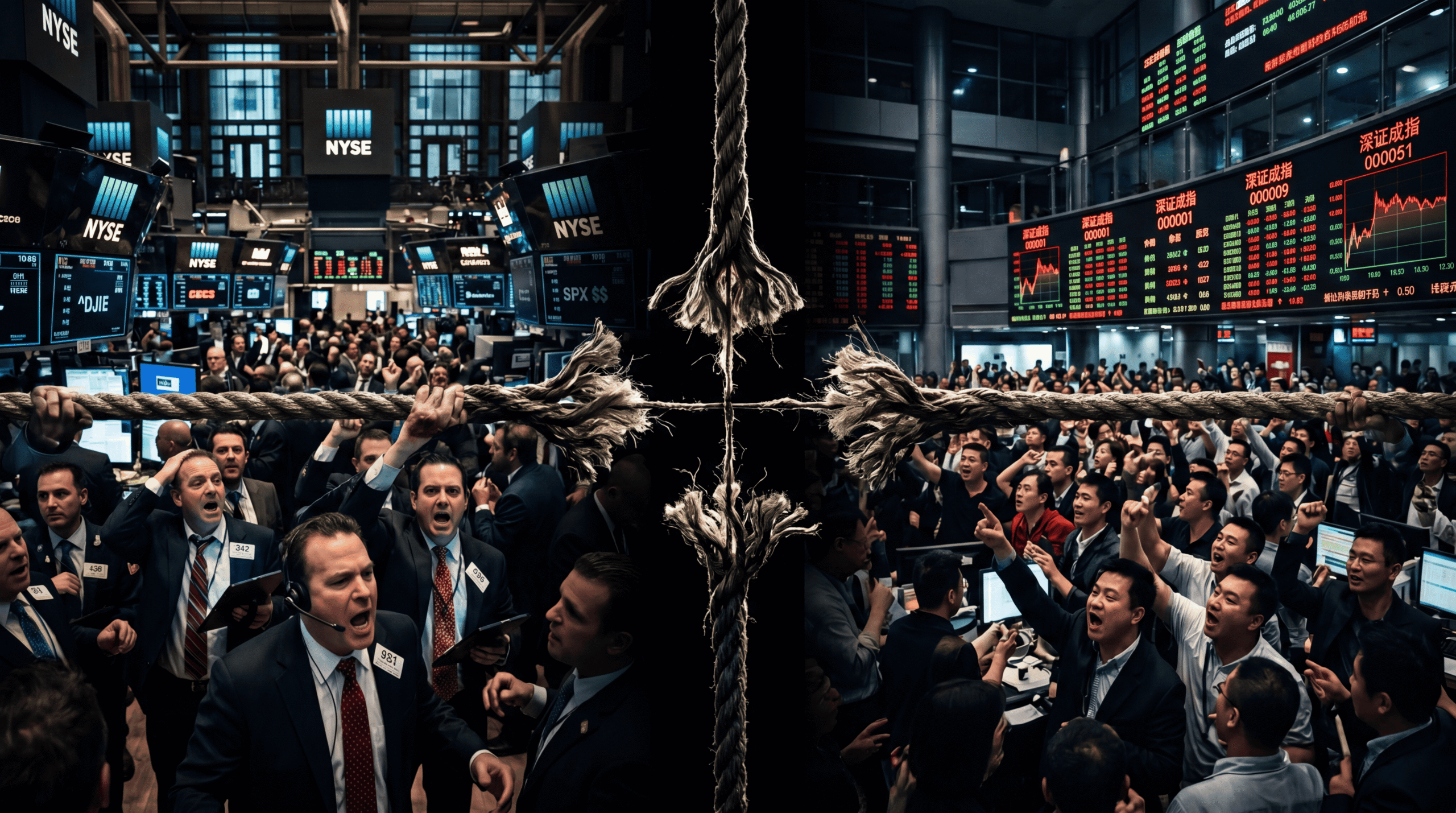

Here’s what Wall Street won’t tell you: the entire architecture of globalization could crack in the next 30 days. Not from a war, not from a recession, but from a diplomatic miscalculation between Washington and Beijing that sends shockwaves through every supply chain, every tech stock, and every manufacturing hub from Stuttgart to Shenzhen.
I’ve spent two decades watching central bankers pretend they control economic outcomes. They don’t. What controls outcomes right now is whether Donald Trump and Xi Jinping can sit across from each other on May 14-15 without triggering the most expensive game of chicken in modern history.
The stakes? $28 trillion in combined GDP. The microchips in your data centers. The rare earth metals in your EVs. The entire premise that multinational corporations can operate without choosing geopolitical sides.
Why May 2025 Is Different From Every Other Trade Dispute
Let me be blunt: this isn’t 2018. Back then, tariffs were leverage. Today, they’re doctrine.
The IMF’s latest World Economic Outlook projects global growth at 3.2% for 2025—but that number assumes U.S.-China trade tensions don’t escalate. Strip out that assumption, and we’re looking at sub-3% growth, which in post-Keynesian terms means insufficient demand to absorb global productive capacity.
Translation: factories idle, inventories pile up, corporate earnings miss, and markets reprice risk across every asset class.
What changed? Five pressure points have converged simultaneously, each capable of independently triggering market turbulence. Together, they form what complexity theorists call a “critical state”—where small shocks produce massive cascades.
Flashpoint One: Tariffs That Could Add $2,100 to Your Car Price
Trump’s threat to impose 60% tariffs on Chinese imports isn’t campaign rhetoric anymore—it’s live policy risk. Here’s what CFOs aren’t pricing in: China exports $427 billion worth of goods to the U.S. annually, according to U.S. Census Bureau data.
A 60% tariff doesn’t just hit Chinese exporters. It hits American retailers who can’t find alternative suppliers for electronics, furniture, toys, and auto parts. The Brookings Institution estimates that broad-based tariffs would raise costs for U.S. households by $1,700-$2,100 annually.
But here’s the kicker: China won’t respond symmetrically. Beijing learned from 2018 that tit-for-tat tariffs on soybeans and pork hurt Chinese consumers. This time, expect surgical strikes—export controls on gallium and germanium (already implemented), restrictions on graphite (critical for EV batteries), and bureaucratic delays for American firms operating in China.
The real damage? Uncertainty itself. When companies don’t know next quarter’s tariff rates, they freeze capital expenditures. Business investment contributed just 0.4 percentage points to U.S. GDP growth in Q4 2024—the weakest since 2020. Prolonged tariff uncertainty could turn that slightly positive number negative.
Flashpoint Two: The Technology Cold War Goes Nuclear
Forget trade. The existential fight is over who controls the commanding heights of 21st-century technology: semiconductors, AI, quantum computing, and 5G infrastructure.
The U.S. has spent three years trying to strangle China’s chip industry through export controls. The Bureau of Industry and Security now restricts sales of advanced semiconductors, chip-making equipment, and even the software used to design chips.
China’s response? A $1.4 trillion domestic semiconductor push. Yes, they’re behind—Chinese firms can’t yet manufacture 3nm chips at scale. But they don’t need to match TSMC tomorrow. They need to achieve “good enough” technology to power AI models, surveillance systems, and military hardware. And they’re getting there faster than Washington expected.
For global markets, this creates a bifurcation no one is prepared for: two incompatible tech ecosystems. If you’re selling cloud services, you’ll need separate data centers for U.S. and Chinese clients. If you’re manufacturing smartphones, you’ll need dual supply chains. The World Economic Forum’s Chief Economists Outlook warns this fragmentation could reduce global productivity growth by 0.5-1.0 percentage points annually.
That might sound small. Over a decade, it’s the difference between stagnation and prosperity.
Flashpoint Three: Taiwan—The $500 Billion Trip Wire
Here’s a statistic that should terrify every supply chain manager: Taiwan Semiconductor Manufacturing Company (TSMC) produces 92% of the world’s most advanced chips. Not 92% of Taiwan’s chips. Ninety-two percent of all chips below 10 nanometers globally.
These chips power everything from iPhones to F-35 fighter jets. Apple, Nvidia, AMD, Qualcomm—all depend on TSMC. There is no substitute. Not Intel. Not Samsung. Not in the next three years.
Any military escalation around Taiwan doesn’t just risk geopolitical catastrophe—it guarantees economic catastrophe. Atlantic Council modeling suggests a Taiwan blockade would trigger a global recession worse than 2008, with semiconductor shortages cascading through automotive, consumer electronics, defense, and industrial equipment sectors.
The market impact would be immediate: tech stocks would crater 30-40%, supply chain-dependent sectors like automotive would halt production within weeks, and central banks would face an impossible choice between fighting inflation (from supply shocks) and supporting growth (from collapsing demand).
What happens in that Trump-Xi meeting matters enormously. If both leaders commit to maintaining the status quo, markets breathe easier. If Trump makes ambiguous statements about Taiwan’s defense, or Xi issues new threats, volatility will spike across global equity and commodity markets.
Flashpoint Four: Rare Earths—China’s Hidden Stranglehold
Pop quiz: What do wind turbines, electric vehicles, guided missiles, and MRI machines have in common? They all require rare earth elements—specifically neodymium, dysprosium, and terbium—for the permanent magnets that make them work.
China controls 70% of global rare earth mining and 90% of rare earth processing, according to U.S. Geological Survey data. In December 2024, Beijing banned exports of certain rare earth processing technologies. In February 2025, they restricted exports of several rare earth metals themselves.
This isn’t hypothetical leverage—it’s live economic warfare. European automakers are already scrambling. The average EV contains about 1 kilogram of rare earth magnets. There’s no synthetic substitute. Recycling can’t scale fast enough. New mines in Australia, Canada, and the U.S. won’t come online until 2027-2029.
For the next 24-36 months, China holds a veto over the Western green energy transition. If Beijing wanted to crater Tesla’s production, they could do it with a single export license decision. The same applies to Siemens’ wind turbines, Lockheed Martin’s defense systems, and General Electric’s MRI machines.
The price impact? Rare earth oxide prices have already jumped 40% since January 2024. If China tightens restrictions further in response to U.S. tariffs, expect another 30-50% spike, which feeds directly into EV sticker prices and renewable energy installation costs.
Flashpoint Five: Supply Chains That No Longer Make Economic Sense
Here’s the uncomfortable truth about “reshoring” and “friend-shoring”: it’s far more expensive than anyone admits publicly.
Moving a semiconductor fab from Taiwan to Arizona doesn’t just cost $40 billion in construction (TSMC’s current outlay). It requires training thousands of specialized workers, replicating a supplier ecosystem that took 30 years to build in Taiwan, and accepting yields that will be 10-20% lower for the first several years.
The same applies across industries. Apple has spent three years trying to shift iPhone production from China to India and Vietnam. Progress? About 14% of iPhones are now made outside China, up from 5% in 2022. But costs are higher, quality control is harder, and the entire supplier network for components still runs through Shenzhen.
The McKinsey Global Institute estimates that fully decoupling U.S. and Chinese supply chains would cost American companies $1.6-2.4 trillion over five years. European companies face similar costs.
For CFOs, this creates an impossible optimization problem: Do you pay the premium for supply chain resilience, knowing it craters short-term profitability? Or do you stick with cost-efficient Chinese suppliers and accept geopolitical risk?
Most companies are choosing a messy middle path: “China plus one” strategies that maintain Chinese production while slowly building capacity elsewhere. But “slowly” is the operative word. These transitions take 5-10 years, not quarters.
What This Means For You
If you think this is just a problem for multinational corporations, reconsider. These five flashpoints will hit ordinary consumers hard:
Your car: If rare earth exports tighten, expect EV prices to rise $3,000-$5,000. Legacy automakers using Chinese battery components will face supply disruptions.
Your electronics: A Taiwan crisis would make the 2021 chip shortage look mild. Expect 9-18 month delays for laptops, smartphones, and appliances.
Your grocery bill: China is the largest buyer of U.S. soybeans, pork, and corn. Retaliatory agricultural tariffs would hammer farm income, potentially requiring $20-30 billion in federal bailouts funded by taxpayers.
Your retirement account: Tech stocks comprise 28% of the S&P 500. A technology cold war directly threatens the index’s largest components—Apple, Microsoft, Nvidia, Alphabet, Amazon. A 20% correction in mega-cap tech would pull the entire market down 5-7%.
What Happens Next: Three Scenarios
Scenario One: Managed Détente (40% probability)
Trump and Xi reach a narrow deal: tariffs pause at current levels, no new tech restrictions for 12 months, both sides commit to maintaining Taiwan status quo. Markets rally 4-6% on relief. But underlying tensions remain—this just buys time.
Scenario Two: Escalatory Stalemate (45% probability)
Talks happen but produce only vague commitments. Both sides continue incremental restrictions. Tariffs drift higher to 30-40% on selected goods. Tech decoupling accelerates. Rare earth prices spike. Markets enter a grinding bear market with elevated volatility. This is the slow-motion train wreck.
Scenario Three: Acute Crisis (15% probability)
Talks collapse. Trump announces 60% across-the-board tariffs. China retaliates with rare earth export bans and dollar asset sales. Taiwan tensions spike. Markets experience a 15-20% correction in 4-6 weeks. The Fed faces 1970s-style stagflation—supply shock inflation plus collapsing demand.
How to Prepare Right Now
If you’re a CFO or financial decision-maker, here’s what post-Keynesian theory tells us: in a demand-constrained environment with fragmented supply chains, cash is king and flexibility is everything.
Immediate actions: Stress-test supply chains for 90-day China disruptions. Identify single-source dependencies. Pre-negotiate contracts with alternative suppliers, even at higher cost. Build inventory buffers for critical components—yes, this ties up working capital, but it’s cheaper than production halts.
Financial positioning: Increase cash reserves to 6-9 months of operating expenses. Expect credit markets to tighten if uncertainty persists. Lock in fixed-rate financing now before risk premiums widen. Consider currency hedges if you have significant Asia exposure.
Strategic pivots: Accelerate digitalization and automation to reduce supply chain labor dependence. Invest in supplier diversification even if near-term ROI is negative—this is risk mitigation, not optimization. Build relationships with policymakers—companies that engage early with government on supply chain strategy will get better support when crisis hits.
The Bottom Line Nobody Wants to Say Out loud
We’re not in a trade dispute. We’re in the early stages of economic bifurcation between the world’s two largest economies. That bifurcation will be expensive, inefficient, and inflationary. It will reduce global growth, increase business uncertainty, and force companies to choose sides.
May 2025 won’t resolve these tensions. But it will reveal whether both sides still believe managing them is possible—or whether we’re accelerating toward something far more disruptive.
The meeting that might happen in Beijing in two weeks matters more than any Federal Reserve decision, any earnings report, or any fiscal policy announcement this year. Because unlike those things, which affect economic variables at the margin, a U.S.-China rupture would rewrite the rules of the global economy entirely.
And once those rules are rewritten, there’s no going back to the world we knew.